


SMART-1 to the Moon on an ion engine
Launched 27 September 2003, SMART-1 was the first of ESA's 'Small Missions for Advanced Research in Technology'. It travelled to the Moon using solar-electric propulsion and carrying a battery of miniaturised instruments; it entered lunar orbit 15 November 2004.
As well as testing new technology, SMART-1 did the first comprehensive inventory of key chemical elements in the lunar surface. It also investigated the theory that the Moon was formed following the violent collision of a smaller planet with Earth, four and a half thousand million years ago.
Having conducted extensive lunar science operations, its mission ended through a controlled lunar impact on 3 September 2006.
SMART-1 was the first European spacecraft to travel to and orbit around the Moon - this was only the second time that ion propulsion has been used as a mission's primary propulsion system (the first was NASA's Deep Space 1 probe launched in October 1998).
SMART-1 mission operations were conducted from ESOC, ESA's European Space Operations Centre, Darmstadt, Germany.
More information: Smart-1
Note: hi-res PDF download file is very large! Please be patient while file is transferred.

SNECMA PPS-1350 ion engine will provide SMART-1's pr…
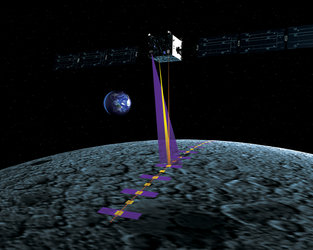
Remote-sensing instruments on SMART-1 scan the Moon'…
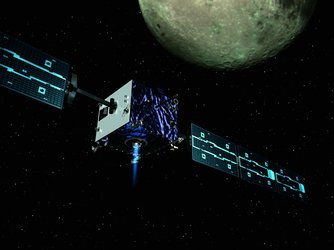
SMART-1 mission at the Moon
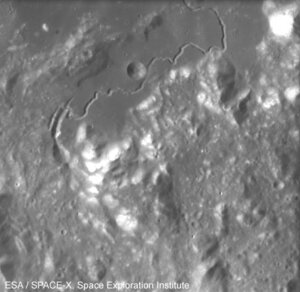
Hadley Rille on the Moon, seen by SMART-1
