The anatomy of our Sun
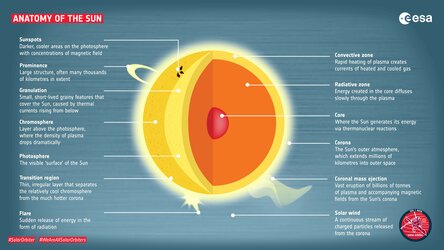
Explore the anatomy of the Sun in this interactive graphic. Click on the circle markers for more information.
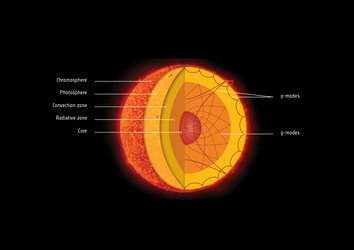
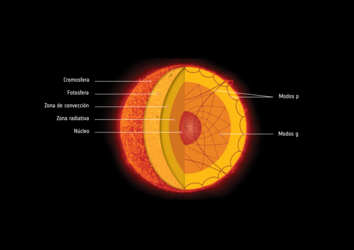
The ESA/NASA SOHO mission monitors the Sun's outer layers by taking images of it in different wavelengths of light. To explore the Sun's interior, it uses sound waves. Just as seismology reveals Earth’s interior by studying seismic waves from earthquakes, solar physicists use ‘helioseismology’ to probe the solar interior by studying how sound waves move through it.
Left cutaway: Red depicts layers where sound travels faster than predicted by theory, implying that the temperature is higher than expected, while blue indicates slower speeds and lower temperatures. The prominent red layer marks the transition between the turbulent outer convection zone and the more stable inner radiative zone.
At the boundary, SOHO found that the speed of the rotating gas changes abruptly. The measurements indicated that, near the equator, the outer layers rotate faster than the inner layers, while at mid-latitudes and near the poles the situation is reversed. This is depicted in the right cutaway, where red depicts fast rotation and blue slower rotation.
Outer layers: Visible light images show sunspots, cool dark features in the photosphere, which lies below the chromosphere. Flares, resulting from the release of a buildup of magnetic energy, and coronal mass ejections (CMEs, giant clouds of electrically charged atomic particles launched into space) often occur in magnetically active regions around sunspot groups.
Coronal holes are darker, cooler and less dense areas of the Sun’s corona – its outer atmosphere – where the Sun’s magnetic field reaches into space, allowing hot gas (plasma) to escape. The high-speed solar wind originates from coronal holes.