Ariane 6 project logo
Ariane 6 is the latest rocket in a long history of launchers to fly from Europe’s Spaceport in French Guiana – demonstrating the power of multinational cooperation for over five decades.
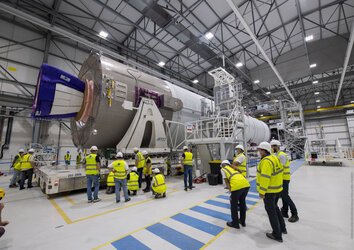
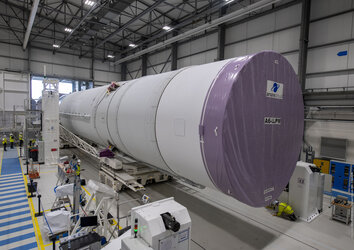
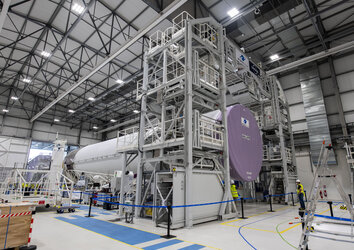
Ariane 6 comprises three stages: two or four boosters, and a main and upper stage – known together as the central core.
The main stage together with the solid rocket boosters propels Ariane 6 in the first phase of flight. The core stage is powered by the liquid-fuelled Vulcain 2.1 – an upgraded engine derived from Ariane 5’s Vulcain 2 – and the P120C boosters provide additional thrust at liftoff.
The upper stage is powered by the reignitable Vinci engine fuelled by cryogenic liquid oxygen and hydrogen. This allows Ariane 6 to reach a range of orbits on a single mission to deliver more payloads. The upper stage will typically burn multiple times to reach the required orbits. After separation of the payload, there will be a final burn to deorbit the upper stage and reduce space debris.
The fairing, a nose cone that splits into two vertically, at the top of Ariane 6 comes in two sizes: 20 m and a shorter 14 m version. Both are 5.4 m in diameter and made of carbon fibre-polymer composite. The fairing protects satellites from the thermal, acoustic and aerodynamic stresses on the ascent to space.