Rome, Italy
Thousands of people in cities all over Europe are working to ensure European access to space, bringing all the benefits of our wider Universe to people on Earth. This satellite photo highlights one of the cities of Ariane 6, where people are working to make Europe’s new heavy-lift rocket, Ariane 6, fly.
They say all roads lead to Rome, but for Europe the road to space also starts near Rome, Italy. Close to the Italian capital lies, Colleferro, where the boosters that are used on Europe’s Vega and Ariane family of rockets start production.
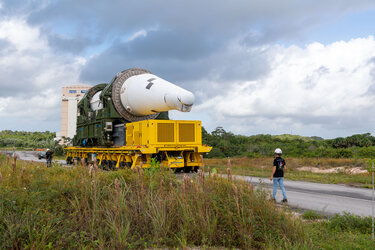
Ariane 6 comes with boosters that produce thrust each that is equal to more than 35 jet engines. Every Ariane 6 has at least two boosters, and can be equipped with four, depending on the weight and destination of the satellites it pushes into space.
It takes 3500 km of carbon fibre, wound over 33 days in a climate-controlled room held at 21 °C to make the 25 cm thick walls for the boosters. They consume 142 000 kg of solid propellant in just over two minutes on launch. Like fireworks, once the boosters are ignited there is no going back, the engines will consume their solid propellant until they run out of fuel.
The boosters are developed by Europropulsion, owned by Avio and ArianeGroup and their industrial partners in Europe that design and build the Vega and Ariane 6 rockets. They are used for Ariane 6 as well as in the first stage of Vega, ESA’s rocket for smaller satellites.