Connect
A space antenna farm amid the Ardennes forest
ESA’s European Space Security and Education Centre in Redu, Belgium, not only has a focus on cybersecurity and education, but is also tasked with oversight of the Proba series of minisatellites. The largest antenna seen here, with its full-motion 20-m diameter dish, played a key role in the in-orbit testing of the European Union’s first Galileo satellites, able to acquire the satellite signal-in-space at high resolution for detailed examination.
Radio (along with, increasingly, optical) communications are what keep space missions connected with home, uplinking commands and downlinking platform status information as well as mission data for end users. Satellite orbits vary with their functions – close to Earth or far deeper into space – making worldwide networks of ground stations essential.
ESA’s Estrack system of ground stations has a core network of ten stations in seven countries, complemented by commercial providers as required. In general, the bigger the radio dish the more distant the spacecraft they are able to serve – so Estrack has three 35-m diameter Deep Space Antennas for interplanetary missions such as the Juice mission to Jupiter. For Galileo, Europe’s single largest satellite constellation, a dedicated global network of ground stations is essential to ensure the continued reliability of the time and positioning information embedded within the signals from orbit, established by ESA and overseen by EUSPA – maintaining Galileo’s status as the world’s most precise satellite navigation system.
With connectivity becoming an essential public good, the European Union has established the European Union Governmental Satellite Communications programme, GOVSATCOM, ensuring availability of reliable, secure and cost-effective governmental satellite communications services, serving EU institutions and national public authorities managing security critical missions and infrastructures. The IRIS2 constellation – which stands for Infrastructure for Resilience, Interconnectivity and Security by Satellite – will comprise hundreds of satellites in low Earth orbit and others in medium Earth orbit. Placing interlinked satellites into these different orbits will enable the constellation to communicate securely and quickly and remain constantly connected without needing thousands of satellites. An additional layer in low Earth orbit providing further services will also be developed. ESA is supporting the development of IRIS2 through a Partnership Project contract with an industrial consortium called SpaceRISE selected by the European Commission.

Govsatcom: pooling civil and secure satcoms

Satcom for safety and security

The future is here, panel on Govsatcom and 5G
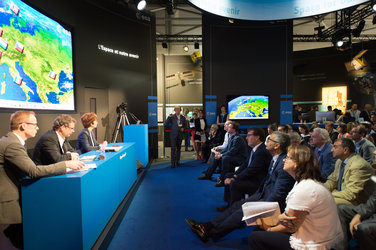
Roundtable: 'The future is here, panel on Govsatcom and 5G'