


ESA and Airbus engineers test Smile spacecraft boom
The ESA/CAS Smile mission carries two magnetic field sensors at the end of a 3 m-long boom.
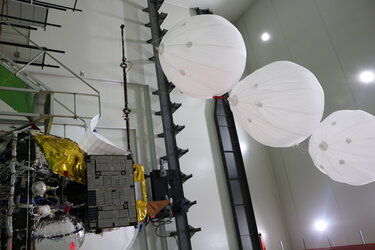
On 21 November 2024, engineers at ESA’s technical heart (ESTEC) tested the release of this boom to check that it will properly unfold after the spacecraft is launched.
The first test was not 100% successful; although the release went well, the boom did not lock into place. The team entered into intense discussion and very quickly discovered the cause: a bundle of cables that was too stiff and not mounted correctly, so the boom was not able to lock.
Engineers fixed the issue immediately by loosening the bundle and mounting it slightly differently. They successfully released the boom again the following day. A round of applause filled the room when the boom clicked into place.
The two sensors make up Smile’s magnetometer instrument (MAG). This vital device will measure the strength and direction of magnetic fields around the spacecraft to help us understand how the solar wind from the Sun affects Earth’s magnetosphere and thereby our planet as a whole.
MAG sits at the end of the boom, three metres away from the body of the spacecraft, to ensure that it doesn’t pick up any of the magnetic fields from onboard electronics. To stay safe during launch, this boom stays folded away, unfurling only once the spacecraft is in orbit around Earth.
Find out more about the testing of Smile at ESTEC
Smile (the Solar wind Magnetosphere Ionosphere Link Explorer) is a 50–50 collaboration between the European Space Agency (ESA) and the Chinese Academy of Sciences (CAS).
[Image description: Six engineers stand around a spacecraft in a cleanroom. They wear protective coats and hats. The spacecraft is wrapped in gold and has a long boom sticking out of it.]

Smile deploys its magnetometer boom (artist impression, GIF)
Smile spacecraft during a test of the magnetometer b…

Smile payload module travels to China

Smile deploys its magnetometer boom (artist impression)
