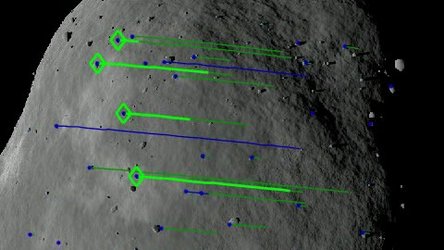
Hera's autonomous surface feature tracking during Mars flyby
As ESA’s Hera planetary defence mission flew planet Mars it autonomously locked onto dozens of impact craters and other prominent surface features to track them over time, in a full-scale test of the self-driving technology that the spacecraft will employ to navigate around its target asteroids.
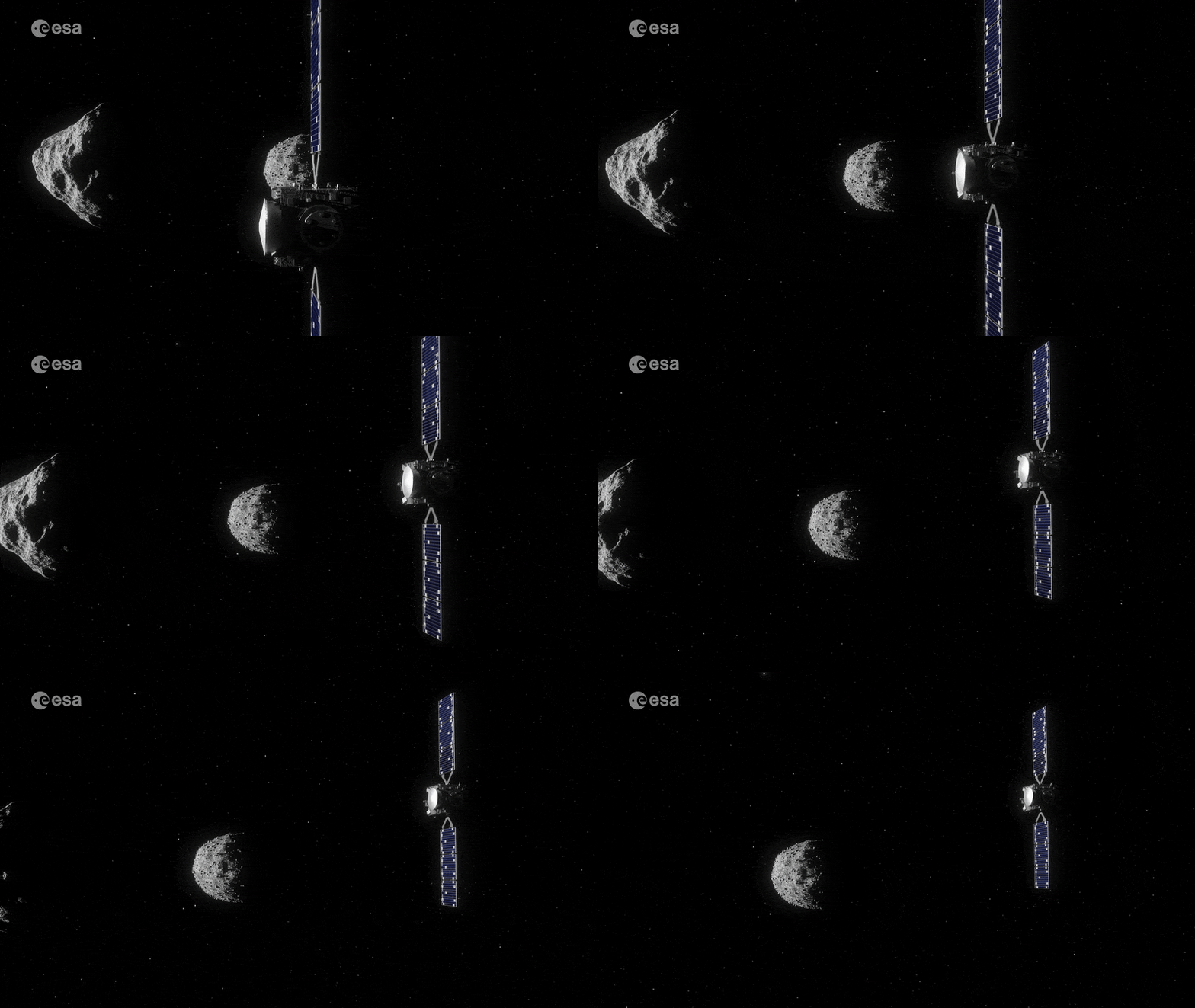
Developed for the mission by a GMV team from Spain and Romania, this system will be used by Hera to navigate autonomously around its Dimorphos asteroid target when it comes too close for other navigation techniques to be reliable. Accordingly autonomous surface tracking becomes essential: by imaging the same features – such as boulders and craters – in successive pictures Hera will be able to derive its own altitude and trajectory with respect to Dimorphos. The autonomous surface tracking system acquires up to 100 features, distributed equally across four quarters of the target surface, but employs only the top six for calculating its relative position and direction, so as limit its computational load.
On 12 March Hera came to within 5700 km of the red planet, using its gravity field to shift the spacecraft’s trajectory towards its final destination: Dimorphos and the larger Didymos asteroid it orbits around. This manoeuvre shortened Hera's journey time by many months and saved a substantial amount of fuel.