

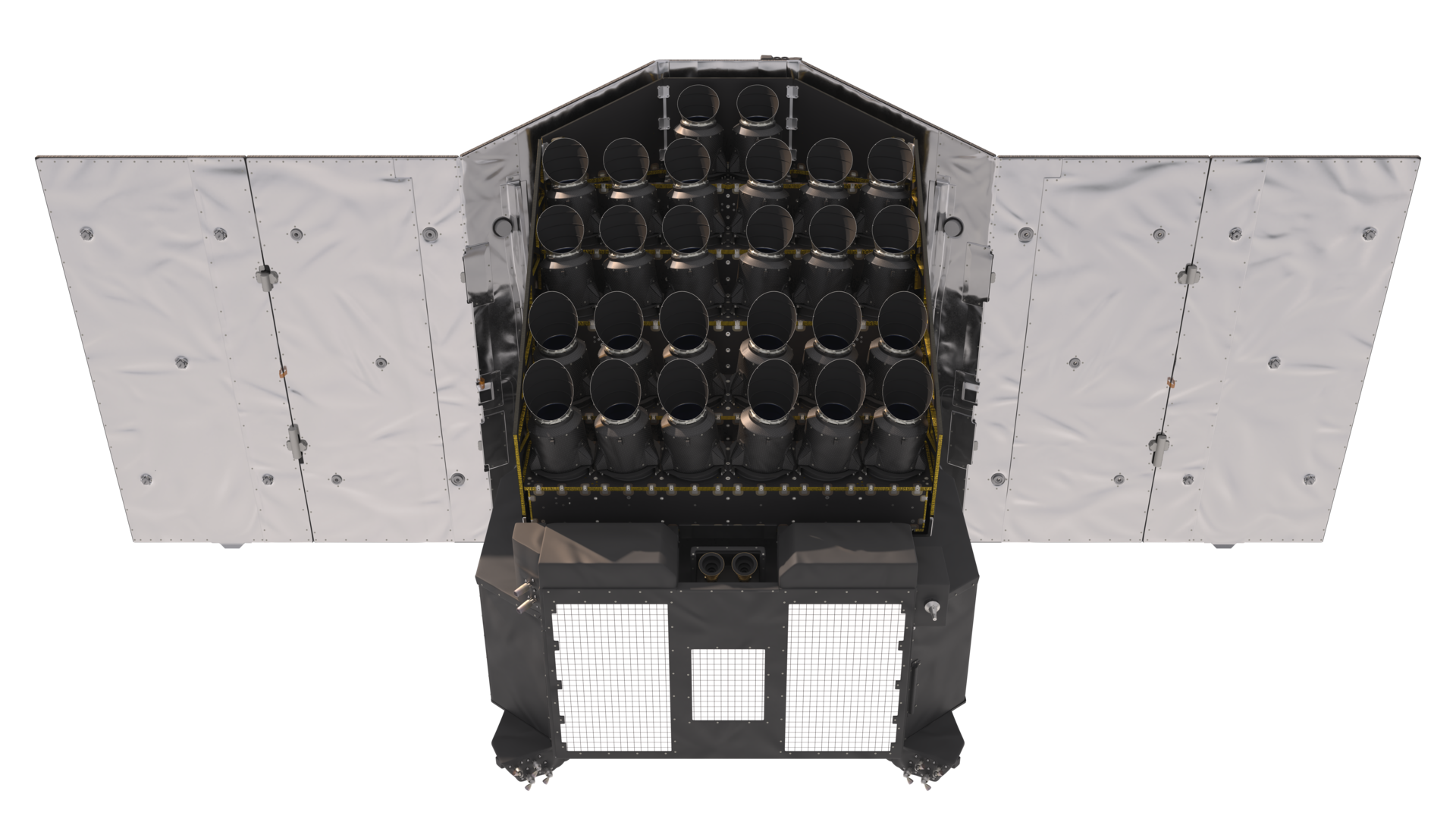
Plato’s artist impression, front view
Artist impression of the European Space Agency’s Plato mission.
The spacecraft is black and silver and consists of three main elements. The top part, called ‘payload’, carries the 26 ultra-sensitive cameras; they are mounted on the spacecraft’s optical bench – the structure that keeps all cameras firmly pointed in the right direction.
The boxy bottom part, called ‘service module,’ contains computers to operate the cameras’ electronics and other critical spacecraft components; these include subsystems to control its orientation and orbital motion, propel it through space, distribute power, communicate with Earth, and handle data transfer.
Finally, the structure wrapping around the ‘back’ of the spacecraft and extending outward like a pair of wings supports the solar panels and acts as a sunshield.
Plato will use all its cameras simultaneously to stare at the sky and discover planets that orbit stars similar to our Sun, searching for potentially habitable worlds. The mission is designed to study thousands of exoplanets in detail, focussing on terrestrial ones, and uncover exomoons and rings around them. Plato will also fundamentally advance our understanding of the interior and evolution of stars by monitoring tiny intensity variations in the starlight it receives.

Plato’s artist impression

Plato’s artist impression, view from below

Plato’s 26 eyes peer into space (artist impression)

Plato selfie above Earth (artist impression)
