

Smile above the north pole
Unpredictable and temperamental, the Sun is a violently raging star. Every second, it sends out millions of tonnes of material, some of which heads straight in our direction.
Fortunately we have a defence – Earth's magnetic field. Smile will reveal how Earth's magnetic field reacts to the streams of particles and bursts of energy that the Sun constantly throws in our direction. It will give humankind its first complete look at how the solar wind leads to geomagnetic storms and auroras.
Within Smile’s scientific toolbox are four instruments that will each collect a vital puzzle piece of information that, when combined with information from the other three instruments, will reveal our magnetic shield in a whole new light.
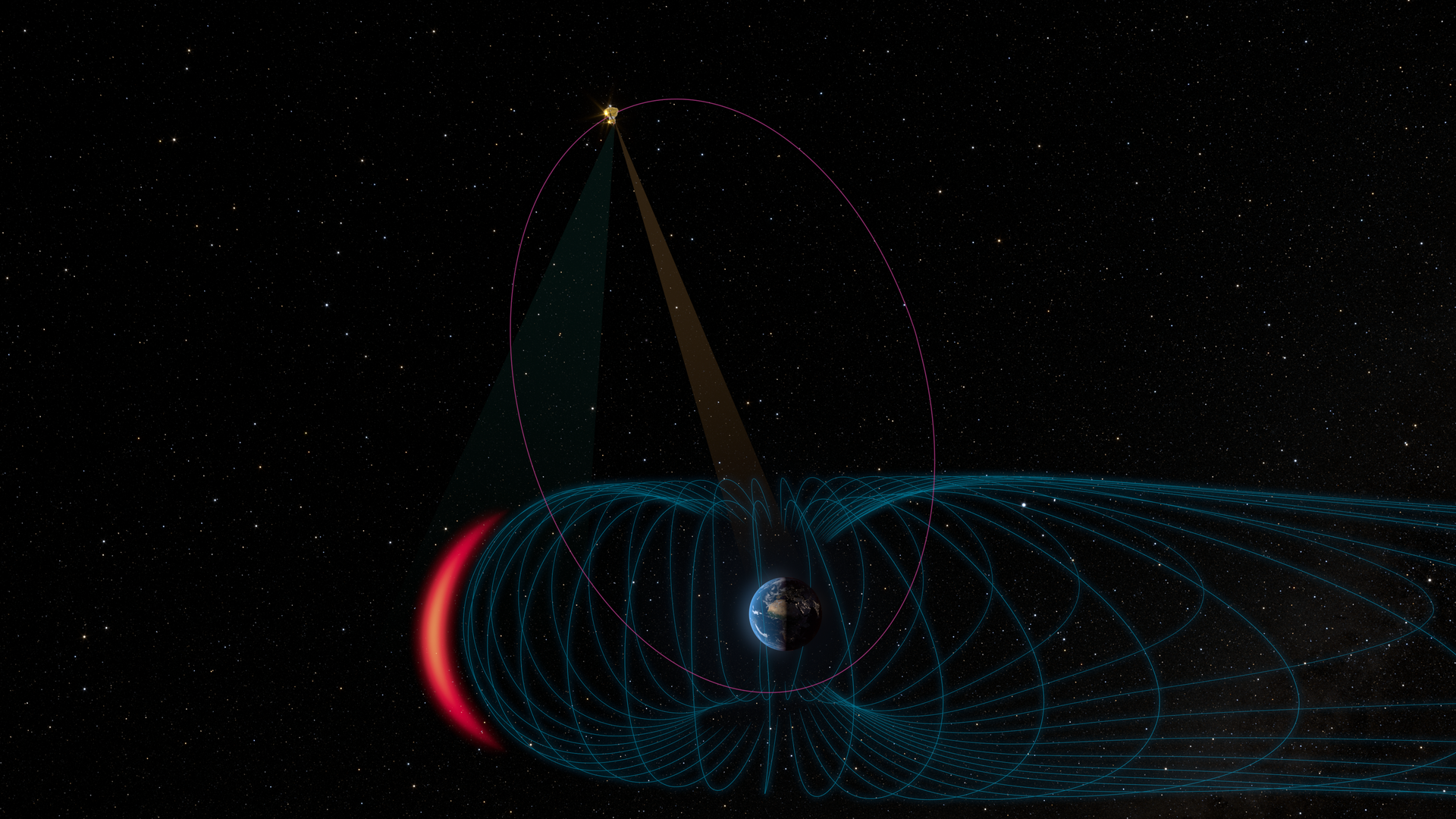
Earth's magnetic field is invisible to our eyes, but with its X-ray camera (very faint blue cone), Smile will reveal it. With its ultraviolet camera (orange cone), Smile will record the northern lights for up to 44 hours at a time, to see how the interaction of the solar wind with Earth's magnetic field ultimately leads to the auroras.
Smile will have a very elongated orbit around Earth, taking it 121 000 km above the north pole every two days and then close to the south pole to send its data down to DLR’s German Antarctic Station GARS O’Higgins. This type of orbit enables Smile to spend much of its time (about 80%, equivalent to nine months of the year) at high altitude above the northern hemisphere, allowing the spacecraft to collect continuous observations of the northern lights for longer periods of time.
During each two-day orbit, Smile will collect about 100 Gb of data, which will be downloaded in just 15–30 minutes as Smile flies close (relatively speaking) over the ground station. Whilst the spacecraft is downloading, its X-ray and ultraviolet cameras will be switched off.
Smile (the Solar wind Magnetosphere Ionosphere Link Explorer) is a collaboration between the European Space Agency (ESA) and the Chinese Academy of Sciences (CAS).
[Image description: The Smile spacecraft orbiting around Earth. The orbit takes it far above the north pole, where it peers down towards the edge of Earth's magnetic field with its X-ray camera, and towards the auroras with its ultraviolet camera.]

Smile above the south pole

Smile's special orbit

Smile fires its boosters (artist impression, GIF)

Smile's ultraviolet camera sees Earth reacting to co…
