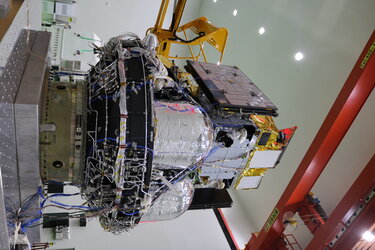
Smile on the scales
During April 2025, engineers measured the mass properties (total spacecraft mass, position of the centre of gravity and moment of inertia about all three axes) of the Smile spacecraft.
It is important to make these measurements very precisely to ensure that the spacecraft is compatible with the Vega-C rocket that will launch it into space. Spacecraft controllers also require this information to correctly manoeuvre Smile once it is in orbit around Earth.
Smile is currently in its ‘space environment testing’ phase at ESA’s technical heart, ESTEC, in the Netherlands. Engineers are taking the spacecraft through tough checks, needing it to pass with flying colours before being allowed out on its own. Tests include making sure that the entire system can operate properly in the vacuum of space, that the different parts of the spacecraft don’t create too much electromagnetic disturbance for other parts, and that the violent launch won’t shake the spacecraft apart.
Smile (the Solar wind Magnetosphere Ionosphere Link Explorer) is a collaboration between the European Space Agency (ESA) and the Chinese Academy of Sciences (CAS).
[Image description: A spacecraft inside a cleanroom environment. The spacecraft is mounted on a large white platform. The upper part of the spacecraft is covered in gold-coloured thermal insulation material, with several black solar panels attached to it. There are various cables and equipment connected to the platform.]