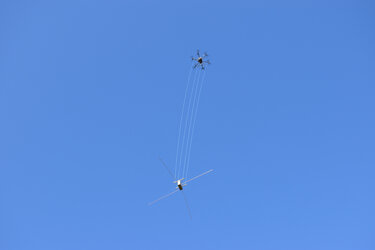
Dielof van Loon’s tethered drone setup
A drone tethered to a rover-simulating platform designed by Dielof van Loon, a student from Delft University of Technology, during his internship at the European Space Agency’s Planetary Robotics Laboratory.
In his project, Dielof investigated the potential of tether localisation, a technique that uses a physical tether attached to a drone to determine the drone’s location.
“My research project focused on a scenario in which a drone is tethered to a rover with a cable,” explains Dielof. “The cable would transmit data from the drone to the rover, and the rover would provide power and processing capacity, making the drone lighter and allowing it to fly for longer periods of time.”
“I created a system that allows me to measure the length of the tether currently unwound, as well as its angles at any given moment,” he adds.
“One sensor measures the tether’s angle at the point where it is attached to the drone, while the other measures it at the point where the tether enters the platform. The base station computer then uses the measurements from the two sensors, together with the tether length and tension measurements, to determine the drone’s position.”
In addition to the rover-simulating platform and tether management system, Dielof developed the necessary software and hardware and added them to a bare drone to suit his testing setup.
[Image description: This is a photograph of a drone testing setup, with various elements highlighted. The setup consists of an open box-like structure. Inside the box, different mechanical components and wiring are visible. On top of the box is a simple red and black drone. The scene is set in a simulated martian landscape environment with a rocky terrain and reddish sand in the background.]