Gaia discovers our galaxy’s great wave (side-by-side)
The European Space Agency’s (ESA) Gaia space telescope has revealed that our Milky Way galaxy has a giant wave rippling outwards from its centre.
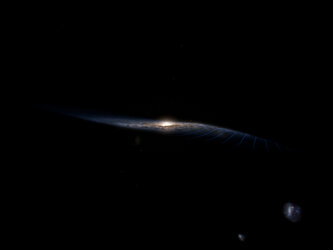
The unexpected galactic ripple is illustrated in this figure. Here the positions of thousands of bright stars are shown, overlaid on Gaia’s maps of the Milky Way.
In the left image, we look at our galaxy from ‘above’. On the right, we see across a vertical slice of the galaxy and look at the wave side-on. In this perspective, the Sun is located between the line of sight and the bulge of the galaxy. This perspective also reveals that the ‘left’ side of the galaxy curves upward and the other side curves downward (this is the warp of the disc).
The newly discovered wave is indicated in red and blue: in red areas, the stars lie above, and in blue areas the stars lie below the warped disc of the galaxy.
[Image description: This image consists of two sides. Left side: A top-down view of a spiral galaxy is shown. It has a bright central bulge with several spiral arms radiating outward. Overlaid on the lower part of the galaxy is a data visualisation, with colours ranging from blue to red. A label reading ‘Sun’ marks a specific location within this overlay. Right side: An edge-on view of the same spiral galaxy is presented. It reveals the galaxy's thin disc and central bulge from the side. Coloured points are scattered along the disc, representing the same data as the overlay on the left side.]