Interior of Saturn's moon Enceladus
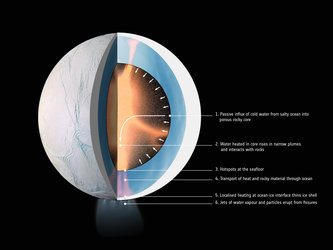
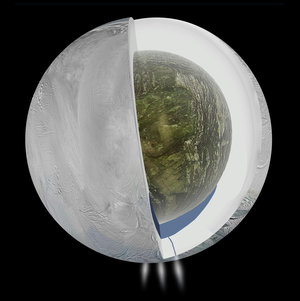
This artist's impression shows Saturn's icy moon Enceladus. With a frozen surface covering a deep ocean, Enceladus is a fascinating target to search for signs of habitability elsewhere in our Solar System.
Cold water from the ocean seeps down into the rocky core. The water is heated in the core, and rises back towards the ocean, interacting with rocks along the way.
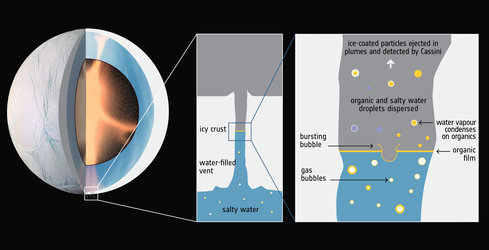
Hydrothermal vents in the moon's ocean floor release heated water, laden with minerals and dissolved gases. This mixture of warm water and rocky material rise through the ocean towards the moon's ice shell, where it melts the ice and escapes onto space.
Some of Enceladus's secrets were already revealed by the NASA/ESA/ASI Cassini-Huygens mission. ESA is now studying a dedicated mission to Enceladus. Planned for launch in the 2040s, the mission would fly through the jets and even land on the moon's south polar terrain to collect samples.
Enceladus ticks all the boxes to be a habitable environment that could support life: the presence of liquid water, a source of energy, a specific set of chemical elements and complex organic molecules. A mission that takes measurements directly from the moon’s surface, seeking out signs of life, would offer Europe a front seat in Solar System science.
[Image description: Scientific illustration showing the internal structure and activity of Saturn's moon Enceladus. It presents a cross-section with three main layers: the icy shell, a subsurface ocean and a rocky core. The image explains a six-step process: 1. Cold ocean water sinks into the rocky core; 2. It heats up and rises, interacting with the rocks; 3. Heated water escapes through hydrothermal vents; 4. Water and rocky material move upward through the ocean; 5. Warm water melts parts of the ice shell; 6. Jets of water and particles erupt through cracks in the ice.]