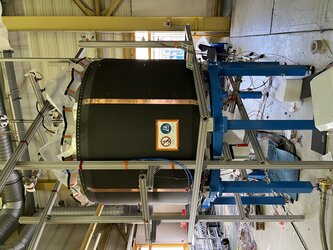
Phoebus 2m-scale hydrogen tank on automatic fibre placement machine
Phoebus hydrogen tank during production at MT Aerospace in Augsburg, Germany, October 2025. This tank will hold almost 2600 litres and is 2 m in diameter.
The tank completed the first manufacturing steps on its inner tank pressure vessel at MT Aerospace in Augsburg, Germany in September 2025.
Phoebus is a European Space Agency (ESA) project together with ArianeGroup and MT Aerospace. It aims to assess the feasibility and benefits of replacing the metallic tanks on ESA’s Ariane 6 upper stage with carbon-fibre reinforced-plastic tanks. While this lightweight material offers the possibility of saving several tonnes of mass, such an approach has never been implemented before and presents significant technical challenges.
The central core of ESA’s Ariane 6 rocket runs on liquid oxygen and liquid hydrogen, two very different molecules, so the Phoebus project is developing and producing two versions of the same carbon fibre tank concept.
Hydrogen is the smallest molecule in the Universe, and when used as fuel on the Ariane 6 rocket it has to be cooled to −253 °C, just 20 degrees above absolute zero, the coldest temperature in the Universe.
Generally, carbon fibre composites do not like it that cold, like your skin in winter. With the cold your skin gets dry and brittle such that when you move it can crack. This is the same for carbon fibre tanks: when filled with cool propellants under pressure, small cracks can form which is not what you want on a rocket tank.
Phoebus is part of ESA’s Future Launchers Preparatory Programme (FLPP), that helps develop the technology for future for space transportation systems. By conceiving, designing and investing in technology that doesn’t exist yet, this programme is reducing the risk entailed in developing untried and unproven projects for space.
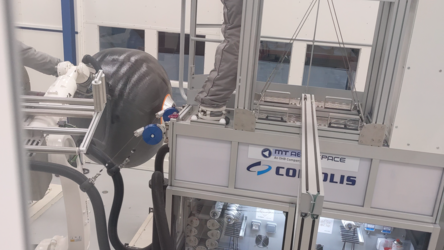
Automated carbon-fibre placement for Phoebus tank

Phoebus hydrogen tank in production at MT Aerospace

Phoebus oxygen tank during testing

Prototype carbon fibre cyrogenic fluids tank