Flying for the Moon
How do you prepare for life on the Moon? Start with a flight that bends gravity.
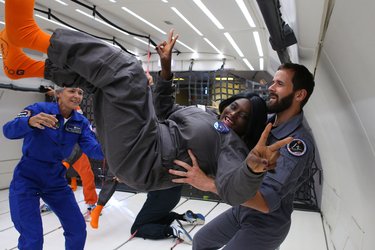
ESA’s 88th parabolic flight campaign took off from Bordeaux, France, for three flights dedicated to lunar gravity research aboard the Airbus A310 Zero-G aircraft. Sponsored by ESA, this campaign gave scientists hands-on time with experiments that will shape how we can live and work on the Moon.
Before leaving Earth, parabolic flights offer a way to simulate the Moon’s gravity—about one-sixth of Earth’s pull. During this lunar campaign, nine experiments tackled big questions, from how blood flows and muscles adapt in partial gravity to how astronauts regain balance and coordination after prolonged immobility.
Research explored how crews could manage injuries without specialists by their side, fire safety in lunar habitats, wearable suits to counteract fluid shifts, and technologies for sorting, moving, and excavating lunar soil to build and extract resources.
Originally designed for astronaut training, parabolic flights now primarily serve science and technology. By flying along a special trajectory, the aircraft creates short periods of reduced gravity, up to 22 seconds of weightlessness for zero-g flights, mimicking the floating experience of the International Space Station, or slightly longer for the partial gravity experienced on the Moons (0.16 g). During these windows, researchers can run experiments in physiology, biology, fluid physics and engineering, gaining insights that ground tests cannot provide.
In the near future, the European Service Module will propel astronauts aboard Orion to the Gateway in lunar orbit and ESA's Argonaut landers will deliver cargo and payloads to the Moon. To make those missions safe and successful, scientists and engineers need to understand how people and technology behave in lunar conditions.
This effort is strengthened by the growing research and testing capabilities of the ESA-DLR LUNA facility in Cologne, Germany—a Moon-analogue environment for surface operations. Soon equipped with a gravity off-loading system to simulate the Moon’s gravity, LUNA will enable astronauts to train for realistic lunar scenarios. These combined ESA initiatives mark a major step toward making future lunar missions safer, smarter and more sustainable.