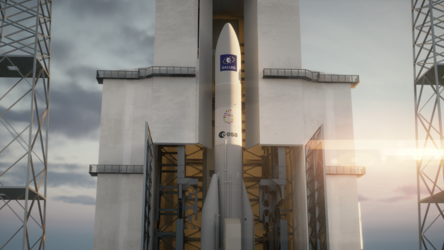
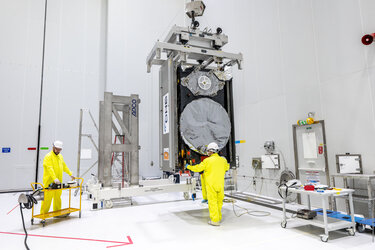
Galileo launch 14 timeline on Ariane 6
Infographic showing the steps and expected timings for the 14th launch for Galileo navigation satellites.
Launch 14 is Galileo’s first launch on Ariane 6 and the fifth launch of Europe’s heavy-lift launcher.
The two Galileo satellites, designated SAT 33 and SAT 34, will improve the robustness of the Galileo system by adding spares to the constellation to guarantee the system can provide 24/7 navigation to billions of users. The satellites will join the constellation in medium Earth orbit 23 222 km above Earth’s surface.
Galileo is currently the world’s most precise satellite navigation system, serving over five billion smartphone users around the globe since entering Open Service in 2016. All smartphones sold in the European Single Market are now guaranteed Galileo-enabled. In addition, Galileo is making a difference across the fields of rail, maritime, agriculture, financial timing services and rescue operations.
A flagship programme of the EU, Galileo is managed and funded by the European Commission. Since its inception, ESA leads the design, development and qualification of the space and ground systems, as well as procuring launches. ESA is also entrusted with research and development activities for the future of Galileo within the EU programme Horizon Europe. EUSPA acts as the service provider, overseeing the market and application needs and closing the loop with users.
Ariane 6 is Europe’s heavy-lift launcher and a key element of ESA’s efforts to ensure autonomous access to space for Europe’s citizens. Its modular and versatile design allows it to launch all types of missions, from low-Earth orbit to deep space.
Ariane 6 is designed and built by ArianeGroup. It has three main components each working in stages to escape Earth’s gravity and take satellites to orbit: two or four boosters, and a core and upper stage. For this launch, the rocket will be in its two-booster configuration.