Resonance igniter
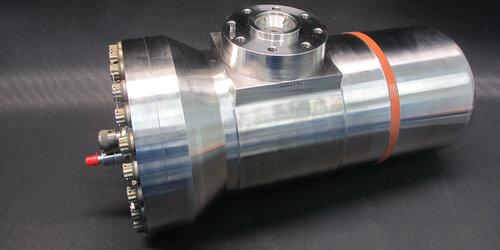
Close up of the resonance igniter built by The Exploration Company in Bordeaux, France.
Building a working rocket engine is one thing, igniting the engine in a stable and repeatable way is an engineering feat in itself. Resonance ignition produces high‑frequency waves inside a shaped cavity. As the waves interact, they resonate and heat the propellants until they ignite. This type of ignition uses just the propellants themselves.
Instead of relying on a spark, a pyrotechnic device or a plasma torch, the system creates self‑amplifying pressure waves that rapidly increase the temperature of propellant gases.
Propellant mixtures are injected in gaseous form through a “resonance nozzle” into a cavity. If the shape of the nozzle and the cavity are exactly right, then the propellants bounce back and forth across the cavity and produce standing acoustic waves: one wave of gas moving in one direction meets the wave returning in the opposite direction. These waves break into each other at points called nodes, resulting in high pressure fluctuations and increasing the temperature of the gas.
The Exploration Company is investigating this phenomenon as a novel technique to start their rocket engines, requiring no external ignition devices, just a resonance nozzle and cavity. An advantage of resonance igniters is that they can be used repeatedly, they use little electricity, there is no need for additional parts and they are therefore lightweight. Current technologies for rocket engines use spark plugs that require a high voltage, glow plugs that need time to warm up, or torch igniters.
The first test campaign concluded in November and showed the technology works, allowing The Exploration Company to develop know-how on the device’s workings and better understand the geometry needed for successful, rapid and repeatable ignition.
They tested different setups and analysed modes of ignition. The data from this test campaign will help develop another version of the device that will be included in the pre-combustors of The Exploration Company’s staged-combustion cycle high-thrust engine programme.
The test was conducted within a €9 M contract from the European Space Agency as part of the Technologies for High-thrust Re-Usable Space Transportation initiative, THRUST!