Anatomy of Earth's magnetosphere
Earth defends itself against dangers from the Sun with a giant magnetic shield called the magnetosphere. We can think of the magnetosphere as a huge bubble full of magnetic field lines that are generated deep within our planet.
Solar wind: The driving rain of charged particles continuously streaming outwards from the Sun at up to more than 2 million km an hour.
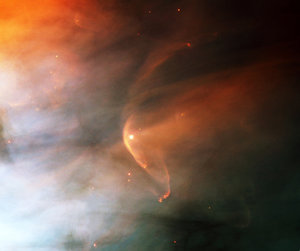
Bow shock: Where the solar wind is slowed down and deflected around Earth, as it begins to plough into Earth's magnetosphere.
Magnetosheath: The very chaotic boundary region between the bow shock and the magnetopause. It mostly contains shocked solar wind particles.
Magnetopause: Where the pressure from the solar wind is balanced by the pressure from Earth's magnetic field. Inside the magnetopause, Earth's magnetic field dominates. There are many more charged particles outside the magnetopause than inside it.
Polar cusps: The holes in the magnetosphere at Earth's north and south poles, where charged solar wind particles can enter the atmosphere and create the auroras.
Auroras: Also called the northern lights (aurora borealis) and southern lights (aurora australis), these colourful, moving, glowing patches of sky form because of solar activity.
Magnetotail: The part of the magnetosphere extending ‘behind’ our planet away from the Sun, with magnetic field lines stretched out like a tail.
Magnetic reconnection: Occurs when magnetic field lines are squeezed together, finally pinching and reconnecting closer to Earth (note: this can also happen when Earth's magnetic field lines meet the Sun's magnetic field lines on the Sun-facing side of Earth, and in many other places in space, including on the surface of the Sun and other stars, and around black holes).
[Image description: Infographic presenting the different parts of Earth's magnetosphere and its interaction with the solar wind. At the centre of the graphic is Earth, with magnetic field lines emanating from the north/south poles. On the Sun-facing side of Earth, a large shield labelled bow shock seems to protect Earth from the solar wind. On the space-facing side of Earth, the magnetic field lines stretch out into space.]

Earth's magnetic field buffeted by solar wind
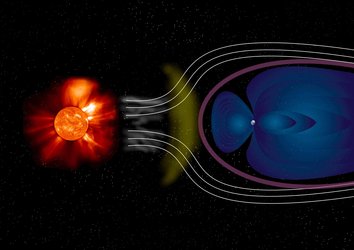
Solar wind buffets Earth's magnetic field
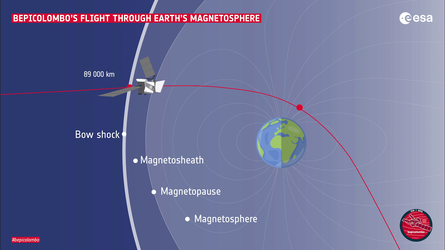
The sound of Earth’s magnetic field by BepiColombo
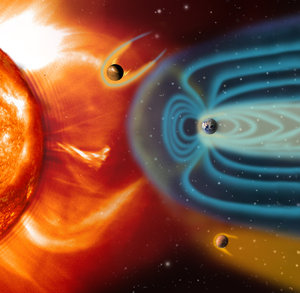
Terrestrial planet magnetospheres