


Smile: A global answer to a global question
Smile (the Solar wind Magnetosphere Ionosphere Link Explorer) is a joint mission between the European Space Agency (ESA) and the Chinese Academy of Sciences (CAS). It will give humankind its first complete look at how Earth reacts to streams of particles and bursts of radiation from the Sun.
ESA is responsible for providing Smile’s payload module (which carries three of the four science instruments: SXI, UVI and MAG), the largest of the four science instruments (the soft X-ray imager, SXI), the launcher, and the Assembly Integration and Testing facilities and services. ESA contributes to another instrument (the ultraviolet imager, UVI) and the mission operations once Smile is in orbit.
On behalf of ESA, Airbus Defence and Space (Spain) built the payload module and the University of Leicester (UK) built the SXI instrument. Together the payload module and SXI instrument involved contributions from institutes and industries in 14 European countries.
CAS oversees the development of Smile’s platform (which carries the science instrument LIA), three of the four science instruments (UVI, MAG, LIA), and is overall responsible for the spacecraft system and its operation once in orbit.
Follow the mission at esa.int/smile
Smile (the Solar wind Magnetosphere Ionosphere Link Explorer) is a joint mission between the European Space Agency and the Chinese Academy of Sciences.
[Image description: In the top centre of the infographic is an artist impression of the Smile spacecraft with parts highlighted in either yellow or blue. Below the spacecraft a blue box titled 'ESA responsibility' lists the main ESA contributions to the mission. A yellow box titled 'CAS responsibility' lists the main CAS contributions to the mission. An orange circle linking the two boxes explains that both partners are involved in all stages of mission development, launch and operations.]

Vega-C launching Smile satellite (artist impression)

Inspector Smile, chapter 2: she’s ready

Top three mysteries Smile will solve
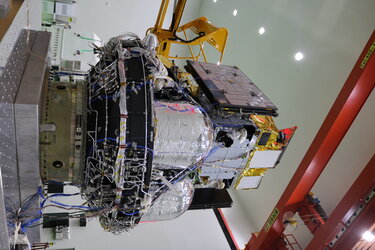
Smile spacecraft during mechanical testing
