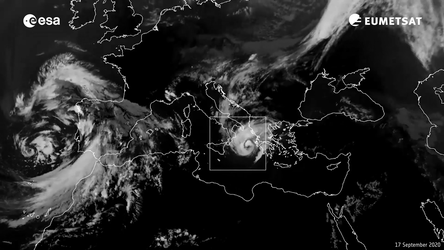
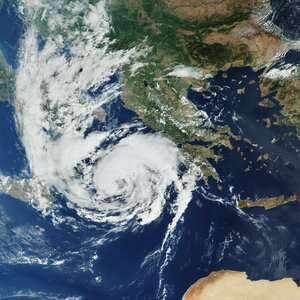
Medicane Jolina from MSG
Everyone knows what a hurricane is, but a lesser-known storm type – a medicane – recently made landfall in Libya. While the arrival of Medicane Jolina, a rare Mediterranean cyclone, brought extreme weather, it also provided scientists with a crucial test case. Using different types of data from Earth-observing satellites, researchers are gaining new insights into how these storms form and evolve, and therefore, how their impacts can be predicted more accurately.
Key to classifying the storm as a medicane were images from the Meteosat Second Generation (MSG) mission as well as an algorithm called DeMeTra that uses a deep learning model trained to provide rotational centre tracks in near-real time using the MSG SEVIRI Rapid Scan Service infrared channels. This yielded the exact location of the eye of the storm, shown as a red dot in the image.
Read full story: Getting to the core of a medicane