Where to find gamma-Cas in the night sky
The star gamma-Cas (γ-Cas) makes up the central ‘point’ of the distinctive ‘W’-shaped constellation Cassiopeia. Close to the ‘pole star’ Polaris, it is visible to northern hemisphere observers every night.
The fast-spinning star is ejecting a rotating disc of matter, resulting in variations in its brightness. Small telescopes reveal this flickering brightness, making it a popular target for amateur astronomers.
New research finds that the culprit for the curious X-ray light is the star’s invisible white dwarf companion. It is consuming material from gamma-Cas, closing the case on a mystery that has puzzled astronomers for more than fifty years.
[Image description: Celestial chart showing several constellations as pattern of dots (stars) in shades of white, connected by white segments on a blue background. In the centre, a W-pattern of five dots is highlighted by connecting bold lines. The star at the tip of the W is marked by a red-arrow and labelled ‘γ-Cas’.]

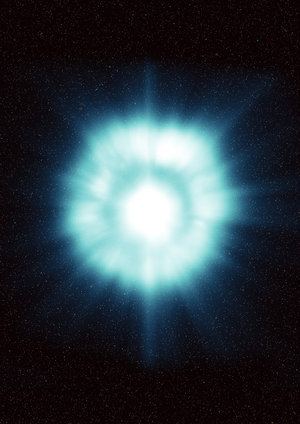
Gamma-Cas and its hungry white dwarf companion

The secret life of gamma-Cas, revealed

X-ray mission lifts off to study high-energy Universe

Gamma-ray burst