Graphene and lasers experiment setup
Experiment setup during ESA’s 86th parabolic flight campaign in May 2025.
An international research team boarded the 'Zero-G' Airbus A300 with ultralight graphene aerogels, then hit them with light during zero gravity phases to observe their reaction under space-like conditions.
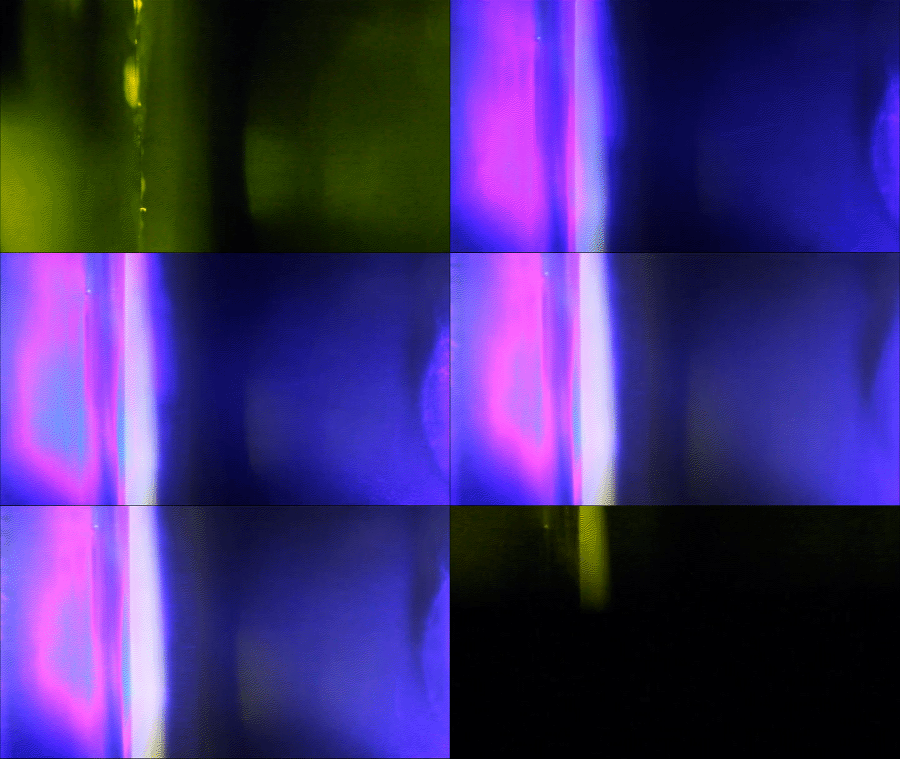
Inside a vacuum chamber, a continuous laser beamed on three small cubes made of graphene aerogel. A high-speed camera recorded the action through glass tubes. This video has been slowed down 10 times; each experiment run lasted 30 milliseconds.
The effect of the laser during the microgravity phases was startling: the graphene samples shot forward instantly. Another finding was the ability to control the propulsion by tuning the light beam. The stronger the laser, the greater the acceleration.
Under Earth’s gravity conditions, the aerogels barely moved at all. The results, published in Advanced Science, demonstrate that microgravity unlocks the potential of light propulsion for graphene aerogels in terms of velocity, thrust and distance.
Researchers at the Université Libre de Bruxelles (ULB) in Belgium and Khalifa University in the United Arab Emirates (UAE) led the study.