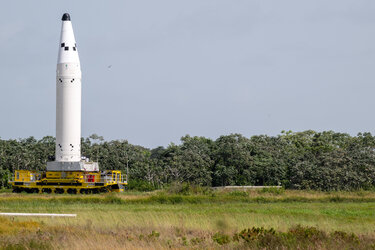
Ariane 6 colouring page
Colouring page of Europe's largest rocket Ariane 6, download a PDF version for easy printing here.
Three… two… one… lift-off! Rockets are very important as they are the only means we have of transporting things like satellites from Earth to space. Although we have been using rockets for decades, the science and technology of them continues to improve, and ESA's latest rocket is Ariane 6!
Ariane 6 rockets are complex pieces of technology, standing at over 60 metres tall – the height of about 15.5 elephants stacked on top of one another. The bottom part is called the main stage, which is powered by a liquid-fuelled engine called Vulcain 2.1. The Vulcain 2.1 engine and the solid rocket boosters on the side of the main stage are what first blast the rocket off the ground, and create the fire and loud whooooosh! sound we think of when imagining a rocket launch!
Next comes the upper stage, which has a special engine called Vinci that can be used multiple times, meaning that an Ariane 6 can reach different orbits during a single mission. The top, cone-shaped part of the rocket is called the fairing. This is where the rocket’s cargo – called the payload – is stored. The fairing protects payloads during the journey into space, and eventually splits into two before the payload needs to be released.
Ariane 6 rockets come in two varieties. The first is called Ariane 62. This has two boosters, and can lift 10.3 tonnes into Low Earth Orbit (which is where many satellites, and the International Space Station, are). If even more power is needed then the second variety, called Ariane 64, can be used. This has four boosters, and can lift more than twice as much as an Ariane 62! Both rockets can carry payloads even further out into space if that is what the mission requires.
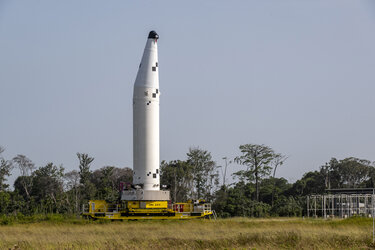
First Ariane 6 booster gets lift to launch zone
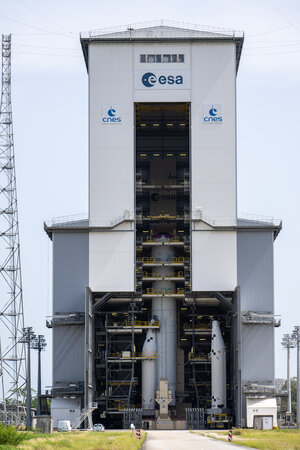
First Ariane 6 for launch with boosters
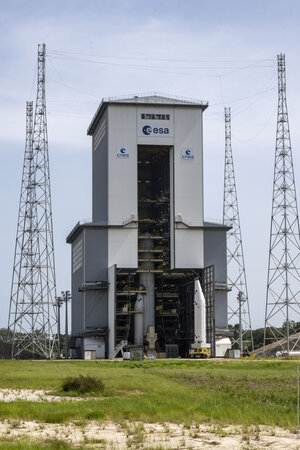
Second booster completes Ariane 6 propulsion stages…
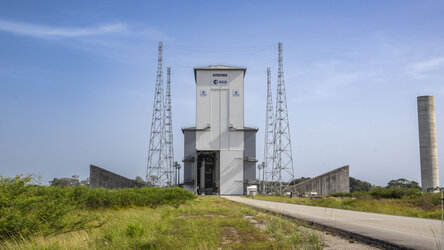
First Ariane 6 booster at the launch zone