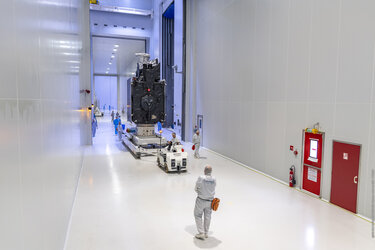
Fuelling begins for MTG-I2
The Meteosat Third Generation-Imager2 (MTG-I2) satellite has begun its five-day process to load its tanks with propellant. The spacecraft uses two types of propellant – one is a fuel and the other is an oxidiser (since no oxygen is present in space). Compared to low-Earth orbit satellites, the MTG satellites require far more propellant to reach their geostationary orbit, at about 36 000 km from Earth. After liftoff, the satellite is placed in what is known as a ‘transfer orbit’, from where it has to raise its altitude using its own fuel – and about 80% of the propellant is used during this phase.
Propellant loading takes place in the Hazardous Processing Facility at Europe’s Spaceport in French Guiana. Personnel from Thales Alenia Space (TAS) are pictured in this photo wearing Self-Contained Atmospheric Protection Ensemble (SCAPE) suits. This equipment is needed for protection when working with propellants.
MTG-I2 is part of the MTG constellation – a cutting-edge weather mission based on the long-standing partnership between the European Space Agency (ESA) and Eumetsat. MTG guarantees the continuity of data for weather forecasting from geostationary orbit for the next two decades.
The satellite will improve data for weather forecasts in Europe and in North Africa with its two powerful imagers. One is the Flexible Combined Imager, which provides a rapid scanning service every 2.5 minutes over Europe. The other instrument on board MTG-I2 is the Lightning Imager. This is also an innovative and powerful instrument, able to capture individual lightning events, by day and night.
As well as providing a huge increase in the quality, quantity and frequency of data for European weather forecasting, the MTG instruments also provide climate data.
The satellite will be transported into orbit by Ariane 6.