Ultrawideband technology on the Moon
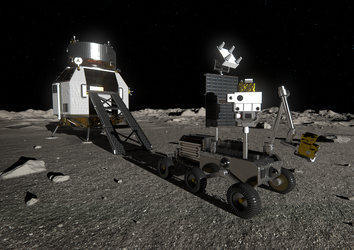
One of three terminals for ESA's UWB technology demonstrator.
Future missions on the Moon will need reliable ways to communicate and navigate in areas beyond satellite coverage. ESA's ultra-wideband (UWB) demonstrator will test wireless communications and precise ranging between a lunar lander and rover.
UWB is a short-range wireless technology that uses extremely short radio pulses to measure the time it takes signals to travel between devices. This allows the users to determine distances very accurately while also exchanging data.
On the Moon, where communication and navigation services are far more limited than on Earth, UWB could enable landers, rovers and astronauts to communicate and locate one another within centimetres. By testing UWB in the lunar environment, the payload will help assess the technology’s potential to support future operations on the Moon’s surface.
The demonstrator will fly on ispace Mission 3, currently planned for 2028. The payload consists of three UWB terminals: one installed on the lander and two on an ispace-Europe rover. As the rover moves across the lunar surface, the terminals will exchange signals to test both communications and ranging capabilities.
In November 2024, ESA awarded Romanian company Control Data Systems a contract to develop the demonstrator; the mission is set to become the first Romanian payload on the Moon.