

ExoMars parachute high-altitude drop test

The most complex parachute system to ever deploy on Mars has successfully slowed down an ExoMars mock-up landing platform for a safe touchdown on Earth.
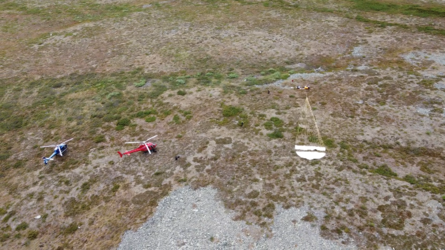
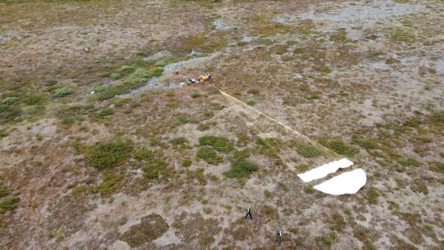
A stratospheric helium balloon lifted a dummy descent module and released it above the Arctic Circle at an altitude of nearly 30 km, triggering the deployment of two large parachutes from their doughnut bags.
This high-altitude drop test campaign took place at the Swedish Space Corporation’s Esrange Space Center in Kiruna, northern Sweden, on 7 July.
To match the combination of density and speed that the capsule will experience when diving into the thin martian atmosphere – about 1% of the density of Earth's atmosphere at sea level – the balloon had to fly very high.
The ExoMars parachutes dropped from an altitude of 29 km, or about three times the altitude where commercial aircraft cruise.
The dummy capsule then went into free-fall for about 20 seconds, reaching almost the speed of sound, before deploying the parachutes in turn.
Landing on Mars is a high-risk endeavour. In just six minutes, the descent module has to decelerate from 21 000 km/h at the top of the planet’s atmosphere to a soft landing to keep its precious cargo, the Rosalind Franklin rover, fit for surface exploration.
The first stage main parachute is 15 m-wide. The second stage main parachute is 35 m-wide and it is formed from a series of rings with gaps in between them. This will be the largest parachute to ever fly on Mars or anywhere in the Solar System besides Earth.

ExoMars parachute high-altitude drop test
ExoMars parachute high-altitude drop test

ExoMars parachute high-altitude drop test
ExoMars parachute high-altitude drop test
