Installing Laplace in the ICE Cubes Facility

This video was published on social media by ESA astronaut Sophie Adenot with the following caption:
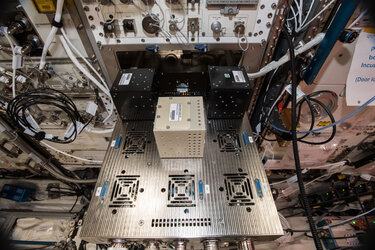
Day 130, orbit 2017 — The variety of research carried out on board the International Space Station is simply amazing — and in this timelapse, I’m installing an experiment at the intersection of planetary science and astrophysics. 230 years ago, French scientist Pierre-Simon Laplace theorised that planets are born from vast clouds of gas and dust. Today, the experiment named after him aims to reproduce this process… and observe it in real time!
Set up inside the commercial ICE Cubes Facility in the Columbus module, Laplace explores how tiny grains of dust can come together to form the first building blocks of planets. To do this, it observes clouds of dust floating in a thin gas, watching them collide and gradually stick together – something best studied in microgravity.
The results will improve our models of planet formation, shedding light on the origins of Earth, and guiding the study of exoplanets. They will also help scientists make better sense of what we see through both space- and ground-based telescopes. Go science!
--
Jour 130, orbite 2017 – La variété des recherches menées à bord de la Station spatiale internationale est impressionnante – pour preuve ce timelapse de l’installation de l’expérience Laplace, à la croisée de la science planétaire et de l’astrophysique. Au 18e siècle, le scientifique français Pierre-Simon Laplace postulait que les planètes naissent d’un nuage de gaz et de poussière. Aujourd’hui, l’expérience qui porte son nom vise à reproduire ce processus… et à l’observer en direct !
Installée dans le dispositif commercial ICE Cubes Facility du module Columbus, Laplace cherche à comprendre comment de simples grains de poussière finissent par former les premières briques d’une planète. L’expérience propose donc d’observer, jusqu’à leur aggrégation, des nuages de poussière en suspension dans une fine atmosphère gazeuse – un phénomène qui s’étudie bien mieux en micropesanteur !
Les résultats permettront notamment d’améliorer les modèles de formation planétaire, contribuant à mieux comprendre la formation de la Terre et éclairer l’étude des exoplanètes. Ils permettront aussi d’affiner l’interprétation des observations réalisées au moyen des télescopes spatiaux ou terrestres. Vive la science !