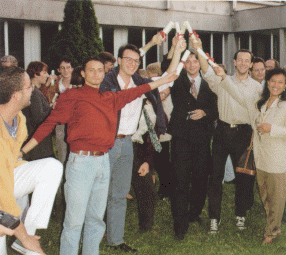
Figure 1. Students celebrating the receipt of the Diplomas at the 1993 Summer Course, Toulouse, France

ECSL has directed many of its activities towards the student community. With space activities expanding in Europe, it was considered of great importance to stimulate and promote interest in space law in today's student community in order to meet future demand for space lawyers. Moreover, taking into account the privileged situation of ECSL as a source of access to information for students and academics, it was natural for them to gather around the Centre and form a strong community.
Although space law was taught at several European Universities, some thinking had to be devoted to possible ways in which to coordinate and enhance the teaching provided in Europe in this respect. In order to complement existing courses at Universities with activities to promote interest in and knowledge of space law, ECSL has carried out many successful activities.
ECSL Summer Course on Space Law and Policy
Lawyers face more and more
practical issues in the field of space activities. In the past, lawyers
could follow trends and study space law as a sideline to their main activities.
This is not true any more and young lawyers will have to be trained appropriately
in order to be able to adapt to growing needs in the field of space activities,
and to foresee legal challenges of the future. The European Centre for
Space Law has developed specific training in this field, and the success
of this formula is now going far beyond the expectations of its founders.
The community of space law teachers and professors gathered together by ECSL is exceptional not just in Europe but worldwide. The Summer Course represents a significant part of ECSL's effort in the field of teaching. This course is designed to be an introduction to legal and political issues arising from space exploration and space applications. It is organised with the support of the European Union Erasmus Programme, the host university, and ECSL. It also received the support of other sponsors: the British National Space Council, Arianespace, Matra Marconi Space, Spot Image, the Centre National d'Etudes Spatiales, Gras-Savoye, SENER, CASA, INTA, the Canadian Space Agency and Martinus Nijhoff Publishers. It lasts two weeks and has now been organised three times in different universities: Messina (1992), Toulouse (1993) and Granada (1994). The 1995 Summer Course will take place in Aberdeen and the 1996 Summer Course will be organised in Leiden. It is provided by about 35 professors and attended by about 50 students, coming, at present, from 25 European Universities from Belgium, Canada, Finland, France, Germany, Italy, The Netherlands, Portugal, Spain, United Kingdom.
Figure 1. Students celebrating the receipt of the Diplomas at the 1993 Summer Course, Toulouse, France

Figure 2. Participants at the 1994 Summer Course, Granada, Spain
In three years, ECSL has already acquired significant experience, thanks to the quality of the teaching staff gathered for the course. The programme has been constantly updated, in order to take into account the most recent developments in space activities and related legal issues.
The course is preceded by a demonstration of the use of the ESALEX database and IRS databases related to law, so as to enable the students to use them during the whole session. The course itself is composed of two parts. The first deals with the basic principles of space law and the main treaties. The students acquire a sound knowledge of the core of space law which contains the rules governing the use of the space environment. The institutional organisation of space activities is explained, with particular emphasis on ESA. A full day is devoted to ESA, with presentations on the history of European space endeavours, a description of ESA, the industrial policy of ESA and its relations with other organisations such as the EC, Eutelsat, and Eumetsat. In the second part of the course, the students become familiar with issues encountered in space applications (satellite telecommunications, remote-sensing, launch services ... ). Specific lectures are given on liability, insurance, intellectual property etc. Often, guest lecturers, usually practitioners, come to give the students an idea of the specific questions they are dealing with in their daily practice. Their presentations are very important in bringing out the relationship between what the theory may be and what the practice is. They help students understand the practical side of what they are learning during the course.
To train the students to react to a practical case, a new formula was inaugurated for the 1994 course with respect to the work done in groups. A practical case was designed, dealing with a mission on the Moon, where many surprises were encountered and created a legal nightmare. Students were split into groups, each group representing States or organisations involved in the case, and constituting a delegation to an international conference convened to agree on a settlement of all legal issues arising out of this mission to the Moon. Under the direction of tutors and with the help of the professors, the students prepared their arguments and exchanged memos and correspondence among delegations to prepare for the conference. The conference itself lasted two days, at the end of which concessions and compromises led to a reasonable settlement of the disputes. The minutes of the conference were taken and a final act was agreed upon and signed by the heads of delegations. Besides the role-playing aspects of such an exercise, it proved to be a tremendous success. Students are very often under-prepared by universities to face practical problems. The teaching in Europe remains mostly theoretical and practical cases are often dealt with on an individual basis. The idea of organising such an international conference proved to meet the expectations of students, who logically need to put their theoretical knowledge to the test, and enjoy the reality of the exchange of legal arguments in somewhat official surroundings. Students learned not only the principles they were arguing about, but all procedural aspects of such a conference, formulation of addresses to the Chair and other delegations, protocol, drafting of legal texts and arguments... The exercise was made more interesting by the variety of nationalities, educational and legal background.
There is no doubt that the ECSL Summer Course on Space Law and Policy is an achievement going far beyond the expectations of those who launched the idea. A solid programme has now been developed and the new working method has undoubtedly passed the qualification tests. Many improvements have to be made, but the foundations are strong and the viability and interest of the course have been recognised by all who are active in the field in Europe. The course has also attracted interest from a number of practitioners, some having even attended parts of it. However, it is not designed to provide space law education to practitioners and advanced students, although there is a need in that respect, which is not always met in Europe. Eventually, the idea of setting up a specific session for advanced courses, in parallel with the basic course, will be considered, but consolidation of the achievements of the latter is the priority at stage.
The success of this course certainly calls for reflection on the role of ESA in this field. Through its daily action, ECSL is contributing to the promotion of ESA in Europe and around the world and the achievements of the Centre undoubtedly help to consolidate the reputation of the Agency in academic and legal circles. The Summer Course is playing an even more important role for ESA: training of lawyers who will be able to deal with the challenges of future space programmes. The development and carrying out of any kind of activity should never overlook legal issues which may arise out of it. And when deciding on major space programmes, ESA will have increasingly in the future to pay specific attention to their legal framework and consequences because not only issues of space law will be at stake, but also issues which will relate to other fields of law such as air law.
For instance, besides the legal framework to be established for the space station, the issues related to future air navigation systems will require an great deal of legal work and specific expertise. Thanks to the support of ESA, ECSL is making every effort, especially in the framework of its Summer Course, to develop training and education tailored to meet those specific needs, and ensure that we will continue to benefit from the contributions of talented young lawyers, able to support technological development and think for the future.
One could read joy in the eyes of 46 students from 24 Universities when a certificate of attendance was delivered after a twelve-day intensive course... I was one of them. Last September I spent nearly three weeks in Spain as a tutor within the framework of the third ECSL Summer Course on Space Law and Policy. This offered us a great experience: having lectures provided by expert lawyers exercising in the field of space and practitioners who explained the legal issues they encounter in their daily practice. A full timetable enabled us to have a broad approach of space activities. As we began with the basic principles of space law and space organisations, it was easier to understand the legal issues related to space applications. The year before I participated as a student in the second ECSL Summer Course on Space Law in Toulouse, France. It brought me to undertake research on space law and that is the reason why I wrote my dissertation of Diplome d'études approffondies in this field. In Granada I realized how lucky I was to follow such lectures in the field of space law and policy and how the entire teaching was of very high quality.
The authors of the articles and books I study were mostly present. This means I had the opportunity to speak with people motivated and desirous to share their experience after their lecture.
The main frame of the course was composed of lectures, nevertheless we had two to three hours a day to make a study of a fictitious case dealing with a dispute between five states. For this, each nationality and specialty (few of us were scientists) were equally divided into five working groups. During the visits to space industries which were made during the three-day stay in Madrid prior to the course, the working groups already got to know one another and became more coherent.
I have to admit that sometimes we were to have a rest or study under the sun. However, we were motivated to do our best for the conference which would crown our research.
Documentation was put at our disposal and our lecturers were whenever and wherever ready to help us. Furthermore we had the access to computers to master the ESALEX language.
Informal negotiations were undertaken between the different groups before the conference. It was an occasion of correspondence, sometimes a bit whimsical... The fear not to see the US-Russia negotiation disappeared when the two astronauts imprisoned were released.. Delegations dressed in their most 'beautiful' suits were monitored by Professor Pocar, who shared with us his experience of negotiations in the COPUOS. Everybody took part in the game. We probably could have spent more time discussing. Finally we could explain our point of view.
I think it was the best thing we could have done to end the course. Whereas in Toulouse it was more an individual work than team work which we had to present at the end of the course, in Granada we were able to confront our ideas and knowledge. The beautiful facilities for the conference and lectures (Universidad Euroarabe) and for the meals and sleeping (Colegio Major San Bartolomé y Santiago) made our stay even more comfortable than expected. Although we had an intensive daylife, we also had a nightlife which was not insignificant . We were introduced to Andalusian nightlife with tapas, sangria, music, flamenco... all under the sun and the warmth of September in the south of Spain.
Improvements of the Summer Courses were made from Toulouse to Granada. It was a great pleasure to participate in these courses. Meeting people from so many different universities at once is unusual and highly formative. We all wish to improve our knowledge of space law even more and above all the course motivated us for further studies. This is the reason why I can recommend this experience to everybody!
Anne Choquet
Université de Bretagne Occidentale, France
The Manfred Lachs Space Law Moot Court Competition is organised annually by the International Institute of Space Law (IISL), in cooperation with ECSL, and aims at stimulating the interest of students by giving them the opportunity to apply their knowledge of space law on a practical case, written especially for the Competition. Besides obtaining a more practical knowledge of space law, students are also given the opportunity to improve their skills in oral and written legal argumentation and to experience how the International Court of Justice works.
ECSL organises the European preliminaries at ESA Headquarters in Paris. The team which wins the preliminaries competes against the winning team of the American preliminaries, in the finals organised by the International Institute of Space Law during the annual IISL Colloquium. ECSL does not only contribute by organising the European preliminaries, but also by sponsoring the European Finalists to go to the Finals where the Court is composed of three Judges of the International Court of Justice.
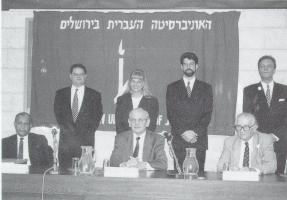
Figure 3. The Court and Finalists of the Manfred Lachs Space Law
Moot Court Competition, Jerusalem, Israel
The number of teams participating has increased from two in 1993 to five in 1995. In 1993, the European Team from the University of Leiden won the competition against George Washington University. In 1994, the team from the University of Chicago won against an excellent European Team from the University of Helsinki. Teams from the Universities of Barcelona, Helsinki, Jaen, Leiden and Paris I will compete for the 1995 Finals, which will be held in Oslo, Norway, in October 1995.
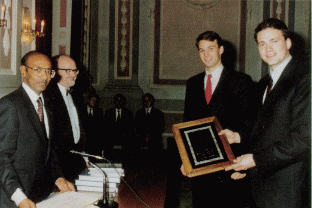
Figure 4. Team from the University of Leiden, Winners of the Finals
of the Manfred Lachs Space Law Moot Court Competition, Graz, Austria
ECSL has paid attention to fulfilling, in as balanced a manner as possible, the needs of all its Members, practitioners in particular. As in the context of academic activities, ECSL has aimed at developing activities which do not duplicate existing conferences or fora and specifically respond to unfulfilled need of European practitioners. Such efforts have been made in three main areas.
The Practitioners' Forum
Practitioners often find it difficult to attend conferences because
they lack time, and also because many conferences focus on issues which
are not directly relevant to their practice. However, practitioners expressed
the need for a short conference allowing them to adequately update their
knowledge of recent developments in space law and related fields of law.
ECSL therefore set up a steering committee with a view to establishing
such a forum, which was inaugurated in November 1993, when the Practitioners'
Forum first met.
The Practitioners' Forum is a yearly one-day meeting. It always takes place in Paris, at ESA Headquarters, in November so as to be a regular gathering which may be entered in the diary well in advance. It is organised by the steering committee, composed mostly of practitioners. The basic structure of the Practitioners' Forum is the following. The meeting is divided into two main parts: the morning session is devoted to a general update on various aspects of the law of space activities, and the afternoon session places emphasis on one subject or one area in particular. The subjects are chosen by the steering committee on the basis of their information on recent important developments, but also suggestions made by practitioners during the year or at Practitioners' Forum itself. This Forum is specifically tailored for practitioners and does not aim to give detailed presentations on each subject, but rather to address them in a concise and professional way. Speakers are specialists on the subjects they address, and currently working in the field concerned. The Forum is mostly devoted to European issues. However, because of the international character of space activities, and of related legal issues, some place has been given to non-European issues. The Second and Third Practitioners' Fora each welcomed an American lawyer, providing his European colleagues with an update on developments taking place on the other side of the Atlantic.
Besides its content in terms of updating knowledge, the Practitioners' Forum is also an opportunity for Practitioners to meet during the Forum or at the cocktail organised afterwards and, very often, to make new contacts. ECSL prints a list of Forum participants, which may be used as a directory by those wishing to contact one another.
The fee payable for participation in the Practitioners' Forum is reduced for ECSL Members.
1993
1994
Cooperation among editors
As part of its catalyst function, ECSL took the initiative of encouraging
increased cooperation among European editors. A meeting organised in June
1993 was attended by nine European editors (Revue française de Droit
aérien et spatial, Space Policy, Chronique des Activités spatiales, Zeitschrift
für Luft und Weltraumrecht, Martinus Nijhoff Publishers, Il Diritto Aereo,
Kluwer Law and Taxation Publishers, ECSL News, Revue de I'Association suisse
de Droit aérien et spatial). This meeting was organised as a preliminary
step, possibly leading to the establishment of a specialised forum for
space law editors. A number of actions were undertaken as a result of this
meeting, which were mainly aimed at improving the exchange of information
among editors themselves but also between editors and ECSL. Exchanges of
views took place on a number of issues (duplication of effort, exchange
of articles and translation in various languages, advertising and exchange
of journals). The role of ECSL in such cooperation was also discussed.
It seems that among publishers, this meeting has had the effect of strengthening
their relations and the exchange of information among them. ECSL also
took steps to implement the suggestions of participants in the meeting.
Firstly, ECSL has published a special issue of ECSL News on 'Space
Law Editing and Publishing in Europe', which contains a description, by
each publisher or editor, of its activities, and provides the reader with
a list of recent publications in European Journals. Such a list will be
published on a yearly basis. Secondly, ECSL News regularly publishes
a column entitled 'Recent Publications', which gives European publishers,
editors and authors, the opportunity to bring their publications to the
attention of ECSL News readers.
The role of ECSL in this field has always been understood as that of a catalyst, and no specific action is intended beyond this. ECSL will propose a second meeting of editors and publishers in the coming months in the same spirit as the first, which means mainly to provide them with an opportunity to meet and, possibly, inform ECSL of any specific support which could be offered to them at European level.
ECSL Research
In his foreword to the first ECSL Biennial Report, the ESA Director
General stated: '"May I wish the Centre a dynamic future, which
I am sure will see ECSL not only studying space law, but helping to make
it. " Taking advantage of its link with ESA, and as such of being
part of the space law community, at European and even international level,
ECSL has followed this approach and studied topics for which the legal
framework was not yet developed and where the law-making process was only
in its initial phases. ECSL has understood its role mainly as that of an
initiator. Once the basic research is done and the law-making process is
en route, the idea is that the appropriate law-making body takes over the
subject and, with the active support of ECSL, undertakes the formulation
of the appropriate legal framework.
The first research subject dealt with the legal protection of remote-sensing data. Research was done in ECSL itself, with the support of ESA and external specialists. A number of workshops and meetings were organised. This research led to the preparation of a recommendation, forwarded by ESA to the European Commission, as to the wording of an EC Directive on databases, which could thereby have its scope enlarged to cover remote-sensing data. Efficient working relations between ECSL and the EU (DGXII, DG XIII and DGIII) for the joint steering of the research project have been established.

The second research subject dealt with intellectual property rights and space activities and was carried out by ECSL with the support of ESA experts. The research started on the specific case of the space station, especially since the partners have different approaches to intellectual property rights. A first workshop was organised on this subject, at which ECSL received a recommendation to continue its efforts and enlarge the scope of its research, with a view to examining the potential need for harmonisation in this field. This second part of the study was carried out in close consultation with the World Intellectual Property Organisation (WIPO), which actively participated in the international conference organised in December 1994 to compare the attitudes of representatives of patent offices or industry in different countries to harmonisation of the rules in this field. At the time of writing, it is expected that WIPO will take over this subject as part of its programme. Interest has also been demonstrated on the side of the European Commission. The proceedings of the first workshop and the international conference have been published by ESA (ESA SP-378).
The second research topic is coming to an end for ECSL and three subjects remain to be studied on the basis of those identified by the General Meeting in 1991:
In view of the forthcoming start of the assembly of the International Space Station, and the increase in cooperative missions flying European astronauts, the ECSL Board has envisaged the possibility of putting the emphasis for the forthcoming research, on the status of astronauts, where the current status of astronauts will be studied in the framework of the various relevant fields of law, with a view to elaborating guidelines for the legal framework needed in this respect.


 ECSL Biennial Report 1993-1994 (BR-104).