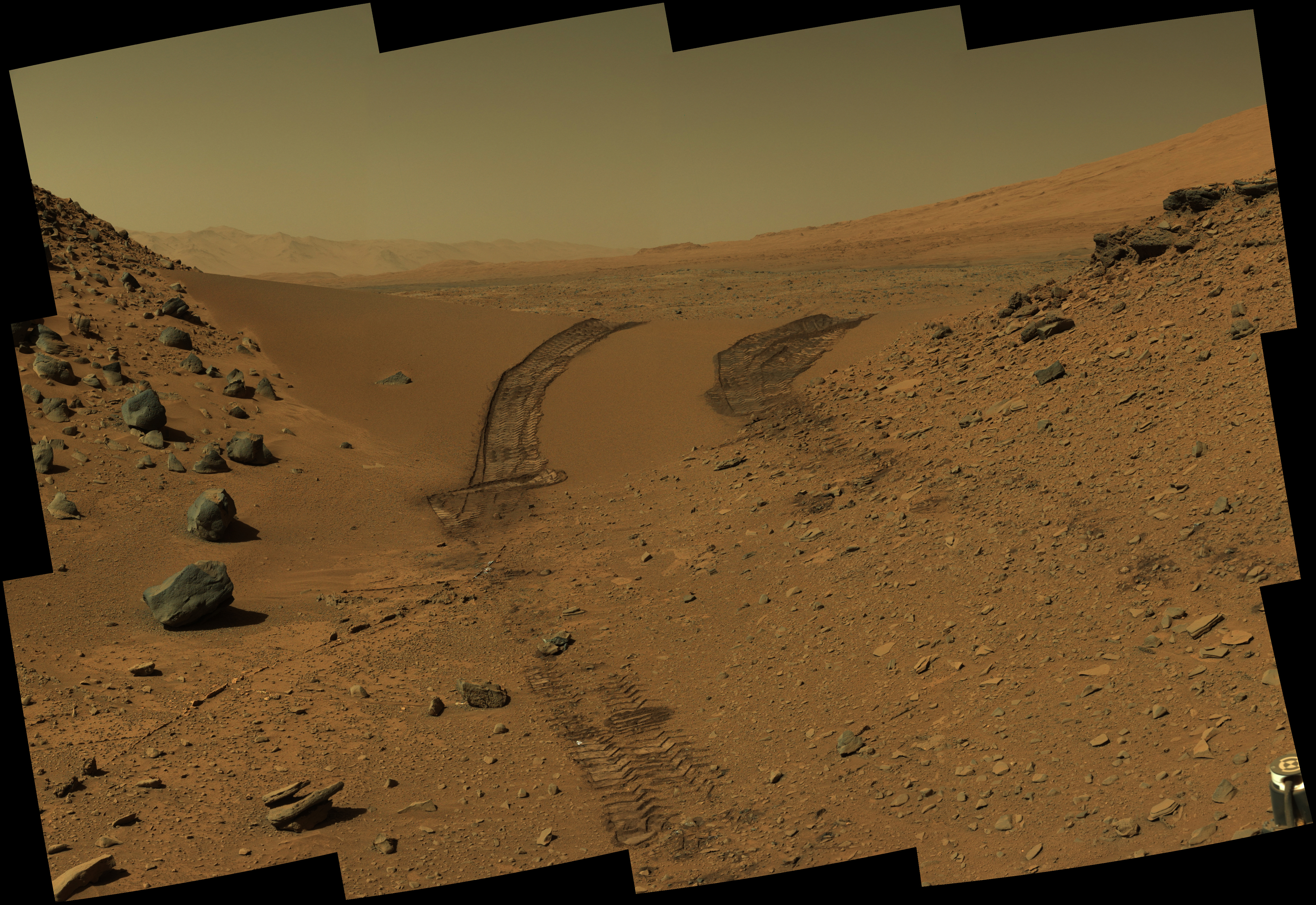
This produces an image that approximates how your eye would see this scene if you were sitting on the spacecraft with a pair of (very strong!) binoculars. Because CaSSIS doesn’t have the same red, green, and blue filters as a smartphone camera and is sensitive to infrared light invisible to humans, the shade of red is slightly different from what you would see with your eyes, appearing more orange. Next to this image is the same scene in the NPB product. Although you can see small colour difference in the pseudo-RGB product, the NPB product really brings out the diversity of this surface.
The whole approach is designed to bring out the colour diversity on the surface of Mars to the maximum extent possible. This processing accentuates the fact that Mars is much more diverse than we had imagined. This naturally yields incredibly pleasing images that can be enjoyed by non-experts. Scientifically, it has a very important purpose. It allows scientists to observe changes across the surface at high spatial resolution, to identify geological units more clearly, and to better understand the stratigraphy (and therefore the geological history) of key areas on Mars. This information is crucial in understanding the evolution of Mars.