Moons and rings
All of the planets travel around the Sun in a counter-clockwise direction – as seen from above Earth’s north pole. Their year - the time they take to complete one orbit - varies with their distance from the Sun. A year on Mercury lasts for just 88 Earth days, so someone born there would have four times as many birthdays as we do on Earth. In contrast, a year on Pluto is equal to 248 of our years. Someone born on Pluto would never celebrate a birthday!
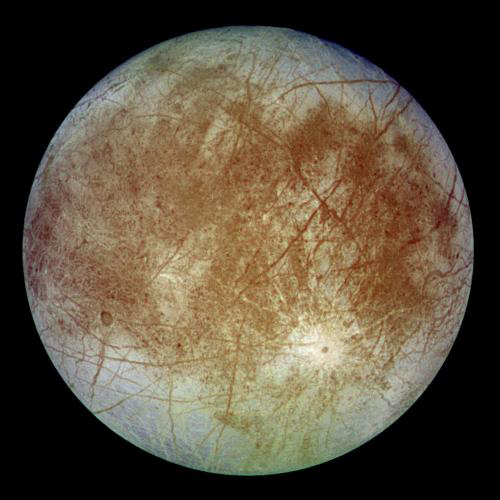
Venus and Mercury have no natural satellites, but the other seven planets all have moons going around them. The total number so far recorded is 138. Most of the moons are very small and difficult to see, even with big telescopes. At present, the record holder is Jupiter, with 63 known satellites. These include four planet-sized moons – Ganymede (the largest satellite in the Solar System), Callisto, Europa and Io.
The strong gravity of the other gas giants has also gathered large numbers of followers: Saturn has 31, Uranus 27 and Neptune 13. Both the Earth and Pluto are orbited by one large moon.
The four largest planets - Jupiter, Saturn, Uranus and Neptune -also have rings. They are made of pieces of ice and rock ranging from in size from mountains to cigarette smoke. The rings may be left-overs from a moon that broke apart, or pieces that have been chipped off nearby moons.
Last modified 21 February 2007