Meet the teams: WETSUS
Three teams of university students were selected to develop and perform their hypergravity experiments during ESA's 'Spin Your Thesis!' 2012 campaign. Here is an introduction to the Dutch team.


A Floating Water Bridge in Hypergravity Conditions
| Institute | Wetsus Centre of Excellence for Sustainable Water Technology |
| Endorsing professors |
Jakob Woisetschläger Graz University of Technology Elmar Fuchs Wetsus Centre of Excellence for Sustainable Water Technology |
| Assistant scientist |
Adam Wexler Wetsus Centre of Excellence for Sustainable Water Technology |
| ELGRA mentor |
David Brutin Polytech Marseille |
| Team | Mathias Eisenhut, Andrea Zsohar, Tjesse Overdijk |

The Wetsus team is composed of a Master’s student and two Bachelor’s students from Graz University of Technology in Austria, Budapest University of Technology in Hungary and Hanze University of Applied Sciences in the Netherlands. This diverse team was brought together by the Wetsus Centre of Excellence for Sustainable Water Technology. They investigated the behaviour of a high-voltage water bridge in hypergravity.
When high voltage is applied to adjacent water filled beakers, a connection spontaneously happens, forming what appears to be a floating water bridge between the two containers. This remarkable phenomenon, discovered in 1893, has become the topic of recent investigations that may change our general understanding of water as a liquid.
The dynamic balance of the bridge is dictated by a delicate interplay of three different forces: surface forces, the electric field, and gravitational forces. When any one of these three forces dominates, the bridge ruptures. Current theoretical models of the water bridge phenomenon assume that the bridge is static. Actually, the floating water bridge is a dynamic system with an active flow and a complex internal structure. As a result, current theory is unable to make accurate predictions about the interplay of the forces.
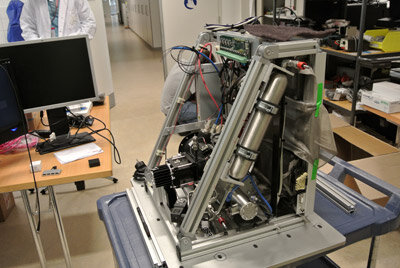
While conducting a series of parabolic flights to examine the behaviour of the floating water bridge in microgravity, the team noticed that it was unexpectedly resilient during the hypergravity periods up to 3g. This new experiment allowed the team to further investigate the behaviour of the water bridge in hypergravity, as well as macroscopically confirm their recent observations of elevated intermolecular forces at a microscopic level.
The experimental apparatus featured two adjacent containers filled with pure water and an induced electrical potential of up to 25 kV across them. The team varied the distance between the two containers with a linear motor. Gravity levels between 1 and 12 g were studied. After a water bridge had been formed, a high-speed digital video camera will captured footage of its behaviour. Particular attention was given to the conditions under which the water bridge ruptured. Auxiliary sensors measured the temperature, dielectric response and density of the water, as well as the exact gravitational acceleration at the level of the experiment.
Read the final experiment report here.