• → European Space Agency

      • Space for Europe
      • Space News
      • Space in Images
      • Space in Videos
    • About Us

      • Welcome to ESA
      • DG's News and Views
      • For Member State Delegations
      • Business with ESA
      • ESA Exhibitions
      • ESA Publications
      • Careers at ESA
    • Our Activities

      • Space News
      • Observing the Earth
      • Human Spaceflight
      • Launchers
      • Navigation
      • Space Science
      • Space Engineering
      • Operations
      • Technology
      • Telecommunications & Integrated Applications
    • For Public

    • For Media

      • Media
      • ESA TV
      • Videos for professionals
      • Photos
    • For Educators

    • For Kids

    • ESA

    • Education

    • Teachers' Corner

    • ESA Kids

    • About ESA Education
    • Education programme
    • International collaboration
    • Projects for Teachers
    • European Space Education Resource Office
    • CanSats
    • Hands-on Projects
    • CubeSats
    • Drop Your Thesis!
    • European Student Earth Orbiter
    • European Student Moon Orbiter
    • Fly Your Thesis!
    • Global Educational Network for Satellite Operations
    • Spin Your Thesis!
    • Previous projects
    • Hands-on Collaboration
    • REXUS/BEXUS rocket & balloon experiments
    • GENSO Experimental Orbital Initial Demonstration
    • Previous projects
    • Opportunities
    • Conferences
    • Courses
    • Gaining experience
    • Affiliation programme
    • Subscribe for news

    ESA > Education

    Transfer of ESA know-how

    Highly qualified and motivated professionals have brought ESA and the space industry where it is today. To maintain this level of performance Europe needs motivated students and young professionals. Education and know-how transfer between the older and the younger generations are vital to ensure a future skilled workforce. To this end ESA has identified a few key areas in which its Education office is making specific efforts to facilitate this transfer of know-how.
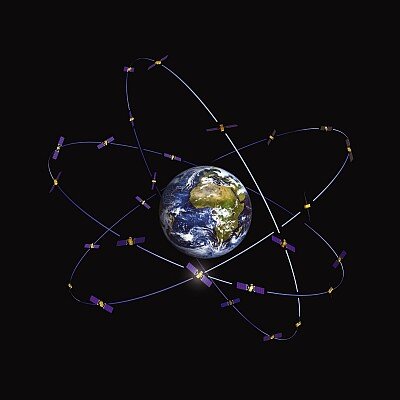
    Global Navigation Satellite Systems (GNSS) is one of the first areas that have been identified. Satellite Navigation has become a keystone for the development of Europe and its citizens. GNSS systems are a component of the global critical information infrastructure enabling broad new market capabilities and facilitating innovation and efficiency in safety, environment, science and public security.

    The European Commission (EC) and the European Space Agency (ESA) have set up two main GNSS projects, the European Geostationary Navigation Overlay System (EGNOS) and Galileo.
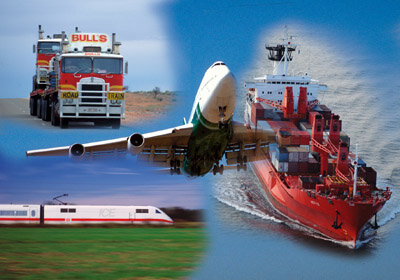

    Applications where GPS are used
    Applications where GPS are used

    Recent studies have revealed that 150,000 jobs in direct, indirect and induced employment will be created in Europe as a result of the Galileo programme. This means that adequate GNSS training and research infrastructures must be in place to supply the emergence of these knowledge-based future GNSS workers in the timescale of the Galileo programme.

    Educational initiatives are being set up to provide educational partners with necessary means to enhance and promote the study and understanding on GNSS systems and applications. ESA, in its role of design agent for EGNOS and Galileo, wishes to share its expertise and knowledge in GNSS with selected European educational partners.
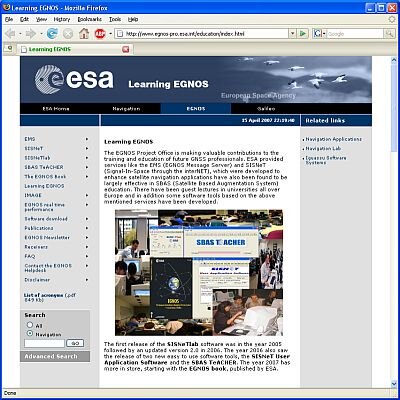
    Screenshot: Learning EGNOS website
    Learning EGNOS website

    As a first initiative a dedicated ESA GNSS Education Workshop was organised facilitating the exchange of information among European universities and is a first step in the creation of a European GNSS University Network.
    e-Learning and other educational materials on the EGNOS program can already be found on a dedicated ESA Learning EGNOS website.

    In July 2009 the ESA International Summer School on Global Navigation Satellite Systems will be held at the Institute of Geodesy and Navigation of the University FAF Munich in cooperation with Stanford University (USA) and Institute Superieur de l`Aeronautique et de l`Espace (France). By supporting this summer school, ESA aims to provide students with a comprehensive overview on the design and development of satellite navigation systems as well as its applications.

    Rate this

    Views

    Share

    • Currently 0 out of 5 Stars.
    • 1
    • 2
    • 3
    • 4
    • 5
    Rating: 0/5 (0 votes cast)

    Thank you for rating!

    You have already rated this page, you can only rate it once!

    Your rating has been changed, thanks for rating!

    41
    Tweet
    • More information
      • Transfer of ESA know-how
      • Applications for ESA Summer School on GNSS 2011
      • ESA Summer School on GNSS 2010
      • ESA Summer School on GNSS 2009
      • EGNOS
        EGNOS
        EGNOS
      • Galileo
      • Satellite navigation
      • Related links
      • GNSS summer school
      • Learning EGNOS

    Connect with us

    • RSS
    • Youtube
    • Twitter
    • Flickr
    • G+
    • Facebook
    • Livestream
    • Subscribe
    • App Store
    • LATEST ARTICLES
    • · Rare merger reveals secrets of gal…
    • · Watching for hazards: ESA opens as…
    • · ESA astronaut Timothy Peake set fo…
    • · Space drives e-mobility
    • · Proba-V opens its eyes
    • FAQ

    • Jobs at ESA

    • Site Map

    • Contacts

    • Terms and conditions
