Space meets medicine at MEDICA 2005
To the general public, the term ‘space research’ still conjures up an image of a remote discipline: extremely complex procedures that only Nobel Laureates can grasp. People consider it something too far removed from reality to have a practical use on Earth. ESA proved the opposite by presenting successful business solutions in the medical field that derive from space research at the Medica trade show 2005, the world’s most important health and medical trade fair.
ESA hosted an international pool of specialist companies at its booth: French space medical institute MEDES, the DLR German Space Centre, ESA’s Commercial Agent ISS Lab Ruhr, European Molecular Biology Laboratory (EMBLEM), and the Russian Institute for Biomedical Problems (IMBP).
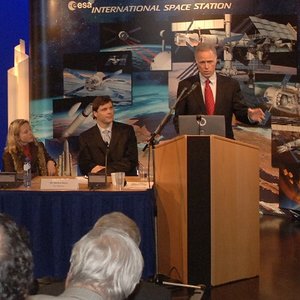
At the booth, ESA attracted the specialist audience by showing examples of how cooperation by medical and biomedical firms with ESA can lead to innovative results. “Most of the visitors did not think that space could have a solution for their specific business branch up its sleeve,” explains Frank M. Salzgeber, Head of Commercial Development of ESA’s Commercial Promotion Office, the initiator of the joint booth. “But we convinced them it could. From medical technology to rehabilitation: space touches almost every medical business sector and holds opportunities for cooperative solutions.”
Rehabilitation methods from outer space
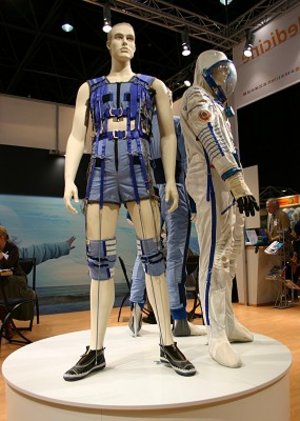
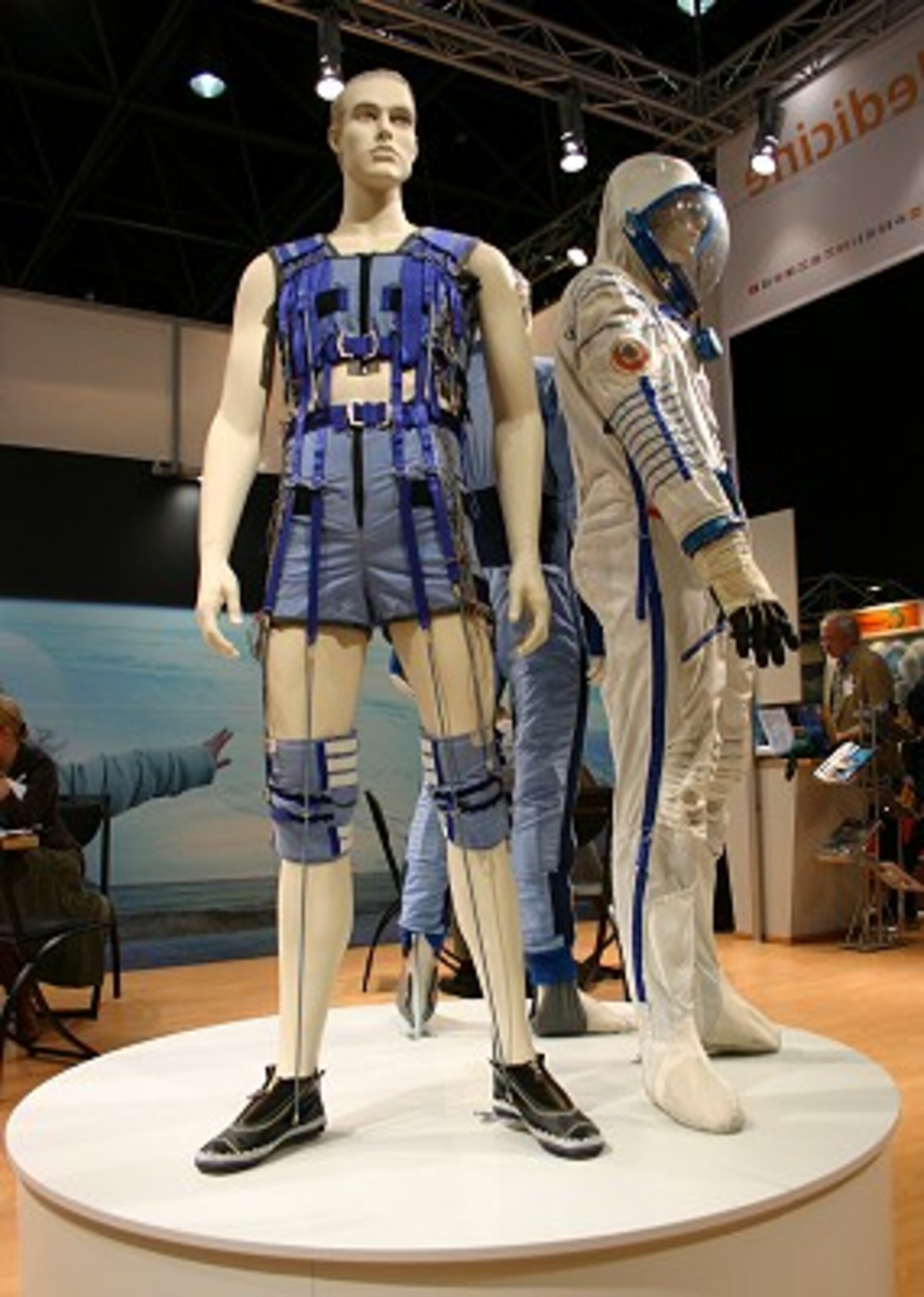
An eye-catcher at the ESA booth was undoubtedly the ‘Regent’ Rehabilitation Suit provided by the IMBP. Visually a mix between sports-shorts and climbing harness, Regent is a highly efficient medical device to treat neuro-muscular malfunctions of the body that occur after strokes and in illnesses such as epilepsy and Parkinson’s Disease.
Regent is the direct descendent of the ‘Penguin’ bodyloading suit that Russian cosmonauts wore aboard the Salyut and Mir space stations from the 1970s to the 1990s. The suit has elastic bands and pulleys that create artificial forces against which the body works to help prevent the bone and muscle loss that occurs in long-term weightlessness.
Killing germs with space technology
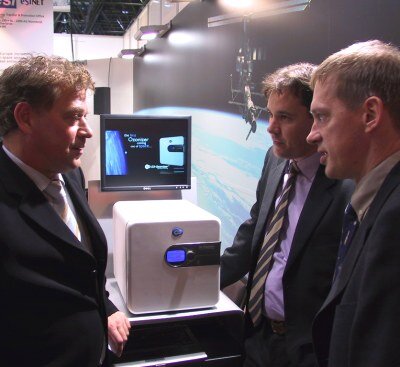
Another tangible example of a successful spin-off of space technology that attracted a high number of experts to the ESA booth was the Ozonizer developed by Bradford Instruments B.V. Bradford Instruments is a startup company that was fostered by ESA’s own business incubation programme ‘ESI’, an initiative of ESA’s Technology Transfer and Promotion Office.
After benefiting from the business incubation’s nurturing help, Bradford Instrument is now successfully teamed with a marketing partner, MDCL, as the joint venture DutchOzone B.V. Resembling a mini-fridge, the Ozonizer is a sterilisation apparatus for medical and dental instruments. The standard sterilisation method used in laboratories, hospitals and doctor’s practices is to employ pressurised steam. In order for the medical instruments to be sterilised, they have to be heated up to temperatures up to 134°C and be exposed to steam at a pressure of 2 bar.
To ensure sterility, the instruments have to be wrapped in a special, steam-permeable packaging. The Ozonizer simplifies this procedure: it uses highly reactive ozone gas to kill germs. The advantage is that the sterilisation can be performed at room temperature in a very short time, which reduces wear. Another advantage is that, after 20 minutes, the ozone vanishes – it decays into pure oxygen without leaving any moisture behind. This also makes it possible to sterilise heat- and moisture-sensitive equipment.
Bradford Engineering developed the technology of ozone-sterilisation for an ESA research facility aboard the ISS: the Microgravity Glovebox (MSG). A hermetically sealed incubator, the MSG hosts experiments in material science, biotechnology, fluid science, combustion science and crystal growth research that have to be conducted in a close and protected environment. In order to avoid cross-contamination, the glovebox must be sterilised between the experiment runs.
As the heat-driven sterilisation used on Earth is out of the question for technical reasons, Bradford Engineers turned to ozone to eliminate germs. The Ozonizer might be the first device to earn the ‘Space Solutions’ trademark, an ESA initiative decorating successful spin-offs from space technology. “Business solutions are rarely achieved single-handedly”, Salzgeber points out.
This is why ESA is looking for partners to foster their businesses through Research & Development and technology demonstrations by using the International Space Station. The objective of ESA is to aim at more commercial cooperation with private companies to bring the expertise of space and industry together to turn scientific solutions into tangible business ideas.