• → European Space Agency

      • Space for Europe
      • Space News
      • Space in Images
      • Space in Videos
    • About Us

      • Welcome to ESA
      • DG's News and Views
      • For Member State Delegations
      • Business with ESA
      • ESA Exhibitions
      • ESA Publications
      • Careers at ESA
    • Our Activities

      • Space News
      • Observing the Earth
      • Human Spaceflight
      • Launchers
      • Navigation
      • Space Science
      • Space Engineering
      • Operations
      • Technology
      • Telecommunications & Integrated Applications
    • For Public

    • For Media

    • For Educators

    • For Kids

    • ESA

    • Delta Mission

    • Human Spaceflight

    • Astronauts

    • International Space Station

    • DELTA Mission
    • About the mission
    • Why DELTA?
    • Mission facts
    • Behind the scenes
    • Soyuz spacecraft
    • Soyuz launcher
    • Factsheets (pdf)
    • Science programme
    • Experiment overview
    • Physiology
    • Biology
    • Microbiology
    • Physical science
    • Earth observation
    • Technology
    • Education
    • Meet the crew
    • André Kuipers
    • Gennadi Padalka
    • Mike Fincke
    • Expedition Eight
    • DELTA Mission live
    • Live webstreaming
    • ESA Television
    • Mission briefings
    • Multimedia
    • Image gallery
    • DELTA: Video gallery
    • Soyuz training with Frank De Winne
    • Soyuz mission: to ISS and back
    • Services
    • Mailing list

    ESA > Our Activities > Human Spaceflight > Delta Mission

    Plants need light to grow in space

    Seeds in Space
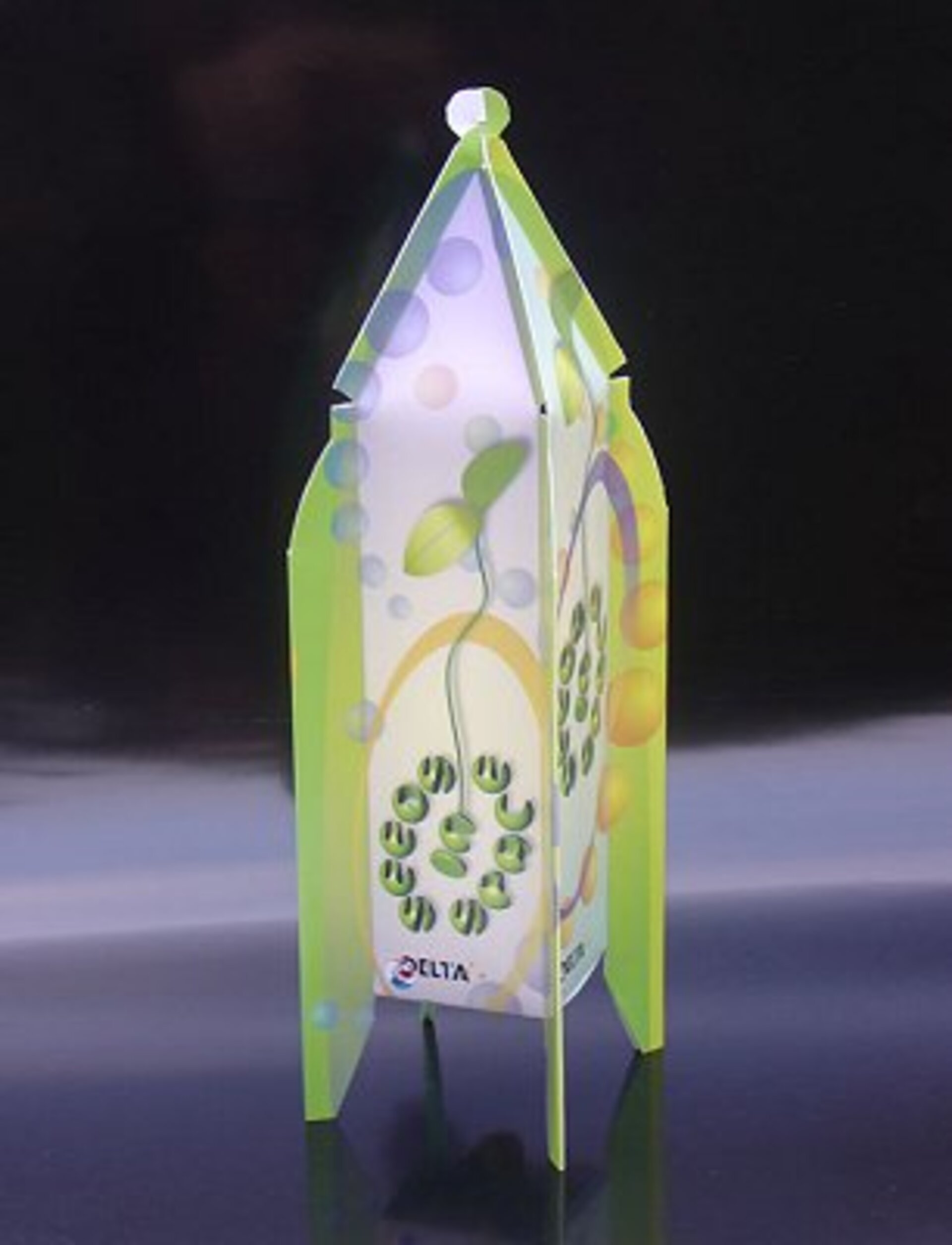
    The 'Seeds in Space' rocket
    27 April 2004

    Do plants grow towards the light, or away from gravity? And what exactly happens in space? The DELTA Mission experiment 'Seeds in Space', in which 70 000 schoolchildren are taking part, aims to answer these questions. These questions were answered yesterday, with a bit of help from ESA astronaut André Kuipers.

    Space News

    Ahead of a special 'Space News' bulletin in which Kuipers would show how his experiment went, the children had already opened their own 'growing rocket'. Inside the rocket were two chambers, one with light and one without. The seeds in the dark chamber had grown taller, but were yellow in colour. In the light chamber, the seedlings although shorter, were a healthier green colour, with wider stems.

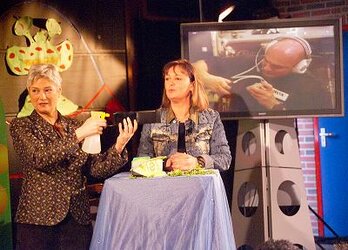
    The children at 'De Klaverweide' a junior school in Noordwijk, The Netherlands, where the experiment was started last week by Dutch minister for Education, Culture and Science, Maria van der Hoeven, concluded that on Earth it didn't matter whether the plants had light or not, they still grew upwards.

    Space
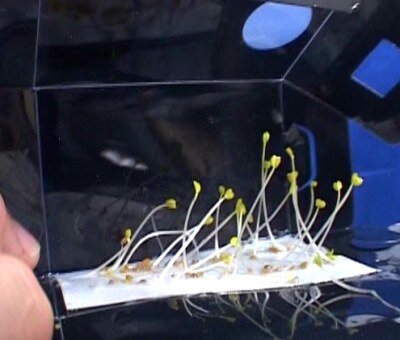
    Seeds light box - space
    Seedling growth in space in the light chamber

    The children speculated about the colour and shape of the seedlings that had grown in space. Maybe they hadn't grown at all, or they might have grown in circles, or perhaps there wouldn't be any difference to those grown on Earth.

    Kuipers opened his 'growing rocket' during a live video downlink from the International Space Station. "The plants in the dark chamber have grown in all directions. Upside down, left, right; they are all over the place." In space the seedlings in the light chamber had grown larger and were greener, and they had all grown towards the same direction – towards the light.


    Research

    Seeds dark box
    Seedling growth on Earth in the dark chamber

    The conclusion of Seeds: light or gravity help plants to know in which direction to grow. In the absence of both, the plants get confused. The result of the Seeds experiment shows the schoolchildren how scientific research is done, but also contributes to space travel in the future. If astronauts are to go on longer space missions in the future, say to the Moon, or even to Mars, they will know the best way to grow their food. According to Seeds in Space, they should be sure to take enough light bulbs along for the journey.

    Seeds in Space was organised by Space Research Organization Netherlands (SRON) and is financed by the Dutch Ministry for Education, Culture and Science.
    Rate this

    Views

    Share

    • Currently 0 out of 5 Stars.
    • 1
    • 2
    • 3
    • 4
    • 5
    Rating: 0/5 (0 votes cast)

    Thank you for rating!

    You have already rated this page, you can only rate it once!

    Your rating has been changed, thanks for rating!

    183
    Tweet
    • Related articles
      • Seeds in Space experiment gets underway
        • Over sixty thousand children help André Kuipers with "Seeds in Space"
        • Related links
        • Seeds in Space
          • Delta Mission

    Connect with us

    • RSS
    • Youtube
    • Twitter
    • Flickr
    • G+
    • Facebook
    • Livestream
    • Subscribe
    • App Store
    • LATEST ARTICLES
    • · ESA astronaut Timothy Peake set fo…
    • · Space drives e-mobility
    • · Proba-V opens its eyes
    • · First new Galileo satellite arrive…
    • · Next destination: space
    • FAQ

    • Jobs at ESA

    • Site Map

    • Contacts

    • Terms and conditions