Mission accomplished
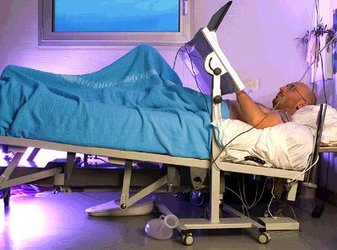
After three months, the expedition is over: its 14 crew members have at last set foot on planet Earth again. They never really left it of course: they were all volunteers for the long-term bedrest experiment conducted by ESA, CNES and NASDA at the MEDES space clinic near Toulouse.
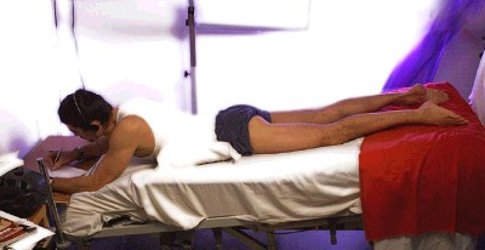
All have just completed a tour of duty of 90 days lying down, their heads tilted 6 degrees below their feet - an unnatural position that goes a long way to simulating some of the effects of weightlessness on the human body. Closely monitored by MEDES clinical staff, the volunteers have been simulating a long-duration space mission.
We spoke to two of them. Frank, a young sports enthusiast and Gilbert, a married man with three children, were both glad their ordeal was over - but they would not have missed it for the world.
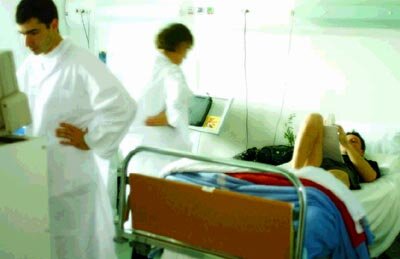
"I would do it again if I had the chance," said Frank. "The hardest part for me was not being able to make real use of my own body but I think it was well worthwhile. Of course, our morale was always high. We were a select group of volunteers and we knew we were contributing to space research and to medical research here on Earth - what has been learned also has applications for patients who have to spend a long time bedridden."
Did he ever think of calling the whole thing off, aborting the mission? "Never, the whole thing was a challenge for all of us I think and it was fascinating to see how your body adapted."
Gilbert agreed, "at the end of the experiment I felt really free. I am standing again and in a few days I'll be home with my wife and children".
What did they think of the experiment? "Well, it was an experiment - and an experience for my wife, too, to spend three, four months with the children on her own. My children are quite proud of their father, I think, and of course they're glad I'll be home for Christmas."
"When I saw the advertisement for volunteers, I knew I had to try for it. Simulating a long space mission was a challenge all right. Standing up for the first time a few days ago symbolized landing. It was quite something after three months lying down to rediscover the vertical, the sense of weight."

For both Frank and Gilbert the experience has been an enriching one. "You're part of something important," said Gilbert, "and 90 days lying down gives you a chance to discover things about yourself, too."
During the three months of the bedrest mission, no visitors - neither family, friends or curious journalists - were allowed to visit the volunteers. "We were not isolated though, we all had a telephone, an Internet connection and of course the TV," said Frank. Gilbert adds "We had excellent communications with the outside world. Also there were two of us in each room and we often met together. After all we were a group of 14. We discussed things with each other - and with the MEDES psychologists."
So what were the toughest moments? "The first few weeks," said Frank. "I suffered from dizziness, vertigo, muscle aches and back pains but the medical support staff were superb."
"It's adaptation," said Gilbert. "That first month, when your whole organism is adapting to a new environment was hard, like seasickness if you like, but you're determined to see it through."
Now, all the volunteers have to re-adapt. "Dizziness, vertigo and muscle pains again," said Frank, "but the medical team here is really excellent, and we know we can count on their support over the next few months."
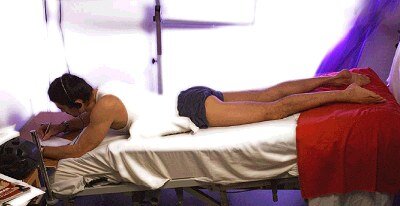
Both men hope to be back at work in January, although it will be three to six months before their bodies have completely readjusted to normal, vertical living. Over the next two years MEDES will keep a careful eye on them all.
A second volunteer team is due to start another 90-day bed mission next Spring. Have Frank and Gilbert any advice for the newcomers?
"You have to know what you're letting yourself in for," said Frank. Not surprisingly, Gilbert was in full agreement. "You have to be motivated," he said, "you have to want to do it."
Would they do it again? "Of course", said Frank, "absolutely" agreed Gilbert.