• → European Space Agency

      • Space for Europe
      • Space News
      • Space in Images
      • Space in Videos
    • About Us

      • Welcome to ESA
      • DG's News and Views
      • For Member State Delegations
      • Business with ESA
      • ESA Exhibitions
      • ESA Publications
      • Careers at ESA
    • Our Activities

      • Space News
      • Observing the Earth
      • Human Spaceflight
      • Launchers
      • Navigation
      • Space Science
      • Space Engineering
      • Operations
      • Technology
      • Telecommunications & Integrated Applications
    • For Public

    • For Media

    • For Educators

    • For Kids

    • ESA

    • Human Spaceflight and Exploration

    • Space Shuttle

    • 50 years of humans in space

    • ESA History

    • The Space Shuttle
    • Space Shuttle timeline
    • Space Shuttle fleet
    • Space Shuttle missions
    • Shuttle technical facts
    • Spacelab
    • Tribute to the Space Shuttle
    • A remarkable flying machine
    • Europe’s involvement: Spacelab
    • From Spacelab to Columbus
    • Birth of an international spirit
    • A veritable work horse
    • After the Shuttle
    • European astronauts about the Shuttle
    • Jean-François Clervoy
    • Christer Fuglesang
    • Ulf Merbold
    • Ernst Messerschmid
    • Claude Nicollier
    • Thomas Reiter
    • Gerhard Thiele
    • Michel Tognini
    • Roberto Vittori
    • Ulrich Walter
    • Other European Shuttle astronauts
    • Downloads
    • Thirty Years of Partnership: The Shuttle, the ISS and Europe (pdf)
    • Spacelab (pdf)
    • Multimedia
    • Europe and The Space Shuttle
    • ESA Online videos
    • ESA Multimedia gallery
    • Further reading
    • More reading about the Space Shuttle

    ESA > Our Activities > Human Spaceflight > Space Shuttle

    Europe’s involvement: Spacelab

    Europe’s involvement in Space Shuttle activities dates back to 1969, when NASA invited ESRO, ESA’s predecessor organisation, to participate in its Post-Apollo Programme.

    NASA had reached the Moon, with Apollo proving that the boldest goals could be achieved. However, to conduct post-Apollo programmes within reasonable budget limits, a new vehicle was needed to carry astronauts and cargo into space, without throwing away hundreds of million dollars per flight. This was the rationale to develop the first reusable launch system in 1972: the Space Transportation System (STS) – otherwise known as the ‘Space Shuttle’.

    Europe, then represented by ELDO (European Launcher Development Organisation) and ESRO (European Space Research Organisation), the precursors of today’s ESA, was invited to take part in early studies in 1969. ELDO developed a concept for a reusable space tug to ferry cargo from low to geostationary orbits and beyond, but NASA eventually turned to US expendable ‘kick stages’ for this role.

    Heading towards human spaceflight

    Signature of the Spacelab Memorandum

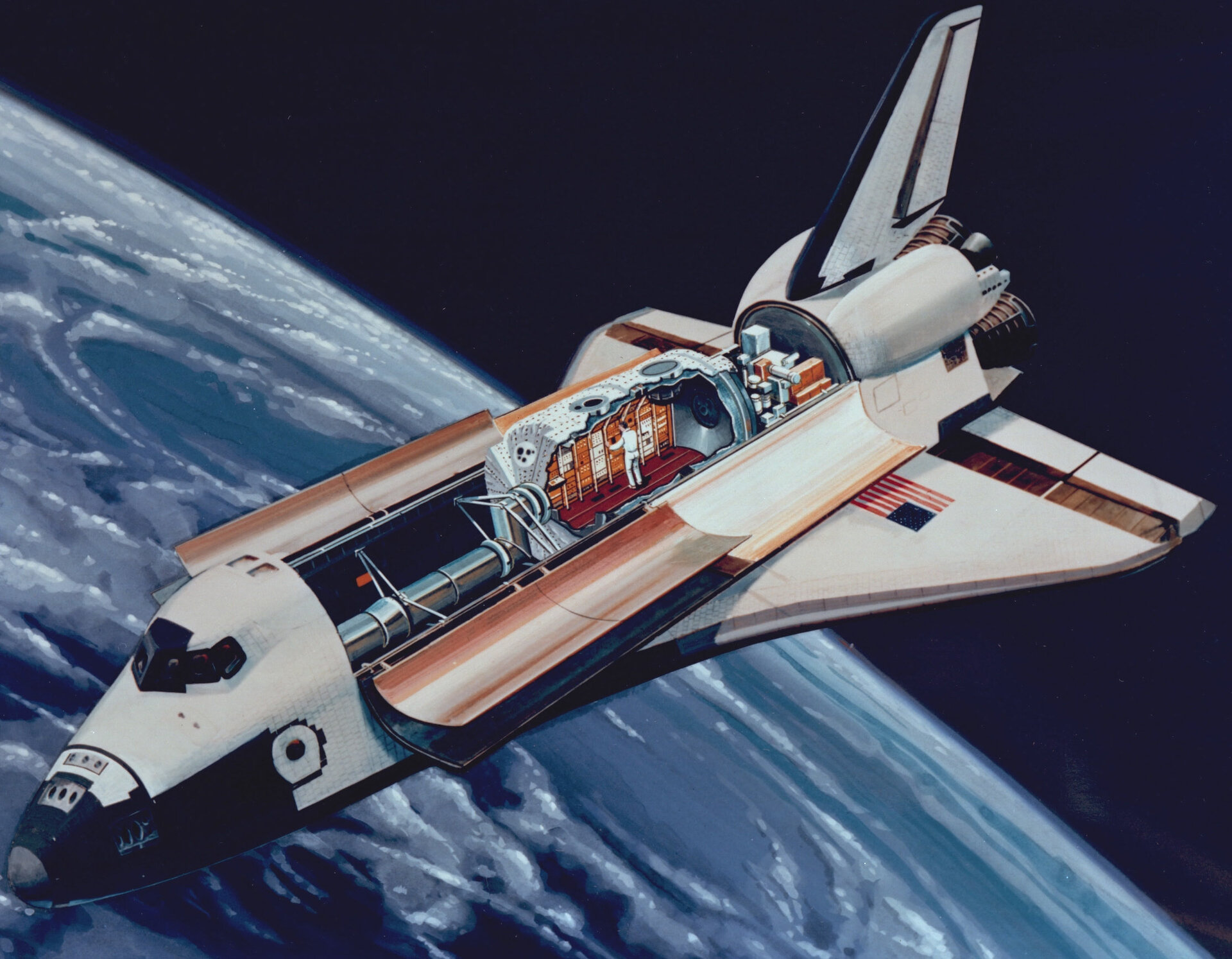
    ESRO focused its efforts on a ‘Sortie Module’ to be flown in the Shuttle’s cargo bay. The laboratory’s original ‘freeflying’ mode was later abandoned, and so it became ‘Spacelab’. In December 1972, Europe opted to develop 'Spacelab' as an integral element of the US Space Transportation System in which scientific missions of up to nine days could be conducted. The Spacelab programme was approved in July 1973, during the European Space Conference in Brussels.

    At this important meeting, European ministers agreed on the Ariane programme and the inception of the European Space Agency (ESA). The signing of the Memorandum of Understanding between Europe and NASA for the implementation of Spacelab took place on 24 September 1973. Europe was heading towards human spaceflight.

    Unlike Skylab, the first US space station, which had been built mostly from existing Apollo hardware, Spacelab was a new construction offering a much wider range of applications.


    Building Spacelab
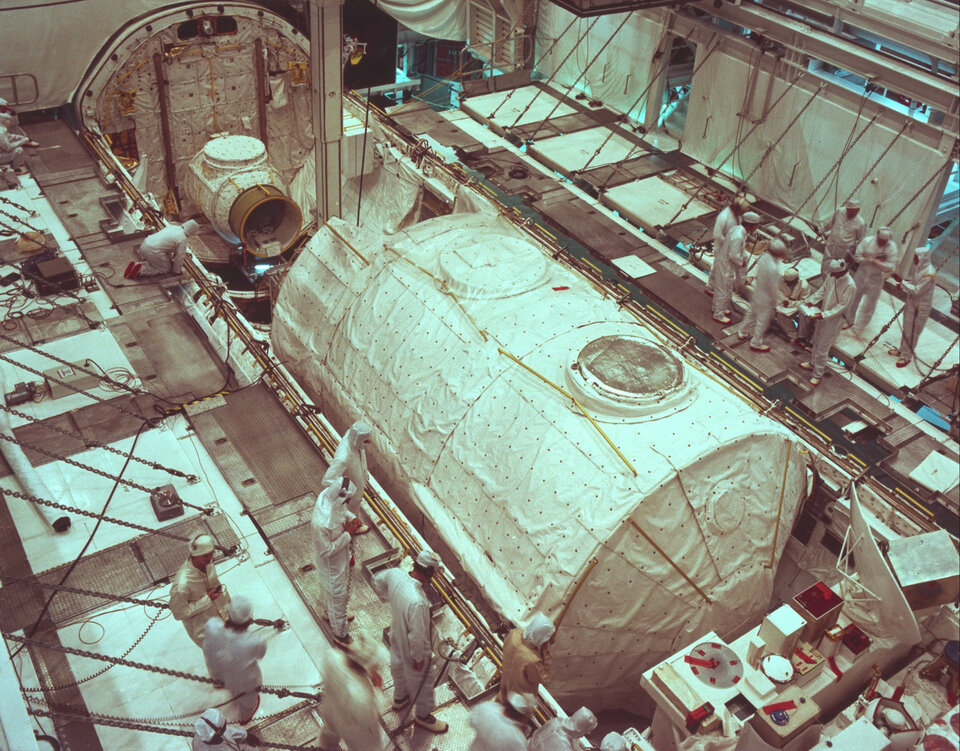
    Spacelab 1 preparations

    In June 1974, ESA selected an industrial consortium led by MBB-Erno (now EADS Astrium) to develop the modular elements making up Spacelab: a pressurised laboratory, a gimballed instrument pointing system and cargo bay pallets.

    At that time, the Shuttle was planned to fly up to once a week and about a hundred Spacelab missions were anticipated through the 1990s. This number significantly decreased as the Shuttle began flying. Spacelab pallets were flown as early as the second Shuttle mission, in November 1981. The first ESA-sponsored mission, Spacelab-1, followed two years later.

    Spacelab 1 in orbit

    Under a barter agreement, a first set of Spacelab modules was handed over to NASA, which also bought a second set later. In total, 22 Spacelab missions were flown by the time the programme ended in 1998, representing some 244 days on orbit. Most included a significant ESA science/payload contribution and two dedicated missions were sponsored by the German Aerospace Center, DLR.

    The Spacelab laboratory module was even flown in 1995 on a milestone international mission: the first Shuttle docking with Russia’s Mir space station.

    Continue reading

    Rate this

    Views

    Share

    • Currently 0 out of 5 Stars.
    • 1
    • 2
    • 3
    • 4
    • 5
    Rating: 0/5 (0 votes cast)

    Thank you for rating!

    You have already rated this page, you can only rate it once!

    Your rating has been changed, thanks for rating!

    22
    facebook
    twitter
    reddit
    google plus
    digg
    tumbler
    digg
    blogger
    myspace
    • A video to the Space Shuttle from the European astronauts
    • Tribute to the
      Space Shuttle
    • Human Spaceflight
      Human Spaceflight
      Human Spaceflight
    • History of Europe in Space
    • Space Shuttle logo
      Space Shuttle logo
      NASA: Space Shuttle
    • Space Shuttle Era
    • The Space Shuttle Interactive
    • The Space Shuttle in Pictures
    • NASA Shuttle missions
    • Space Shuttle Reference Manual (NASA)
    • Spacelab (NASA)

    Connect with us

    • RSS
    • Youtube
    • Twitter
    • Flickr
    • Google Buzz
    • Subscribe
    • App Store
    • LATEST ARTICLES
    • · CryoSat hits land
    • · Ariane 5 completes seven launches …
    • · Measuring skull pressure without t…
    • · Malargüe station inauguration
    • · The solar wind is swirly
    • FAQ

    • Jobs at ESA

    • Site Map

    • Contacts

    • Terms and conditions
