Main stage propulsion
This page reflected ESA’s future space transportation policy in 2011 but is not updated. It is kept for historical purposes.
One of the key subsystems that necessary for Europe's next-generation launcher was its main engine.
One objective of ESA's Future Launchers Preparatory Programme, FLPP, was to enable an informed decision to be taken later in the next-generation launcher programme.
FLPP main stage propulsion activities prepare the tools and technologies that are used to design and develop propulsion systems for main-stage concepts.
- Design and trade-off studies of propulsion systems and integrated demonstrators
- Accompanying technologies in the different fields, such as turbo-pumps and thrust chambers
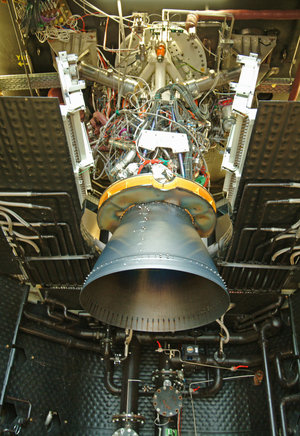
The main stage demonstrator, a High-Thrust Engine (HTE), allows for the understanding of key technological issues, while developing European competence in propulsion system integration and advanced technologies. It also provides the means for industry to keep pace with the competitive market.
The results of this integrated demonstration helped in making the strategic decisions on the initial design and configuration of the main stage engine, limiting the risk of future running costs.
Interaction with launcher system studies
Engine system studies are conducted in close interaction with vehicle system studies in order to establish the engine components and sub-system requirements according to the vehicle architectures.
Engine system studies comprise screening, assessment and trade-off studies of engine thermodynamic cycles and propellant couples, architectures, operational parameters, expected performance and engine mass.
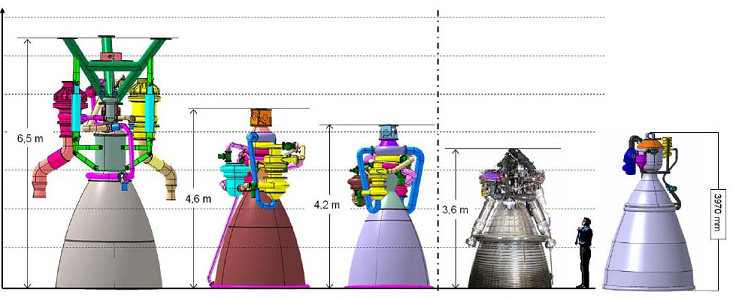
This phasing with the vehicle system study allowed the down-selection of the propellant combination and propulsion system architectures with the highest performance.
HTE integrated demonstrator system studies

Liquid propulsion is a promising candidate for main stage propulsion because of its flexibility, growth potential and proven record.
The configuration of the Staged Combustion Rocket Engine Demonstrator (SCORE-D) was the result of launcher and propulsion system analysis and tradeoffs aiming at covering, within a limited budget, the maximum number of critical enabling technologies and identifying the competences that are needed.
Two propellant combinations were down-selected for future demonstration: liquid oxygen/hydrogen and liquid oxygen/methane propellants with staged-combustion cycle engines.
SCORE-D underwent the Preliminary Requirement Review was preparing its System Requirement Review for the first half of 2011.
The demonstrator’s subsystems were progressively validated and integrated along two axes:
- The combustion axis integrates progressively the main combustion chamber, the preburner, the igniters, the nozzle completed with a radiative skirt, valves and health monitoring and control systems.
- The turbo-machinery axis progressively integrates the preburner prototype, fuel turbo-pumps, the oxygen turbo-pump and possibly health monitoring and control systems.
Main stage propulsion technology maturation
An early start of technology activities, even before system studies were completed, was possible because many critical technologies are generic and common to most engine configurations.
Combustion technologies
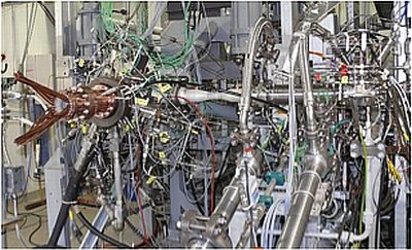
The first set of Thrust Chamber Assembly (TCA) technology maturation activities by means of hot firing tests started in 2006 and focused on the staged combustion injection technology as well as the combustion chamber heat flux characterisation for the two propellant combinations.
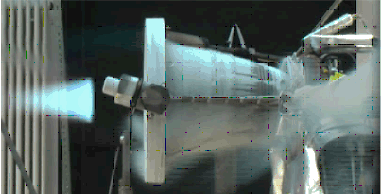
Two test campaigns were performed with this design featuring liquid oxygen and hydrogen, and liquid oxygen and methane propellants. In total, 26 successful hot firing tests were performed and established European ‘firsts’ in terms of achieved combustion chamber pressure levels.
In 2010, the Staged Combustion Engine Nozzle Extension (SCENE) was successfully tested in hot firing test campaign. The next steps include the design and manufacturing of an enlarged subscale hot gas generating device and injector head featuring the HTE demonstrator.
TCA technology maturation continued with the integration of various subsystems and components into SCORE-D and hot firing tests with the preburner.
Turbo-machinery technologies
In the same approach, liquid oxygen turbo-pump propulsion maturation activities were focused on: Dynamic Seal Package (DSP), split pump and axial balancing system in order to avoid unacceptable axial loads onto the spool bearings.
Experience and knowhow gained through the Vulcain and Vinci engine programmes have shown that DSP solutions for SCORE-D’s oxygen turbo-pumps demand innovative designs, which must rely on SCORE-D's performance requirements in terms of high pressure and temperature.
Increasing the technology readiness of an innovative DSP in view of a suitable TPO design of the demonstrator is being looked into. Even the ambitious objective to reduce helium consumption to zero was considered, which would require a new seal concept and performance.