Propulsion activities
This page reflected ESA’s future space transportation policy in 2021 but is not updated. It is kept for historical purposes.
Propulsion is important for maintaining and widening our gateway to space. It takes extreme speed to reach orbit and precisely controlled thrust firing to get a mission where it needs to be. Without propulsion technology, nothing goes anywhere.
New challenges are emerging with the need to cope with lower launch prices worldwide while simultaneously maintaining the high reliability European launch vehicles are known for.
ESA's Future Space Transportation programme identifies the enabling critical launch system technologies to tackle these challenges and offers solutions via maturation of the technology readiness level for future propulsion systems. Key technologies are designed at both component and subsystem level prior to being integrated into propulsion demonstrator engines and tested in a relevant environment.
This approach has specific benefits:
- Offers a pool of options and upgrades for quick spin-offs applicable to existing launchers.
- Performs high added-value research and development.
- Safeguards propulsion system integration and technology competencies in Europe.
Upper stage engine technologies

After the Vinci engine development was transferred to the Ariane 5 ME development programme, the Expander-cycle Technology Integrated Demonstrator (ETID) began mid-2013.
It is a major constituent of the FLPP programme and prepares competitive evolutions of upper stage propulsion for Ariane 6 and Vega by assembling technologies that pave the way for the next generation of cryogenic upper stage engines in Europe.
ETID addresses the following requirements:
- High Isp
- Low cost
- Low mass
- High versatility
- Easy integration and control

This engine demonstrator combines several new technologies. Among them is an optimised combustion chamber design for maximum lifetime and heat pick-up which simultaneously avoids water condensation.
In addition, the engine aims for reduced production times and low cost and makes use of Additive Manufacturing (3D-printing) for the injector head, valve casings and parts of the turbo pumps.
The ignition can be realised via either a spark or novel laser igniter.
Nozzle and engine lines are designed for lower weight making use of a sandwich nozzle with radiative nozzle skirt as well as novel materials.

The valves are electrically actuated and the engine controller is able to conduct automated check-outs and closed-loop operation point control.
At least three different test configurations of ETiD will be hot-fired. The first full-scale demonstrator of the thrust chamber was tested at the DLR German Aerospace Center test facility in Lampoldshausen, Germany, in June 2018.
Storable propulsion
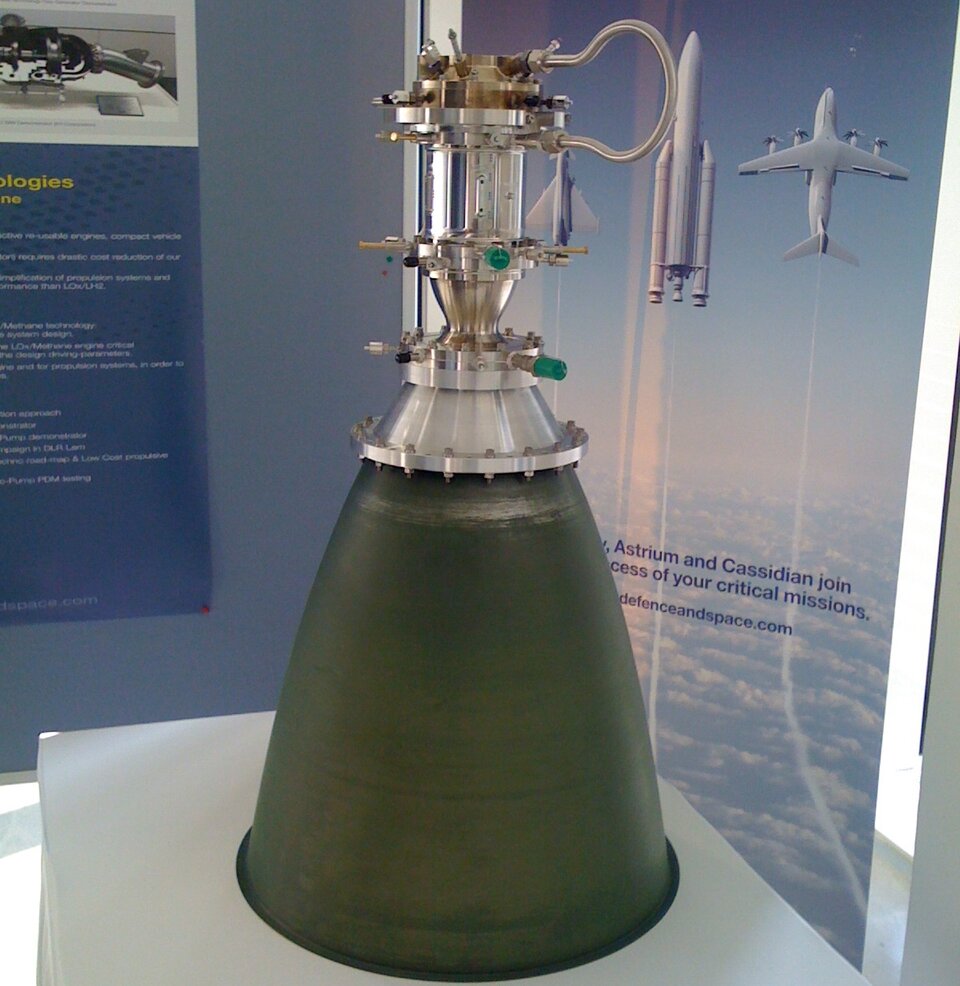
The Storable Propulsion Technology Demonstrator helps develop technologies for a rocket engine in the thrust range between 3–8 kN. The technology developed in this project can be used in upper stages of small launchers or applications with similar thrust requirements like exploration missions or lander engines.
The demonstrator uses novel cooling-, injector- and damping technologies. In two test campaigns, first in 2014 and then in 2015, it performed both ground level as well as vacuum ignitions. Steady state behaviour was tested in a large range of operating points and for durations of up to 110 seconds. In addition, combustion stability and thrust chamber length variations were tested.
Future developments will investigate options to adapt the engine for the combustion of storable green propellants which are more environmentally friendly and drastically reduce the necessary safety precautions for propellant handling.
Hybrid propulsion

Hybrid propulsion offers a cheap and performing solution to power future operational space transportation systems. It combines the benefits of solid and liquid propulsion.
Initiated in 2010 the Unitary Motor (UM) propulsion demonstrator was developed within ESA’s Future Launchers Preparatory Programme.
Following several small scale tests the first large scale hot fire test was successfully achieved in 2014. A final static firing in July 2018 proved the motor for its suborbital launch.
On 27 September 2018, the motor powered the Nucleus demonstrator, a single stage sounding rocket developed around the engine for in-flight testing. Nucleus, launched from the Andøya Space Center, reached an altitude of 115 km in less than 3 minutes, deployed 6 payloads, and then splashed down in the Atlantic Ocean.
The hybrid engine combines liquid hydrogen peroxide with solid HTPB fuel and reaches a thrust level of 30 kN, an equivalent of 40 kN in vacuum. For greater performance, single motors can be clustered while using a common oxidiser supply. A future version of the motor is planned to have an increased thrust of 75–100 kN, harnessing advanced turbopump technology.
This is an important step towards using hybrid propulsion on orbital rockets, such as microlaunchers.
Solid propulsion

Efforts concerning solid propulsion focus on the development of technologies for future motor casings (within the Systems and Technologies section of FLPP) and the investigation of the physics of solid rocket motors, especially pressure oscillations via integrated demonstrators.
The “Pressure Oscillation Demonstrator eXperimental” (POD-X) is an experimental platform dedicated to the investigation of combustion physics and was test fired in cooperation with CNES in 2014, yielding valuable information into solid propulsion combustion processes.
Methane engine
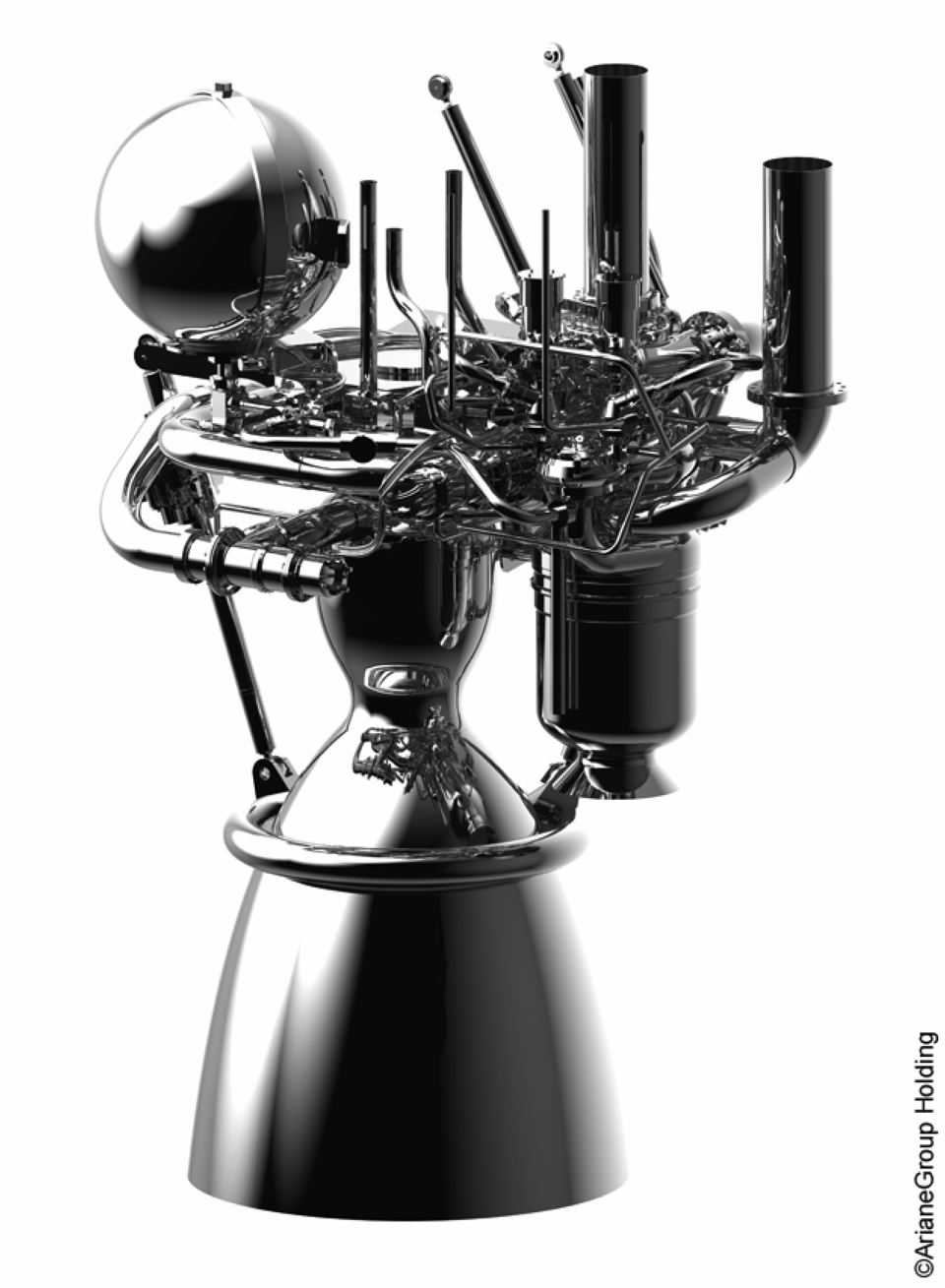
Methane is a candidate for the propellant of the future. Combining high efficiency with operational simplicity while at the same time being environmentally friendly and widely available, it offers unique perspectives as a low cost engine design for first and second stage applications.
Compared to kerosene, methane causes no combustion residuals within the rocket combustion chamber and turbo machinery which makes it a perfect candidate for a reusable booster engine.
Prometheus is being developed by ESA and ArianeGroup. It is an ultra-low cost reusable rocket engine demonstrator which uses liquid oxygen–methane propellants and has a thrust of 1000 kN.
Anticipating the future…
Further project proposals include a reusability demonstrator for the next generation launch vehicle that will aim at maturing the relevant technologies for the reuse of first stages or respective sub-systems and thus lowering launch costs in the future.
Moreover, a kick-stage demonstrator could address the need for increased versatility regarding mission profiles. Potential applications are payload injections into multiple orbits, GTO-GEO transfer manoeuvres, as well as satellite servicing and debris deorbit applications. Electrically powered, pump-fed engines are an interesting technology to be considered in this context.
Another interest lies in the creation of a dedicated micro launcher to inject small payloads into custom orbits. This field will be addressed via feasibility studies. At the same time, multiple developments by private industry are currently taking place in Europe offering the long-term potential for spin-in solutions.