• → European Space Agency

      • Space for Europe
      • Space News
      • Space in Images
      • Space in Videos
    • About Us

      • Welcome to ESA
      • DG's News and Views
      • For Member State Delegations
      • Business with ESA
      • ESA Exhibitions
      • ESA Publications
      • Careers at ESA
    • Our Activities

      • Space News
      • Observing the Earth
      • Human Spaceflight
      • Launchers
      • Navigation
      • Space Science
      • Space Engineering
      • Operations
      • Technology
      • Telecommunications & Integrated Applications
    • For Public

    • For Media

    • For Educators

    • For Kids

    • ESA

    • Navigation

    • EGNOS

    • Galileo

    • Evolution

    • About satellite navigation
    • Europe's satellite navigation services
    • Resources
    • Development Facilities
    • Navipedia
    • Multimedia
    • Galileo's In-Orbit Validation phase - 2012 video
    • Galileo - Europe leads the way 3D video
    • Image gallery
    • Video gallery
    • Documents
    • Galileo factsheet (PDF)
    • Galileo IOV factsheet (PDF)
    • Galileo FOC factsheet (PDF)
    • GNSS Evolution factsheet (PDF)
    • Galileo IOV brochure (PDF)
    • Galileo IOV brochures in French and German (PDF)
    • Archives
    • News archive
    • Navigation projects
    • Services
    • Subscribe

    ESA > Our Activities > Navigation

    Safer air traffic with EGNOS

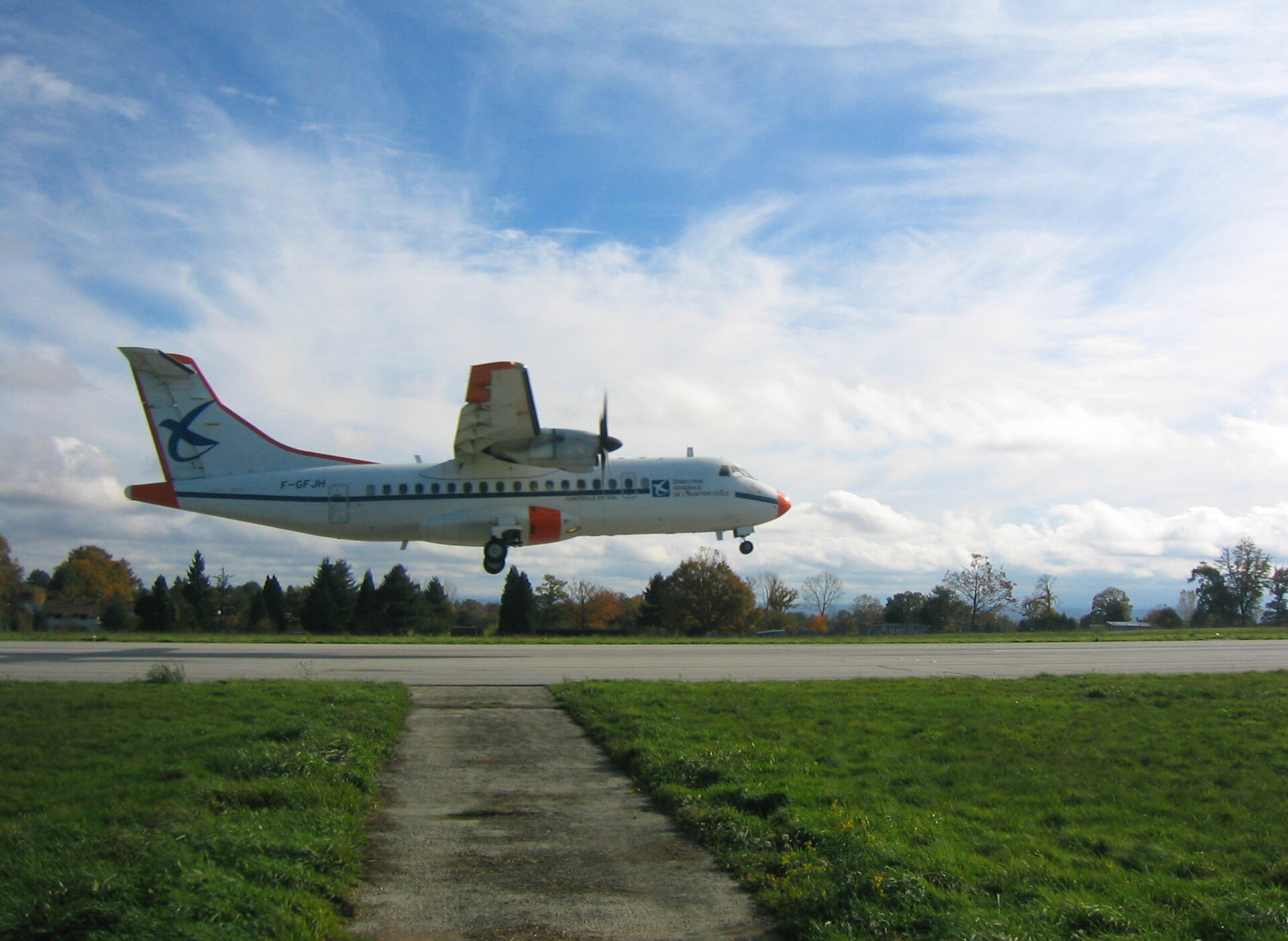
    DGAC ATR42 test aircraft
    20 April 2007

    Vertical guidance by means of signals from the sky: this is what EGNOS, the first European satellite navigation service, will offer pilots during approach and landing.

    Flight trials are regularly conducted to demonstrate the new possibilities offered by the European Geostationary Navigation Overlay Service (EGNOS), which has been launched by ESA, the European Commission and Eurocontrol.
     
    A few weeks ago, the Direction Générale de l'Aviation Civile (DGAC – French Civil Aviation Authority) test plane was specially equipped to make tests using EGNOS. At Limoges airport the ATR42 made a number of approaches and landings using the new procedures, in each case aligning itself with the runway's axis and then following a descent path to touchdown.
     
    Inside the plane, normally used for calibration of airport systems in France, the method of analysing the quality of the EGNOS signals was by comparing the landing phases guided by satellite with landings using traditional means such as the Instrument Landing System (ILS).

    View from control tower at Limoges
    View from control tower at Limoges

    The results of Limoges trials show again that EGNOS signals allow approaches and landings that meet the safety standards that govern international air traffic.
     
    One of the main advantages of EGNOS in this application is that it is available everywhere without the need for ground infrastructure and it provides vertical guidance procedures for every runway. Furthermore, the cockpit data display is the same as for ILS, so there are no familiarisation problems for the pilots and no additional training costs.
     
    Currently in pre-operational service, EGNOS will be certified in 2008 for safety-of-life applications such as air traffic control.
     
    This system for improving GPS performance will provide a precision of better than two metres, compared to 15 to 20 metres for GPS alone. In addition, there is a guarantee as to the quality of the signals: if a problem is detected, an alarm will be sent to the pilot.


    Test instrumentation in the DGAC ATR42
    Test instrumentation in the DGAC ATR42

    Systems that are equivalent to EGNOS have been set up in the United States, Japan and India, and these systems are compatible and interoperable. An aircraft with a suitable receiver could operate in any area of these areas – it would always have satellite navigation support available, without changing equipment.
     
    For Europe, EGNOS is also the first step in satellite navigation, paving the way for Galileo, which will be the first civil global system.
     
    For European Civil Aviation Authorities, the long term plan is to combine all the existing navigation systems to ensure greater assistance for pilots and the best possible safety of air traffic in Europe and worldwide.

    Rate this

    Views

    Share

    • Currently 0 out of 5 Stars.
    • 1
    • 2
    • 3
    • 4
    • 5
    Rating: 0/5 (0 votes cast)

    Thank you for rating!

    You have already rated this page, you can only rate it once!

    Your rating has been changed, thanks for rating!

    23
    Tweet
    • EGNOS resources
    • Related news
      • Commercial flight trials for EGNOS
      • About EGNOS
      • What is EGNOS?
        • How does EGNOS work?
          • Who's involved in EGNOS?
          • Related links
          • Flying with EGNOS
          • More images
          • European Commission
          • Eurocontrol
          • European GNSS Agency
          • Direction Générale de l'Aviation Civile (in French)

    Connect with us

    • RSS
    • Youtube
    • Twitter
    • Flickr
    • G+
    • Facebook
    • Livestream
    • Subscribe
    • App Store
    • LATEST ARTICLES
    • · Proba-V opens its eyes
    • · First new Galileo satellite arrive…
    • · Next destination: space
    • · Leak repaired on International Spa…
    • · After Chelyabinsk: European expert…
    • FAQ

    • Jobs at ESA

    • Site Map

    • Contacts

    • Terms and conditions