• → European Space Agency

      • Space for Europe
      • Space News
      • Space in Images
      • Space in Videos
    • About Us

      • Welcome to ESA
      • DG's News and Views
      • For Member State Delegations
      • Business with ESA
      • ESA Exhibitions
      • ESA Publications
      • Careers at ESA
    • Our Activities

      • Space News
      • Observing the Earth
      • Human Spaceflight
      • Launchers
      • Navigation
      • Space Science
      • Space Engineering
      • Operations
      • Technology
      • Telecommunications & Integrated Applications
    • For Public

    • For Media

      • Media
      • ESA TV
      • Videos for professionals
      • Photos
    • For Educators

    • For Kids

    • ESA

    • Observing the Earth

    • Understanding Our Planet

    • Securing Our Environment

    • Benefiting Our Economy

    • About Observing the Earth

      • How does Earth Observation work?
      • How to get Earth observation data
      • Integrating Earth Observation in your job
      • Earth Observation users speak
    • EO programmes
    • The Living Planet
    • GMES
    • ESA's Earth Observing missions
    • Envisat overview
    • ERS overview
    • Earth Explorers overview
    • Sentinels overview
    • MSG overview
    • MetOp overview
    • Proba-1 overview
    • Third Party Missions overview
    • Opportunities with us

      • Education & training
      • International cooperation
      • Milestones & announcements
    • Multimedia

      • Image Gallery
      • Video Gallery
      • Online resources
      • RSS feeds
    • Services
    • Subscribe

    ESA > Our Activities > Observing the Earth

    Water vapour and clouds

    Invisible water vapour - also called humidity - is actually the largest single greenhouse gas. Water vapour also forms an important link between the land and ocean; it is a carrying mechanism that transports energy around the globe and, therefore, a major driver of weather patterns - a fact demonstrated spectacularly by typhoons and hurricanes powered by tropical evaporation.

    However, water vapour concentration varies strongly in space and time across the Earth, as it evaporates up from warm water surfaces and then falls back down again as precipitation. Space-based monitoring is the only effective way to assess water-vapour levels on a global basis and Envisat is especially well equipped for the task.

    MIPAS, SCIAMACHY and GOMOS between them return vertical water vapour concentration profiles between the surface and a 100 km up. MERIS records the total water-vapour column abundance below it, while the MWR gathers data on atmospheric humidity through measuring distortion in microwave signals propagated through the air.

    When water vapour condenses in the atmosphere it forms clouds, another crucial but poorly characterised element of the climate system. Sixty per cent of the Earth’s surface is typically covered by clouds at any one time, which variously exert cooling or warming effects depending on location, the time of day, the seasons and the regional weather.
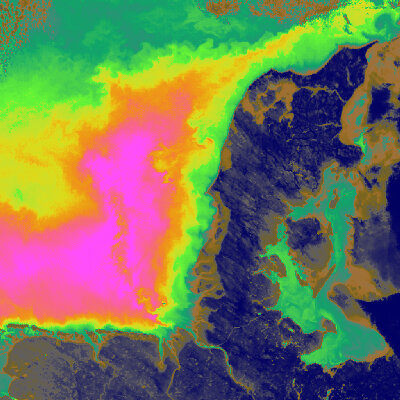
    North Sea, Denmark
    North Sea, Denmark and Nothern Germany

    Bright cloud tops block solar energy from reaching the surface by reflecting it straight back to space, while thick cloud bodies absorb and scatter heat energy radiating out from the Earth’s surface. So if total cloud coverage increases - due perhaps to global warming or increased aerosol loading - would that cool or warm the planet overall? We cannot be sure, yet. Clouds represent something of a blind spot in current climate models.

    Envisat is making good that gap in knowledge, returning detailed characterisations of cloud types and properties. AATSR’s dual-view radiometer design provides stereoscopic images of cloud tops and interior structure. Data acquired by individual AATSR spectral channels gives information on a cloud’s temperature, thickness, particle size and whether it is composed of ice or water particles. Simultaneously, the MERIS optical and near-infrared sensor records cloud type, optical thickness, top-of-cloud radiance, reflectivity, radiance and height.

    These combined observations will improve our knowledge of the role of clouds in global climate and may also improve weather forecasting accuracy in the near-term.

    Last update: 23 September 2004

    Rate this

    Views

    Share

    • Currently 0 out of 5 Stars.
    • 1
    • 2
    • 3
    • 4
    • 5
    Rating: 0/5 (0 votes cast)

    Thank you for rating!

    You have already rated this page, you can only rate it once!

    Your rating has been changed, thanks for rating!

    2
    Tweet
    • Envisat expected results
    • Envisat Expected Results Home Page
      • Oceans
        • Land
        • Atmosphere
          • Climate change
            • Water vapour and clouds
              • Air pollution
                • Ozone hole
                  • Aerosols
                  • Related links
                  • About Envisat
                  • Envisat Project Site
                  • EO Principal Investigator News
                  • Earthnet
                  • Envisat Launch
                  • Envisat multimedia links
                  • 3-D VRM Envisat model
                  • Earth Observation Gallery
                  • Envisat videos
                  • Envisat instruments

    Connect with us

    • RSS
    • Youtube
    • Twitter
    • Flickr
    • G+
    • Facebook
    • Livestream
    • Subscribe
    • App Store
    • LATEST ARTICLES
    • · Banking on satellites in Africa
    • · Earth Explorers take centre stage …
    • · The fast winds of Venus are gettin…
    • · ExoMars 2016 set to complete const…
    • · Herschel ends operations as orbiti…
    • FAQ

    • Jobs at ESA

    • Site Map

    • Contacts

    • Terms and conditions