ATV Jules Verne
Editor's note: This page is no longer being updated, but will be preserved as a record. Click here for the latest information on ATV.
| ROLE | ISS resupply, reboost & demonstration flight |
| LAUNCH DATE | 9 March 2008 |
| LAUNCHER/LOCATION | Ariane 5/Kourou, French Guiana |
| LAUNCH MASS | 10 470 kg (empty) | 20 750 kg (launch mass) |
| ORBIT | Transfer and phasing to dock with ISS |
| NOMINAL MISSION | 6-12 months; ATV Jules Verne mission complete 29 Sep 2008. |
| + First vehicle to conduct fully automated rendezvous with ISS + | |
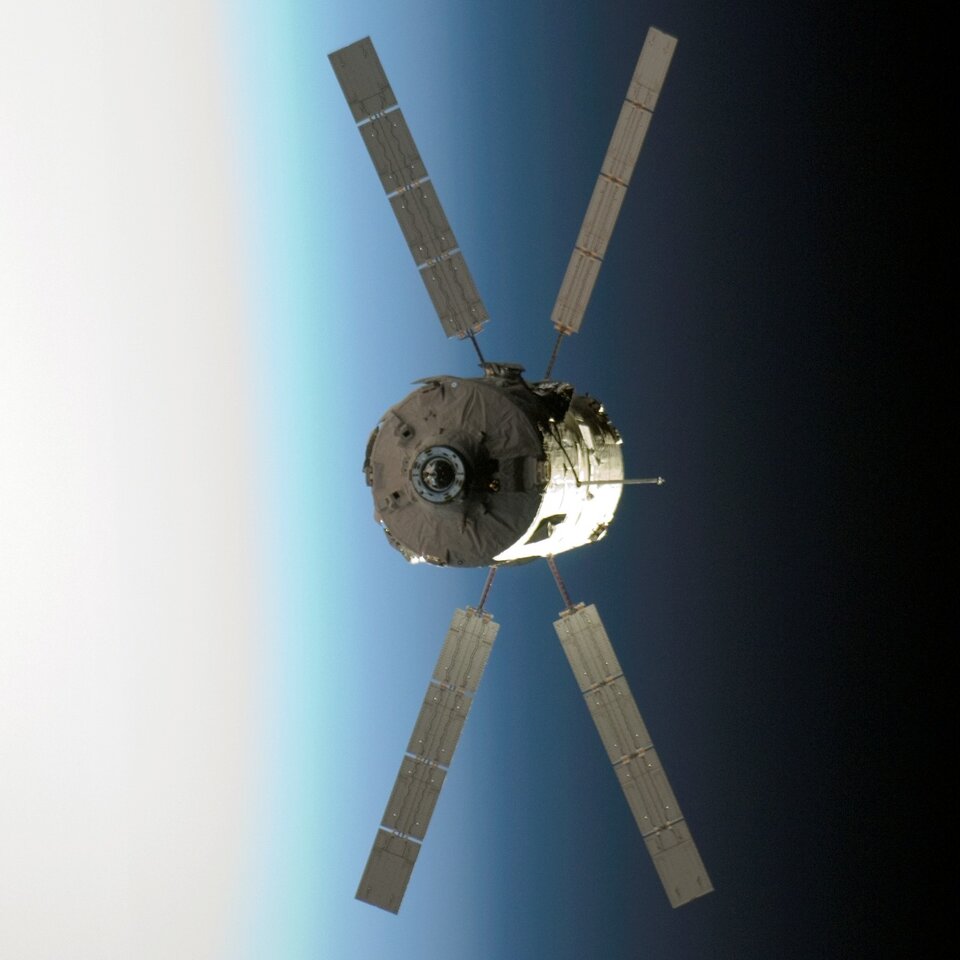
The Automated Transfer Vehicle (ATV) is probably the most complicated spacecraft ever built in Europe, launched and operated by the European Space Agency. The complexity comes from the nature of its mission and the constraints imposed by its destination, the International Space Station (ISS).
The first ATV, dubbed Jules Verne after the famous French author, is designed to carry over seven tonnes of experiments, fuel, water, food and other supplies from Earth to the ISS orbiting at about 350 km. When it arrives, it becomes a 22-cubic-metre extension to the ISS, giving extra space for the six astronauts and cosmonauts who will ultimately form the permanent ISS crew.
Whilst attached, apart from transferring its cargo to the ISS, it also gets loaded up with solid and liquid waste from the station; its thrusters are used to periodically boost the ISS orbit (which decays with time) and it can also be used for emergency manoeuvres, such as those required if a piece of space debris is predicted to hit the station.
After some six months, ATV is undocked from the ISS, and undergoes two carefully planned manoeuvres, which direct it on a trajectory that will cause it to burn up harmlessly in the atmosphere over an uninhabited area of the Pacific ocean. ATV-1, the Jules Verne, completed its mission on 29 September 2008.
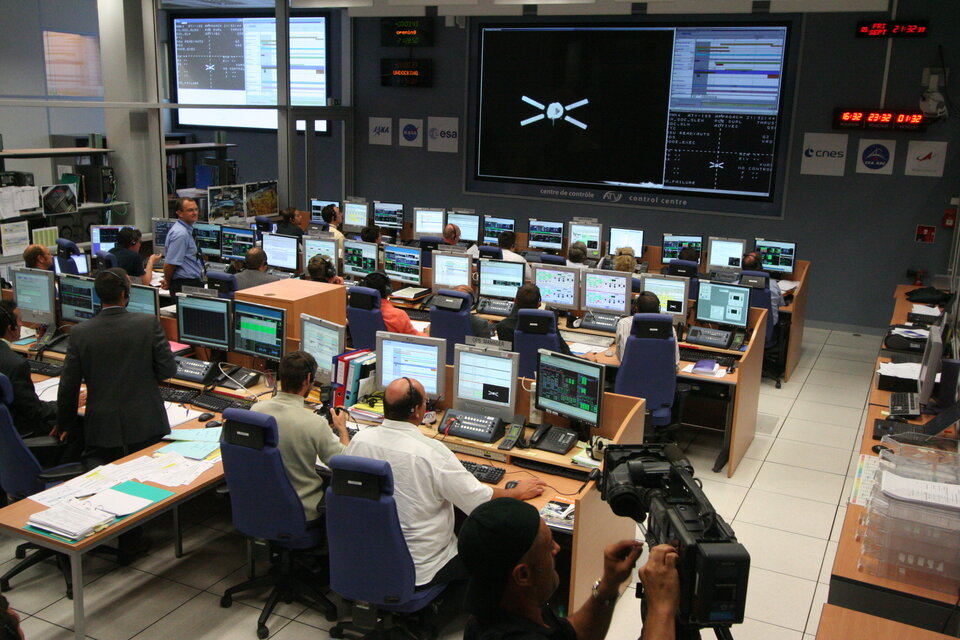
The ATV Control Centre (ATV CC) is located at CNES (the French national space agency) facility in Toulouse, France.
The Mission Operations Team
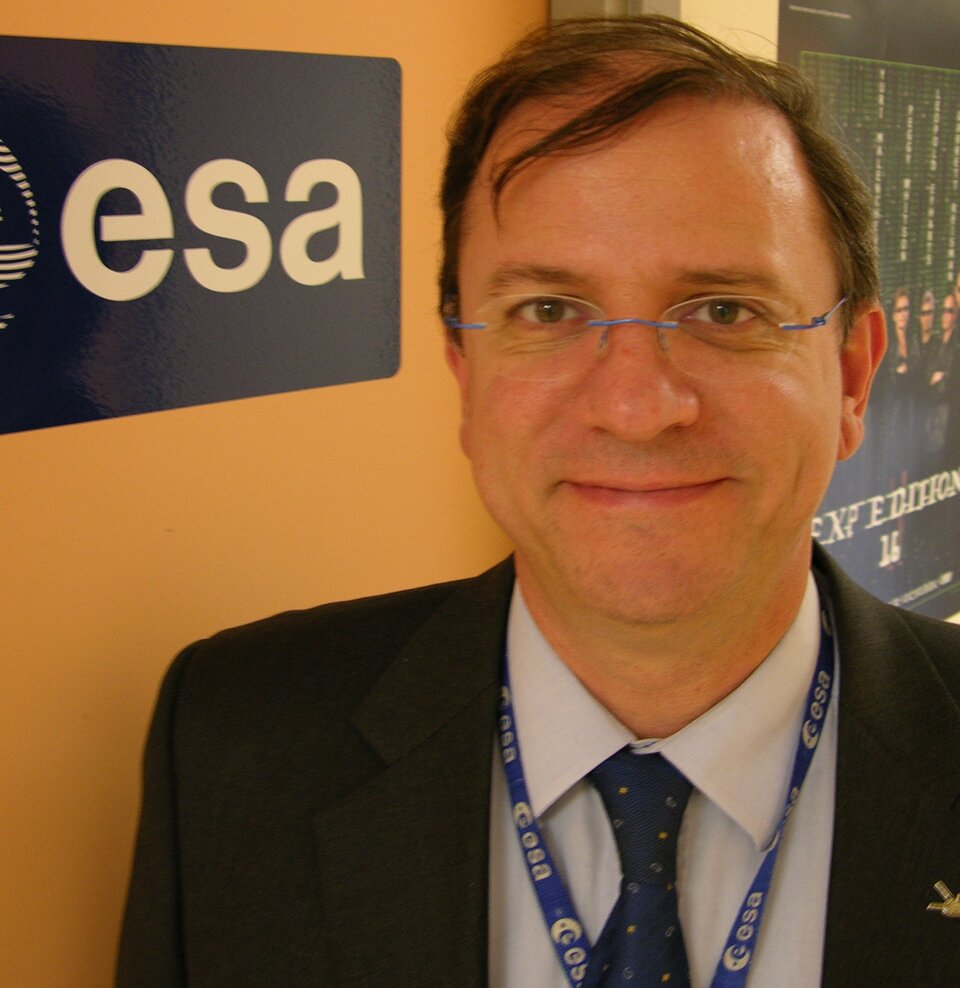
The ATV Mission Operations Team works at the ATV CC in Toulouse and comprises a mixed ESA-CNES (Centre National d'Etudes spatiales - France's space agency) team. Experienced ESA operations and ground controllers work as Mission Directors and in training, simulation and flight dynamics, while CNES engineers work under the CNES Flight Director. ESA's lead Mission Director is Alberto Novelli.
Other teams at the CNES operations centre provide support to ATV operations in the areas of flight dynamics, engineering support and software support.
Mission operations overview
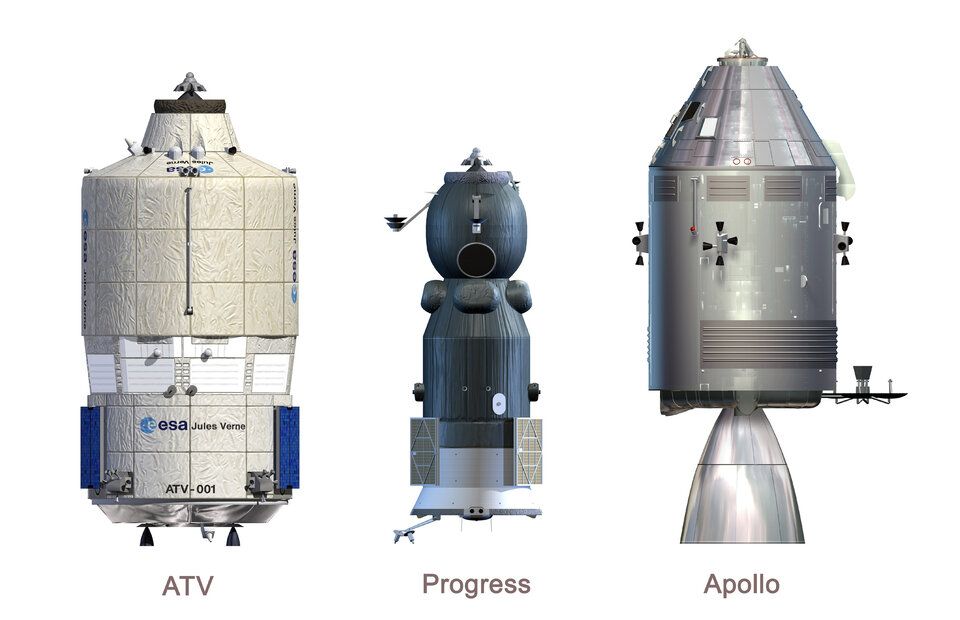
Since ATV will approach and be attached to the ISS, safety is paramount. Most spacecraft functions are doubly redundant, meaning that each subsystem, unit, switch and valve is duplicated - so that the spacecraft can withstand any single failure.
Since anything associated with the ISS must be designed to be triply redundant, ATV is designed to cope with two simultaneous failures.
For example, the ATV propulsion system has both main and redundant thrusters to power it during docking with the ISS. In case both the main and redundant thrusters fail, it has a completely separate, alternative thruster system, controlled by completely different hardware and software.
This system is used particularly if it appears that ATV is not going to dock properly with the ISS. If anything goes wrong, an 'Escape' or a 'Collision Avoidance Manoeuvre' (CAM) can be commanded by ground controllers, by astronauts on the ISS or by the ATV itself, acting autonomously. During an Escape, the normal thrusters are used to bring ATV away from the ISS into a safe parking orbit; during a CAM, the backup thruster system does essentially the same thing.
Much of the complexity of the first ATV mission comes from proving that these Escapes and CAMs work correctly. Only when all of these vital safety operations have been tested in actual orbit and proven to work flawlessly will ATV be allowed to dock with the ISS.
Launch and LEOP
The mission starts with the Launch and Early Orbit Phase (LEOP), when the spacecraft is put into a low Earth orbit by Ariane 5. This is probably the most risky part of the mission, especially until ATV has deployed its four solar array panels used to generate the power necessary to control the spacecraft.
After LEOP, the spacecraft performs a series of manoeuvres to bring its orbit in phase with the ISS, approaching it from behind and slightly below; the crucial Collision Avoidance Manoeuvre is tested during this phase.
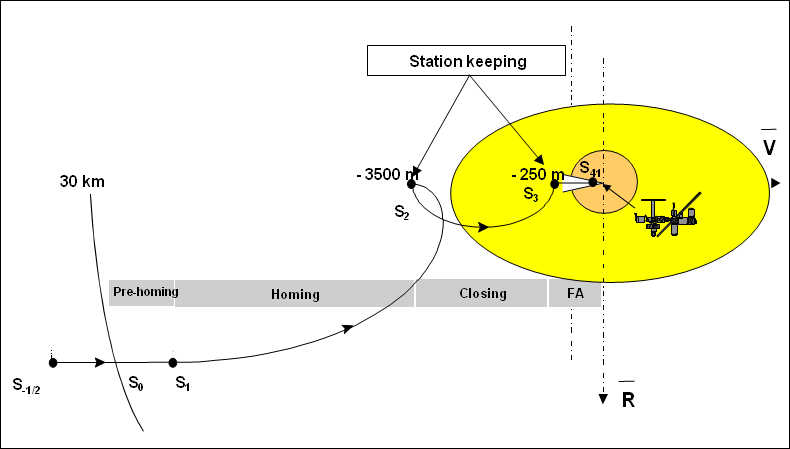
The approach to the ISS is characterised by a series of way-points and station-keeping manoeuvres, which are numbered from S-1/2 (at about 40km from the ISS and marking the start of proximity operations) to S41 - only 12m from docking.
When ATV reaches S-1/2 (around 40 km behind and 5 km below the ISS), GPS receivers on ATV and the ISS are used to calculate the relative positions of the two bodies. ATV starts a pre-homing phase, passes through S0 (30 km from the ISS), performs the homing phase and stops at station keeping point S2, located 3.5 km behind and 100 m above the ISS.
When all checks at S2 are completed, an Escape is initiated to demonstrate correct operation of the safety manoeuvre, after which ATV circles around the ISS and returns to the S-1/2 station keeping point.
- Three days later, a second demonstration phase is initiated. This time, ATV approaches to station keeping point S3, which is 280m behind the ISS.
Further checks are performed at S3, and a switch is made to high-performance sensors for control of the final approach. Before docking can be attempted, a series of hold and retreat commands are demonstrated, to ensure that the crew or ground controllers could stop an unsuccessful docking attempt if necessary.
- Having successfully retreated back to the S3 station keeping point, ATV continues to station keeping point S4, which is 25m from the ISS, and then to S41, a mere 12m away. Again, a retreat to S4 is commanded, and finally an Escape - the ultimate abort test - with ATV again circling round the station and back to the S-1/2 station keeping point.
Finally, about 18 days after launch, the final approach and rendezvous is commanded, and following checks at each station-keeping point, ATV ultimately performs a fully automatic docking with the ISS.
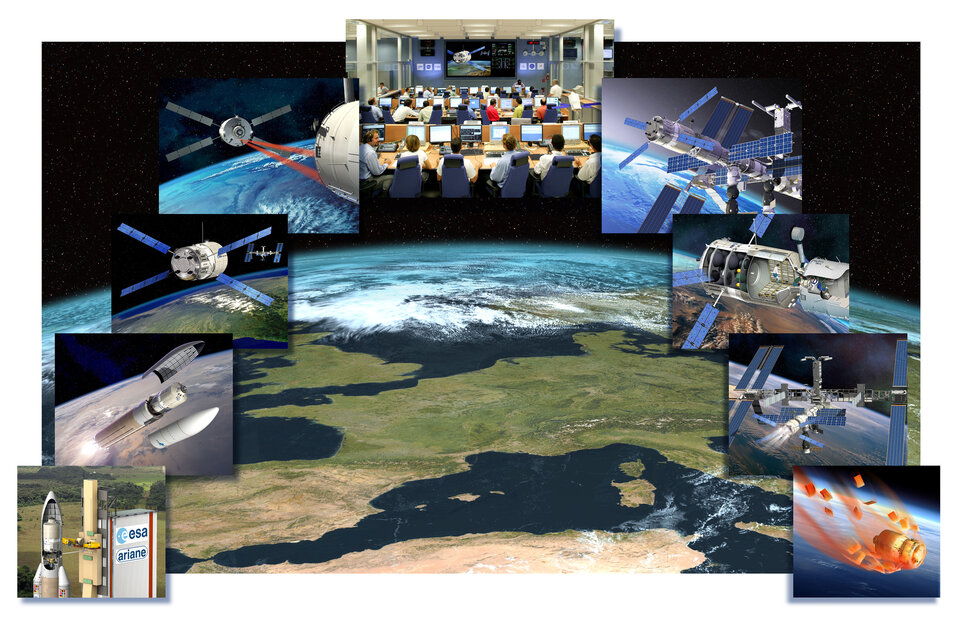
Attached phase
Once attached, the spacecraft is continually monitored. It carries water, gases and ISS propellant, which are transferred to the ISS during the attached phase along with up to 1342 kg of experiments, and up to 6340 kg of waste material is loaded for the return journey (see specifications below).
During the attached phase, the ATV uses its thrusters to correct and adjust the orbit of the 400-tonne ISS structure and to perform debris avoidance manoeuvres when necessary.
Deorbiting
Finally, all good things must come to an end, and ATV undocks from the ISS and plunges to a fiery end in the upper atmosphere - but this is no 'one-off' mission. The design and operations concept proved during the flight of Jules Verne will be used to build and fly at least four further ATV spacecraft, providing support to the ISS programme well into the next decade.
| ATV Platform & Payload | |
|---|---|
| Propulsion | |
| Main propulsion: | 4 x 490N thrusters |
| Thrusters: | 28 x 220N for Altitude control & braking |
| Dimensions | |
| Length (with adaptor, probe retracted): | 10 770 mm |
| Largest diameter: | 4 480 mm |
| Solar arrays span: | 22 281 mm |
| Mass budget | |
| Vehicle dry mass: | 10 470 kg |
| Max. lift-off mass | 20 050 kg |
| Load, total | 7667 kg |
| Inside pressurised module: | 5500 kg |
| Water: | 840 kg |
| ATV-2 launch configuration | |
|---|---|
| Cargo mass | Dry cargo: 1599 kg |
| Water: 0 kg | |
| Gas (N2, O2, air, 2 gasses/flight): 100 kg | |
| ISS refuelling propellant: 850,6 kg | |
| ISS re-boost and attitude control propellant: 4535 kg | |
| Launch vehicle | Ariane 5 (300x300 km & 51.6° transfer orbit) |
| ATV-1 launched with solar panels folded to the body of the spacecraft | |
| Launch site | Kourou, French Guiana |
| Launch date | 15 February 2011 |
Note:
- These are maximum values for each type of load, and cannot be achieved simultaneously on the same mission.
- Figures shown are for ATV1 Jules Verne. Detailed specifications for ATV2 Johannes Kepler may vary.