Herschel and Planck flight dynamics: It really is rocket science
Once Herschel and Planck are launched, ESA's Flight Dynamics team are responsible for knowing where they are, where they are headed and how soon they will get there. The team uses sophisticated techniques to solve some of spaceflight's most complex orbital problems.
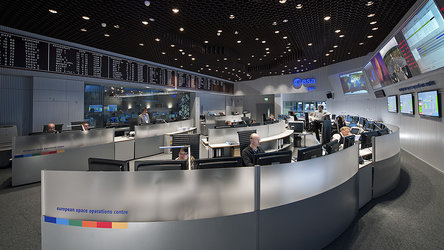
Imagine you are a flight dynamics specialist at ESOC, ESA's European Space Operations Centre, Darmstadt, Germany, on the afternoon of 14 May 2009.
You and your colleagues on the Mission Control Team have just watched two satellites lofted into space on top of a powerful Ariane 5 ECA launcher. On the edge of space and unseen by any human eyes, the two spacecraft separate from the upper stage. An ESA ground station in Perth, Australia, picks up the first telemetry signals from the pair. The launch is a success!
Pressure is on while the clock ticks down
Your colleagues now turn to you, and ask urgent questions: Where are the two spacecraft? In which direction are they heading? How fast are they going? How does their actual speed compare to that required to get into their proper orbits? Also: Should we fire the thrusters to speed them up or slow them down, and if so, by how much?
And by the way: the longer you take to figure out the answers, the further off course both may go, necessitating an even greater course correction later on, burning even more precious fuel and cutting the lifetime of these hugely valuable missions. The pressure is on - the clock is ticking.
These questions, and the limited time in which to answer them, are part of the challenges faced by the engineers, mathematicians, computer scientists and astrophysicists on ESA's Flight Dynamics team during the critical launch and early orbit phase (LEOP) for Herschel and Planck, which lasts about three days after liftoff.
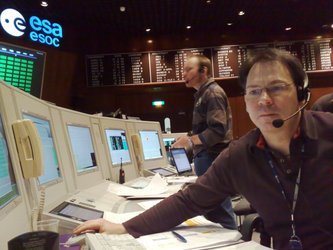
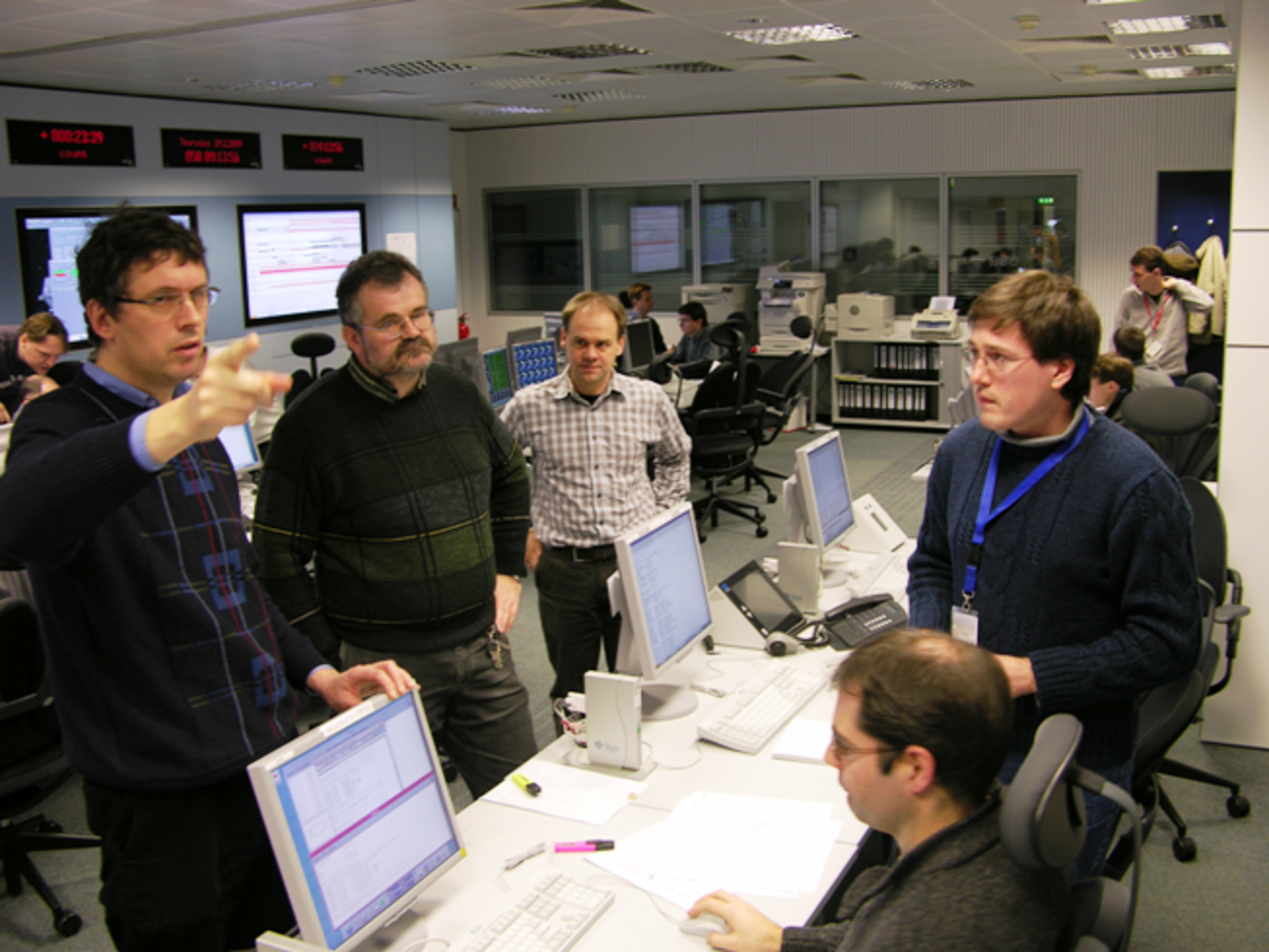
"Immediately after launch, we must determine the two spacecraft orbits and calculate the thruster burns required to conduct the initial trajectory correction manoeuvres. The team will be very busy and will work in shifts to support the missions 24 hours per day," says Gottlob Gienger, the senior flight dynamics advisor for the Herschel and Planck missions.
Gienger explains the process for fixing the spacecraft locations in space.
"From the ground stations, we receive ranging and Doppler data - numbers that tell us very accurately how far away the spacecraft is and how fast it is moving in the direction toward or away from Earth. But we don't immediately know how fast it is moving in any other direction with sufficient accuracy, and space is of course three-dimensional," he says.
This is when the experts on the Flight Dynamics team go into action, using sophisticated software tools to iteratively refine and recalculate a fix of the spacecraft locations, using not only the ground station data but also data sent by the Ariane launch controllers on the booster's actual performance, the time of flight before separation and other inputs.

The team also take into account astronomical details, such as the location of Earth and the Moon at the time of launch; their calculations are based on Kepler's 400-year-old equations of planetary motion and Newton's famous law of gravitation.
"We start with an educated guess based on Ariane performance, and then extrapolate using several hours' worth of ground station data as to where the spacecraft are," says Gienger.
The Flight Dynamics team can, in this case, reuse some of the orbit determination models that were previously developed for ESA's Mars Express and Venus Express, since Herschel and Planck initially leave the Earth on a trajectory similar to the interplanetary trajectories followed by the earlier deep-space missions.
The team is ready and we expect the spacecraft to perform very well.
Once the orbits have been determined, flight dynamics are then responsible for generating the manoeuvre calculations - essentially a set of numbers describing the time and direction for the thruster burns that will correct their post-launch trajectories.
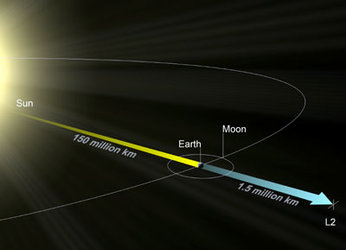
For Herschel, this first trajectory correction manoeuvre (TCM) on L+1, the day after launch, will be followed by several more, slotted for L+2 and L+12. If all goes well, Herschel will then be on target to enter a large, 900x500-thousand-kilometre, 'Lissajous' orbit centred on the L2 Lagrange point. This point is located approximately 1.5 million kilometers away from Earth.
Planck's trajectory is more complicated, and there are the same TCM slots available on L+2 and L+12, plus three more that will enable the spacecraft to be injected into a much tighter, 300-by-200-thousand-kilometre Lissajous orbit, also about the L2 point.
Gienger says that orbits around L2 are unique in many ways and that these are the first ESA missions to go there (NASA's WMAP observatory spacecraft is presently in orbit about L2). "Yes, we can reuse some software from previous missions. But the two spacecraft operate in fundamentally different ways, so everything will have to be calculated, checked and tested twice."
Who's Lagrange? And what's L2?

Lagrange points are special locations in space where gravitational forces and the orbital motion of a body, such as a satellite, balance each other. They were discovered by French mathematician Louis Lagrange in 1772. There are five Lagrangian points in the Sun-Earth system, with L1, L2 and L3 all existing along a straight line running through the centres of mass of the Sun and the Earth, while L4 and L5 exist at the apexes of two equilateral triangles formed between Earth and the Sun.
L2, the Herschel and Planck target, is located 1.5 million kilometres from our planet, on the side of Earth opposite the Sun. As they orbit the Sun-Earth system, the spacecraft will also orbit around the L2 point, following a complex 'Lissajous' pattern. This orbit is inherently unstable, and both spacecraft will need regular thruster burns throughout their missions - about once per month - to stay on track.

"Without regular trajectory corrections, they would naturally drift off into a useless orbit about the Sun or Earth, with the rate of drift increasing with time," says Gienger. The trade-off, however, is that the L2 location provides an almost perfect vantage point from which to conduct both missions' scientific observations, which depend on maintaining a clear view of the universe while minimising influence from the Earth or Sun's gravity, heat or radiation.
Flight Dynamics team members have exhaustively developed and tested possible trajectory scenarios for the two missions since 2005, but the final test will only come after launch, when the spacecraft are on their way. Throughout the critical LEOP period, the two-month voyage to L2 and during the missions' routine phases, ESA's Flight Dynamics team will play a crucial role in day-to-day mission operations.
"In spaceflight, there is always a little uncertainty in determining the actual orbits and in the results of thruster burns. How the missions actually perform is always at least a little bit of a surprise. But the team is ready and we expect the spacecraft to perform very well," says Gienger.