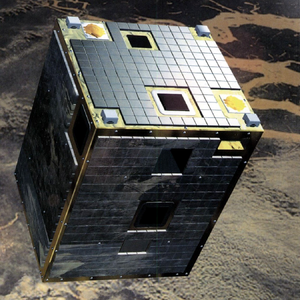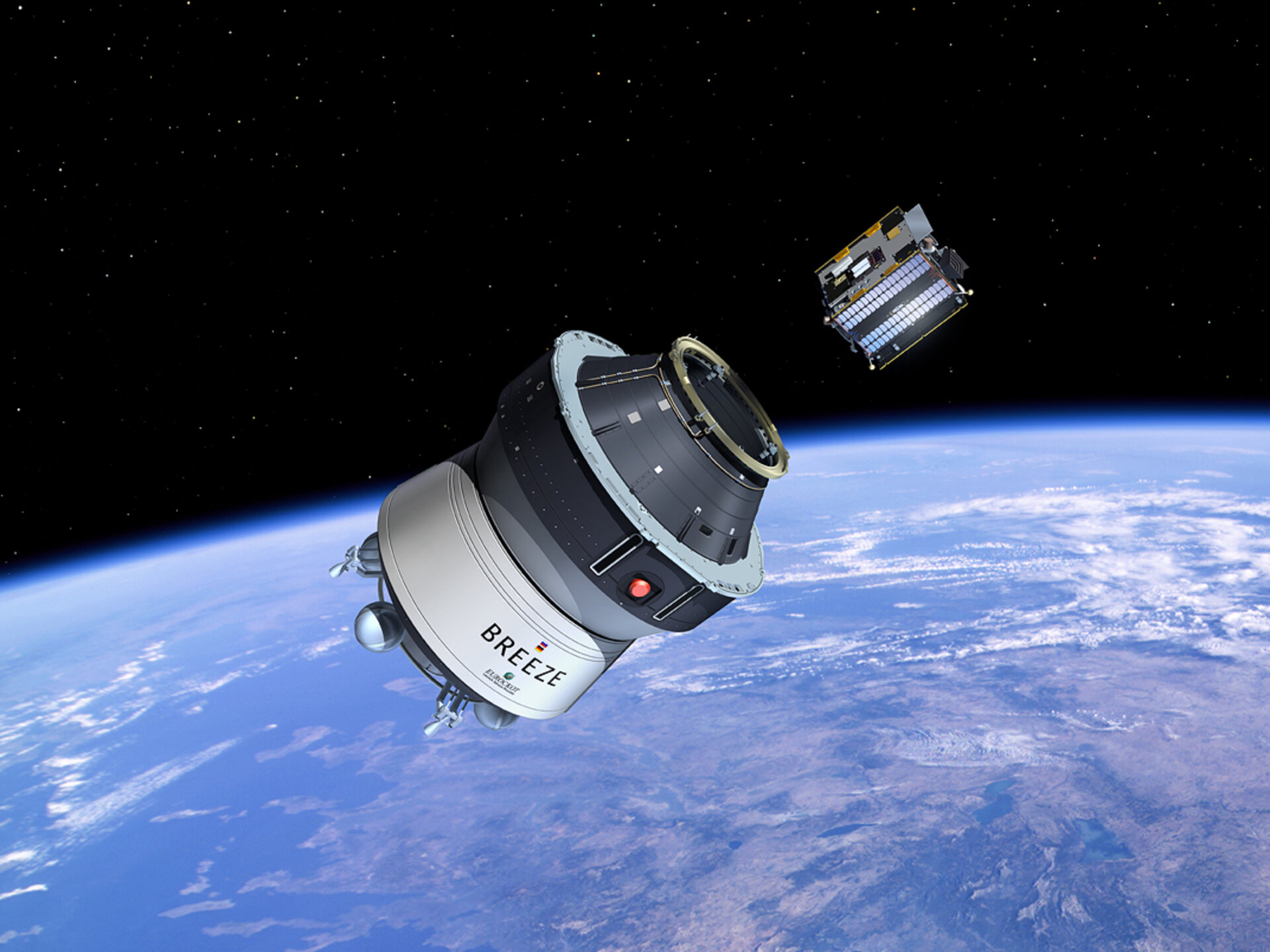
Proba-2 operations
Editor's note: This page is no longer being updated, but will be preserved as a record. Click here for the latest information on Proba-2.
ESA's second Proba (PROject for on-Board Autonomy) satellite is demonstrating in orbit a large number of new technologies.
These can be split into two groups: those which are an integral part of the spacecraft platform and those which are for demonstration purposes (and are not mission critical).
Proba-2 uses a platform similar in size to Proba-1; it will demonstrate the following spacecraft platform technologies:
- Miniaturised and highly integrated avionics bus (on-board computer, telemetry and telecommand processor, power control and distribution) based on the new LEON processor
- All-star tracker attitude control system
- High spacecraft agility using advanced, Active Pixel Sensor star trackers allowing a high slew rate
- High pointing accuracy, suitable for Earth observation and scientific missions
- Autonomous orbit control
- Advanced flight software development and tools using automated software generation together with simulation-based development and testing
- Use of commercial-off-the-shelf products and commercial grade parts
The mission
In addition, ESA is providing other platform elements in cooperation with partner agencies and industry:
- Ddual-frequency GPS sensor
- Miniaturised commercial GPS sensor
- New digital Sun sensor
- Star tracker technology trial for ESA's BepiColombo mission to Mercury
- Solar panel concentrator
- Fibre Sensor technology Demonstrator (one platform technology candidate - X-CAM - was transferred to the payload element)
Proba-2 is operated by ESA's Directorate of Human Spaceflight and Operations, and managed by the Directorate of Technical and Quality Management.
| ROLE | Technology demonstration and solar observation |
| LAUNCH DATE | 2 Nov 2009 |
| LAUNCHER/LOCATION | Rockot/Plesetsk Cosmodrome, Russia (dual launch with SMOS) |
| LAUNCH MASS | 130 kg |
| ORBIT | Sun-synchronous, polar, 700 & 800 km |
| PERIOD | Approx. 100 minutes |
| NOMINAL MISSION | Ongoing |
| + ESA's second microsatellite testing 17 new technologies and carrying 4 scientific experiments + | |
The Flight Control Team
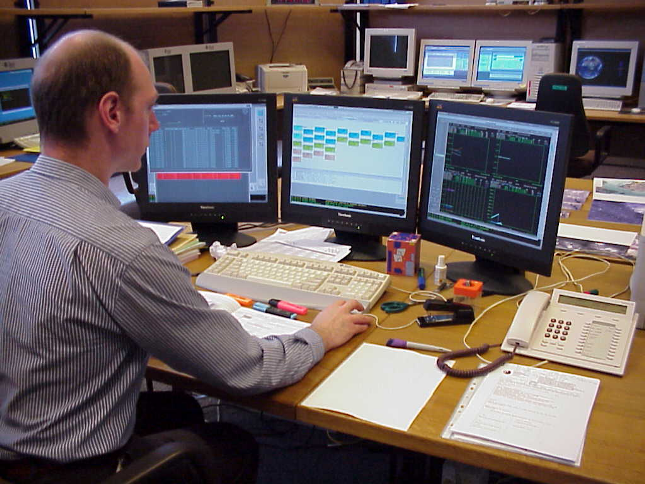
There is no traditional flight control team. Unlike larger, more complex ESA missions controlled from ESOC, Proba-2 is controlled via an automated Mission Control System and a dedicated tracking terminal established at ESA's Redu station, in Belgium.
Scientific data are distributed from Redu via a web server. Autonomous navigation is enabled with GPS position determination and orbit propagation. All the required navigation and manoeuvring computations are performed on-board.
The ground segment is largely automated, permitting unsupervised passes with automatic uplink of telecommands, reception and processing of telemetry, extraction and distribution of payload products to a server.
Mission operations overview
Proba-2 was launched on board a Rockot launcher, an adaptation of the Cold-War era SS-19 missile from Russia's Plesetsk Cosmodrome on 2 November 2009. Proba-2 rode into space in a dual launch together with ESA's SMOS satellite.
The main elements of the ground segment are a fully steerable 2.4m S-band antenna, baseband equipment, a control system based on ESA's SCOS II mission control system, a planning system and a data server.
A unique script language allows interfacing with the telemetry and the telecommand server of the control system and control all satellite pass activities, from the preparation to the post-processing phase.
The innovative design and operating systems were the result of ESA's collaboration with prime contractor Verhaert Design and Development, Belgium, working alongside other European companies and universities.
Proba's payload was designed to be controlled by a computer system 50 times more powerful than its counterpart on board ESA's full-size solar observing satellite, SOHO, allowing the micro-satellite to combine in-orbit technology demonstration, such as an on-board mission planning and on-board navigation and failure detection, with some useful monitoring of the Earth's environment.
Ground segment
The ground segment for both Proba-1 and Proba-2 comprises:
- TM/TC operations performed from the ESA Redu ground station with a small dedicated antenna
- The automated system allows satellite passes without an operator
- The small ops team is in charge of the payload & platform operations, planning, monitoring, reporting and of the complete ground segment
- Proba-1: 2 or 3 CHRIS scientific targets are acquired per day
- PROBA 2 same approach with re-use and integration in the PROBA-1 control centre
- Data downloaded at Redu and Kiruna are automatically made available on the dedicated Internet servers
Proba-2 payload
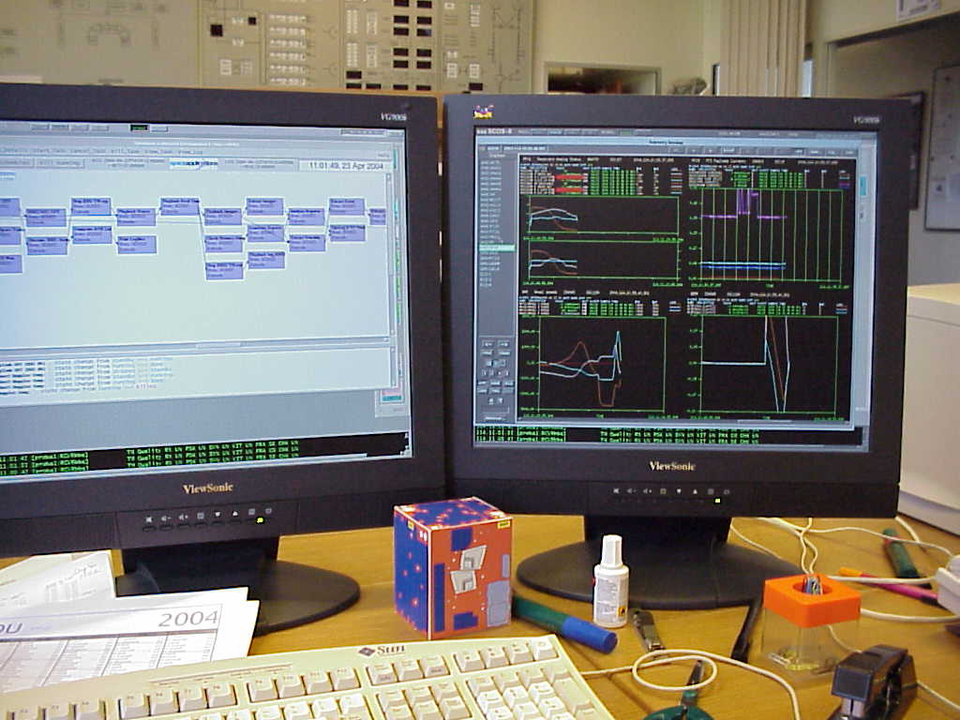
Proba-2's payload includes 17 technology demonstrations and 4 scientific instruments, designed to observe the Sun and space weather. In total, ten European countries and Canada were involved in the construction of the Proba-2 satellite.
The instruments include two complementary solar observation instruments:
- Sun watcher using APS detectors and image processing (SWAP)
- Lyman-alpha radiometer (LYRA)
and two plasma measurement instruments:
- Thermal plasma measurement unit (TPMU)
- Dual segmented Langmuir probe (DSLP)
SWAP was developed by the Centre Spatial de Liège (CSL) of Belgium. LYRA was developed by the Royal Observatory of Belgium. TMPU was developed by a Czech consortium, led by the Institute of Atmospheric Physics, Academy of Sciences of the Czech Republic, Prague, Czech Republic. DSLP was developed by the Institute of Atmospheric Physics, Academy of Sciences of the Czech Republic, Prague, Czech Republic.
Spacecraft platform technologies being tested
- A new type of lithium-ion battery, developed by SAFT (FR)
- An advanced data and power management system, containing many new component technologies including the LEON processor developed by Verhaert Space (BE)
- Combined carbon-fibre and aluminium structural panels, developed by Apco Technologies SA (CH)
- Nnew models of reaction wheels from Dynacon (CA), startrackers from DTU (DK) and GPS receivers from DLR (DE)
- An upgraded telecommand system with a decoder largely implemented in software by STT-SystemTechnik GmbH (DE)
- A digital Sun-sensor, developed by TNO (NL)
- A dual-frequency GPS receiver, developed by Alcatel Espace (FR)
- A fibre-sensor system for monitoring temperatures and pressures around the spacecraft, developed by MPB Communications Inc. (CA)
- A new startracker development being test-flown before use on the BepiColombo mission, developed by Galileo Avionica (IT)
- A very high precision flux-gate magnetometer, developed by DTU (DK) and magnetometer technology experiments from Lusospace (P) and ZARM Technik AG (DE)
- An experimental solar panel with a solar flux concentrator, developed by CSL (BE)
- A xenon gas propulsion system using resistojet thrusters and a solid-state nitrogen gas generator to pressurise the propellant tanks, developed by SSTL (GB) and Bradford (NL)
- An exploration micro-camera (X-CAM), developed by Micro-cameras & Space Exploration (CH)
- New GNC algorithms developed by NGC (CA)