• → European Space Agency

      • Space for Europe
      • Space News
      • Space in Images
      • Space in Videos
    • About Us

      • Welcome to ESA
      • DG's News and Views
      • For Member State Delegations
      • Business with ESA
      • ESA Exhibitions
      • ESA Publications
      • Careers at ESA
    • Our Activities

      • Space News
      • Observing the Earth
      • Human Spaceflight
      • Launchers
      • Navigation
      • Space Science
      • Space Engineering
      • Operations
      • Technology
      • Telecommunications & Integrated Applications
    • For Public

    • For Media

    • For Educators

    • For Kids

    • ESA

    • Space Engineering

    • What we do
    • Directorate of Technical and Quality Management (TEC)
    • Electrical
    • Electrical engineering
    • Control Systems
    • Data Systems
    • Radio Frequency Payload Systems
    • Electromagnetics and Space Environment
    • Power and Energy Conversion
    • Mechanical
    • Mechanical engineering
    • Thermal Control
    • Structures and Mechanisms
    • Mechatronics and Optics, incl. robotics and life support
    • Propulsion and Aerothermodynamics
    • Systems
    • Systems and software engineering
    • Software Systems
    • Systems Engineering, incl. cost engineering
    • Technology programmes
    • Product Assurance
    • Product Assurance
    • Flight Safety
    • Dependability
    • Quality Management and Assurance
    • Materials and Processes
    • Electronic Components
    • Software Product Assurance
    • Standards
    • Requirements and standards
    • European Cooperation for Space Standardization (ECSS)
    • European Space Components Coordination (ESCC)
    • Services
    • ESA calendar of events
    • Subscribe

    ESA > Our Activities > Space Engineering

    Concurrent Design Facility
    Concurrent Design Facility

    Directorate of Technical and Quality Management (TEC)

    All successful space missions have one indispensable ingredient in common: high-level engineering know how. The Directorate of Technical and Quality Management is responsible for maintaining this vital technical expertise and putting it at the disposal of ESA projects – a key role that reaches to the very heart of Agency activities.

    The Directorate of Quality and Management (TEC) provides engineering advice and assistance to ESA programmes and projects throughout their entire lifecycles.

    Bringing a project to life

    ...covering an array of technical disciplines.

    Every project starts with an idea for scientific research or a new application. TEC engineers work with programme and project teams from other Directorates and partners from industry and scientific institutes to evaluate the concept's overall feasibility in terms of meeting mission requirements within an acceptable cost, schedule and performance.

    In parallel, the engineers assess whether the technology the project requires can be made available on time at a sufficient level of technical maturity. Working on the basis that the best way to prepare for the future is to make it, the Directorate supports dedicated engineering teams covering an array of technical disciplines. They work to identify, evaluate and accelerate 'enabling technologies' across multiple fields. These are defined as technical developments that bring new varieties of space mission into the realms of the possible.

    Positive evaluation of an idea and its associated technologies is followed by detailed 'Phase-A' studies where preliminary designs are worked out by trading off alternative approaches. The Directorate operates the Concurrent Design Facility under the leadership of the mission managers from various programmes. This facility allows all specialist engineering disciplines involved to work in parallel on a real-time basis, drastically shortening project design cycles.

    Supporting and guiding project teams

    ESA Propulsion Laboratory (EPL)
    ...delivering the final product on time, on performance and to budget.

    The project team is the group given the mandate of designing and delivering the final product on time, on performance and to budget. The work is contracted to European industry and overseen by dedicated ESA staff from the Programme Directorate concerned. They are empowered with wide responsibility to achieve optimum results, but are required to provide transparent feedback to top-level management.

    In addition to regular progress and financial reporting, two other mechanisms ensure that a project stays running on the right lines. The first is a system of reviews at important milestones throughout a project's lifecycle, carried out by independent teams of ESA engineering experts.

    The second is the day-to-day work of product assurance and safety managers. These are Directorate personnel who are assigned to a given project but their place in the hierarchy is independent of programme management. Their task is to reduce and control risk by raising warnings when a course of action or problem strays too far from accepted quality standards or best-practice.

    Testing and verifying space items

    The Directorate operates a set of state-of-the-art engineering laboratories...

    Project teams also have specialist technical knowledge made available to them on a continuous basis. The Directorate operates a set of state-of-the-art engineering laboratories which checks each and every item, instrument and piece of software to be used on a mission both individually and collectively, to verify its suitability for use by simulating space conditions as closely as possible.

    If an item fails during testing or development – from an individual wire splitting to a software anomaly – then follow-up failure analysis is performed to pinpoint the root cause and come up with a solution. This is done in collaboration with industry and using both internal and external expertise and laboratory facilities.

    Setting engineering standards

    The findings of the Directorate's laboratories also contribute to the progressive establishment of general industrial standards to ensure the quality of space projects.

    This standardisation effort takes place through two Europe-wide initiatives, both overseen within ESA by TEC: the European Cooperation on Space Standardization (ECSS) comprises a family of management, engineering and quality standards, while the European Space Components Coordination (ESCC), specifies the suitability of electrical, electromagnetic and electronic (EEE) components for space.

    Pre- and post-launch activities

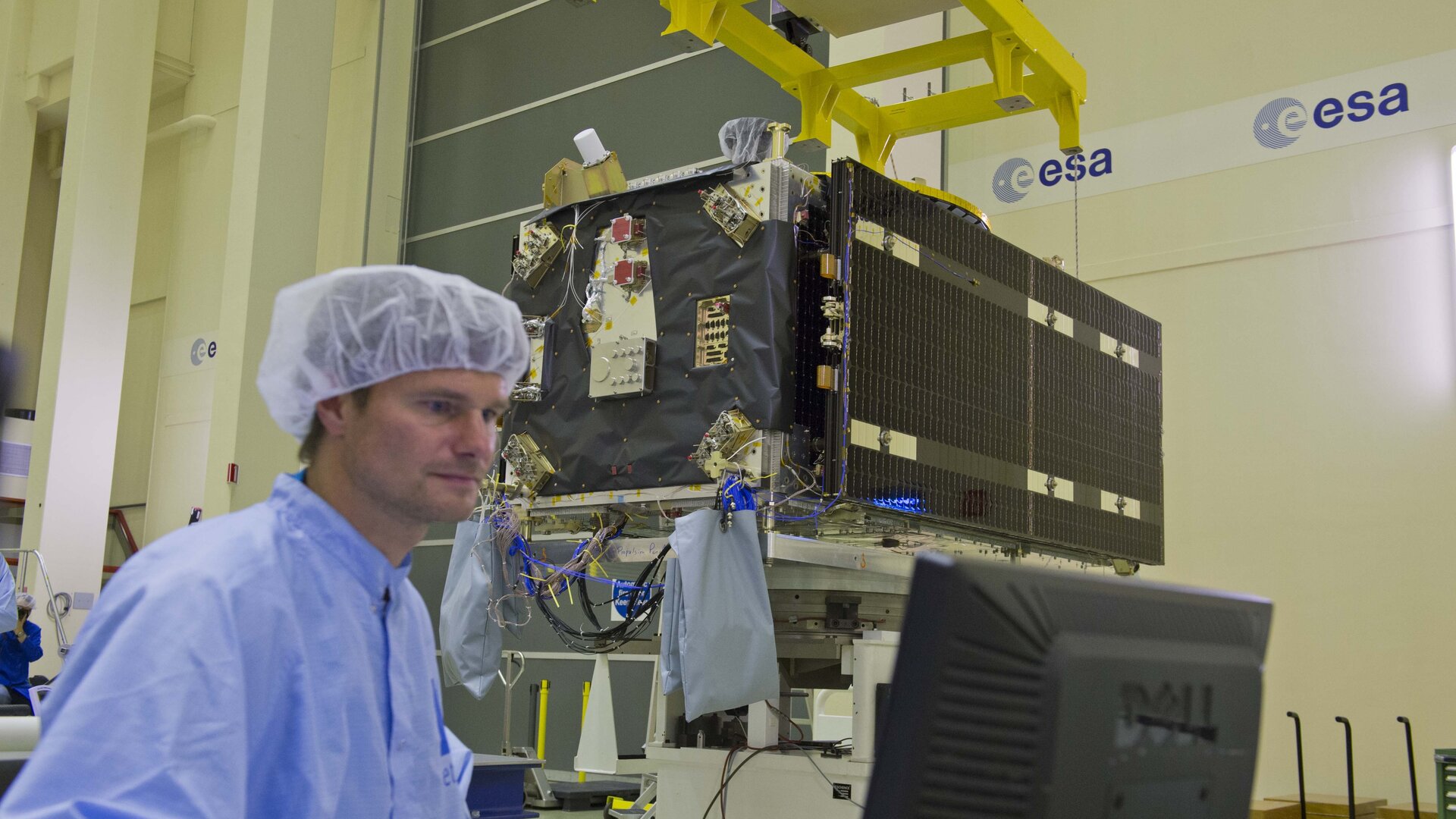
    Planck on multi-purpose trolley

    Assembled space hardware undergoes testing at various stages of its development at the Directorate's ESTEC Test Centre or in various test facilities provided by industry.

    ESTEC facilities include the Large European Acoustic Facility (LEAF) which can simulate acoustic launch effects. An electrodynamic multi-shaker system can create simulated launch vibrations for vehicles of up to five tonnes. Large payloads still can be tested on the hydraulic HYDRA platform, whose maximum vibration is equivalent to a 7.5 earthquake on the Richter scale.The Large Space Simulator (LSS) exposes complete spacecraft to the extreme vacuum, solar radiation and temperatures extremes prevailing in space.

    The Directorate's work is not finished once a satellite is in orbit. Its laboratories remain at the disposal of project teams to advise on the causes of mission anomalies and to research potential fixes. Operational spacecraft performance is compared to that anticipated to compile lessons learnt, which can then be fed back into next-generation mission designs.

    The Directorate also supports the increasingly vital work linked to all aspects of shutting down and disposing of a mission, having responsibility for all aspects of flight safety engineering, space debris mitigation, reentry safety and, most recently, planetary protection – the practice of ensuring that potential alien biospheres are not accidentally contaminated by terrestrial bacteria.

    Last update: 9 December 2012

    Rate this

    Views

    Share

    • Currently 0 out of 5 Stars.
    • 1
    • 2
    • 3
    • 4
    • 5
    Rating: 0/5 (0 votes cast)

    Thank you for rating!

    You have already rated this page, you can only rate it once!

    Your rating has been changed, thanks for rating!

    233
    facebook
    twitter
    reddit
    google plus
    digg
    tumbler
    digg
    blogger
    myspace
    • Related links
    • Franco Ongaro Director of TEC
    • Concurrent Design Facility
    • Test Centre
    • ESTEC - ESA's technical heart
    • Telecommunications
      Telecommunications
      Telecommunications for professionals
    • Navigation
    • Human Microgravity Spaceflight and Exploration Directorate
      Human Microgravity Spaceflight and Exploration Directorate
      Human Spaceflight
    • Space Science
    • Earth Explorers

    Connect with us

    • RSS
    • Youtube
    • Twitter
    • Flickr
    • Google Buzz
    • Subscribe
    • App Store
    • LATEST ARTICLES
    • · CryoSat hits land
    • · Ariane 5 completes seven launches …
    • · Measuring skull pressure without t…
    • · Malargüe station inauguration
    • · The solar wind is swirly
    • FAQ

    • Jobs at ESA

    • Site Map

    • Contacts

    • Terms and conditions