How ESTEC turned up temperature for Mercury testing
Japan’s Mercury Magnetospheric Orbiter recently withstood 10 times standard solar illumination levels during ESTEC Test Centre testing. Simulating the blistering conditions of Mercury’s neighbourhood posed a huge technical challenge, requiring extensive refit of the Centre’s largest vacuum chamber.
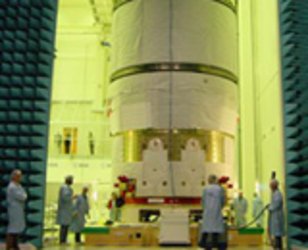
Last September saw the Thermal Test Model (TTM) of the Mercury Magnetospheric Orbiter (MMO) arrive at ESTEC, ESA’s technical heart, in the Netherlands.
The octagonal orbiter is destined to hitch a ride on ESA’s BepiColombo spacecraft in the same way that ESA’s Huygens lander rode aboard NASA’s Cassini mission to Saturn.
MMO’s shiny surface and 15-rpm spin (reduced to six rpm during testing) will help it to withstand the 450°C plus temperatures near Sun-scorched Mercury.
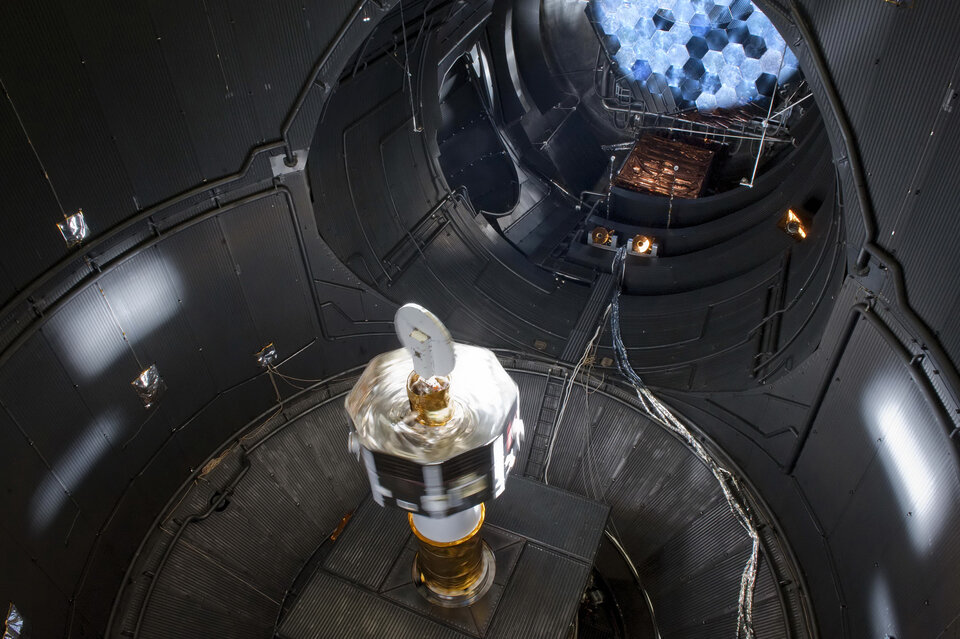
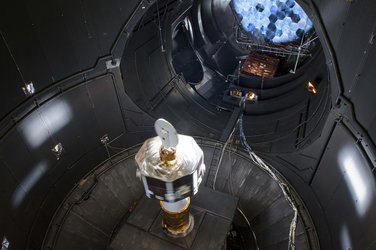
The majority of satellites passing through thermal vacuum testing in the Large Space Simulator (LSS) – Europe’s largest vacuum chamber – are destined for Earth orbit.
“This means they are subjected to standard top-of-atmosphere solar flux, what we call a single solar constant,” said Alexandre Popovitch, overseeing LSS modifications.
“But because BepiColombo is venturing so close to the Sun we needed a way of attaining an order of magnitude higher intensity: 10 solar constants.
“The problems we faced were twofold: first, how to reach and sustain this extreme 14 kW per sq m intensity?
“Second, how to remove the extreme amounts of heat that the light beam would produce over the illuminated chamber wall?”
Tight focus gave solution

The initial solution to the first problem seemed to be replacing the 19 high-power 25-kW bulbs with even more powerful versions.
However, testing showed that all candidate bulbs were unable to match the rigid lifetime requirements.
Instead, engineers turned to the 7 m-diameter mirror used to reflect simulated sunlight into the LSS test chamber.

Made up of 121 hexagonal segments, the mirror has an all-but-flat configuration to produce a 6 m-diameter light beam. The Test Centre team realised that increasing the curvature of the mirror to bring the beam into tighter focus – down to a diameter of 2.7 m – would yield the required intensity.
“To achieve this, we had to move all the mirror segments one by one,” added Alexandre.
“For maximum precision we used a laser guidance system – laser light was shone onto a cinema screen we moved into the LSS to check each mirror was oriented correctly compared to our optical simulation. Moving the mirrors took a couple of weeks in all.”
Reorienting the mirrors meant what was originally a parallel light beam became a converging one – meaning the end walls of the LSS would receive a still greater concentration of illumination and get even hotter.
Turning down the heat

“So to dissipate the high heat flux we installed an extra thermal shroud with a more than six times greater flow of liquid nitrogen than the existing wall shrouds,” explained Alexandre.
“Overall, maintaining the chamber walls at –190°C translates to something like 5000 litres of liquid nitrogen per hour across each two-week test, so our 100 000 litre liquid nitrogen tank on site needed regular topping up by new deliveries by lorry.
“We arranged back-up suppliers to ensure the testing could continue without interruption.”
Improved test equipment

Taking the subject’s temperature during testing was another challenge, explained Test Centre head Gaetan Piret: “Installing any type of sensor on the illuminated body of the satellite would have been very difficult and would certainly have disturbed the temperature equilibrium of the test setup.”
The solution was contactless measurement: a pair of infrared cameras were installed inside vacuum canisters, allowing them to operate in the harsh LSS environment. These serve to map MMO’s changing surface temperatures remotely.
A new levelling table, able to control a test item’s orientation to a hundredth of a degree, was also developed and validated during the LSS refit.
“The satellite is designed to work in weightlessness of course, so its orientation needs to be carefully controlled relative to Earth’s gravity,” added Gaetan.
“This ensures the proper functioning of active cooling systems such as heat pipes.”
These sealed liquid-filled conduits are threaded through satellites to carry away excess heat through evaporation; they are also commonplace in modern laptops.
Two types of test
The MMO underwent testing in two configurations. First it was spun, just as it will during flight. Then for a second test it was kept stationary while mated to ESA’s sunshade, as it will be stored during the cruise phase to Mercury.
Engineering models of the European BepiColombo modules will undergo testing at ESTEC later this year.