• → European Space Agency

      • Space for Europe
      • Space News
      • Space in Images
      • Space in Videos
    • About Us

      • Welcome to ESA
      • DG's News and Views
      • For Member State Delegations
      • Business with ESA
      • ESA Exhibitions
      • ESA Publications
      • Careers at ESA
    • Our Activities

      • Space News
      • Observing the Earth
      • Human Spaceflight
      • Launchers
      • Navigation
      • Space Science
      • Space Engineering
      • Operations
      • Technology
      • Telecommunications & Integrated Applications
    • For Public

    • For Media

    • For Educators

    • For Kids

    • ESA

    • Space Engineering

    • What we do
    • Directorate of Technical and Quality Management (TEC)
    • Electrical
    • Electrical engineering
    • Control Systems
    • Data Systems
    • Radio Frequency Payload Systems
    • Electromagnetics and Space Environment
    • Power and Energy Conversion
    • Mechanical
    • Mechanical engineering
    • Thermal Control
    • Structures and Mechanisms
    • Mechatronics and Optics, incl. robotics and life support
    • Propulsion and Aerothermodynamics
    • Systems
    • Systems and software engineering
    • Software Systems
    • Systems Engineering, incl. cost engineering
    • Technology programmes
    • Product Assurance
    • Product Assurance
    • Flight Safety
    • Dependability
    • Quality Management and Assurance
    • Materials and Processes
    • Electronic Components
    • Software Product Assurance
    • Standards
    • Requirements and standards
    • European Cooperation for Space Standardization (ECSS)
    • European Space Components Coordination (ESCC)
    • Services
    • ESA calendar of events
    • Subscribe

    ESA > Our Activities > Space Engineering

    How are the Materials and Components Laboratories equipped?

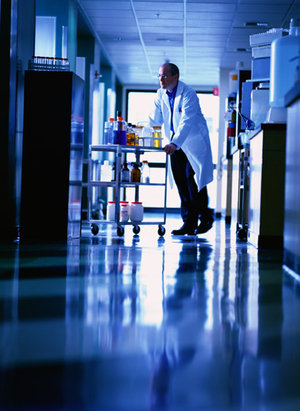
    The Laboratories house a unique collection of specially-designed facilities to assess the properties and performance of materials and components being considered for spaceflight. These include

    Tensile machines to establish the mechanical force needed to deform, break or fracture test items, together with environmental chambers and vacuum furnaces capable of operating at a range of temperatures from -150° C to 1500° C. To assess the surface resistance of very thin films and coatings less than a micrometre (a millionth of a metre) thick, special nano scratcher and nano indenter test rigs are utilised whereby a diamond headed stylus produces a carefully-controlled surface scratch or indentation.

    Purpose-built vacuum chambers are employed to perform outgassing tests, along with dynamic outgassing systems that apply charged particles to speed surface vaporisation. In addition the Laboratories are equipped with various spectroscopic equipment and a gas chromatograph to identify and measure the resulting vapour materials.

    A range of advanced space simulation chambers enable thermal cycling, UV and radiation exposure testing of materials while in vacuum conditions.

    Radiation test facilities investigate the effects of radiation on electronic components. A Cobalt-60 isotope recreates the degradation resulting from a lifetime radiation dose.

    The Laboratories' atomic oxygen simulator is without parallel in Europe. To create atomic oxygen in the same neutral state that it occurs in at the top of the atmosphere, heat is pumped into a tank of oxygen using a laser to split its molecules apart. A valve is then opened to expose the test item. Exposure effects can be accelerated by a factor of up to a thousand.

    Other environmental chambers are employed for corrosion testing, including saltspray and humidity effects as well as galvanic corrosion, where adjacent metals within a structure set up unwanted electrical currents which can induce corrosion.

    To investigate the results of testing a numbered of specialised microscopes are available above and beyond standard optical designs, including scanning electron microscopes (SEMs), stereo and confocal microscopes for 3D vision and a pair of acoustic microscopes that employ ultrasound for examination of the interior of materials in a non-destructive way.

    Specialised preparation tools enable the preparatory cutting, drilling and grinding needed for microscopic examination. The Laboratory also houses two tomographical X-ray systems that can reconstruct the three-dimensional internal volume of a component on a non-invasive basis, typically employed as a first step in deciding how to take it apart for other analysis techniques.

    In addition the Laboratories oversee an affiliated network of external European laboratories. Close contact is maintained with other facilities to maintain and develop knowledge of novel materials, components and processes.

    External laboratories also assist with investigations the Laboratories are not directly equipped to perform, such as micrometeoroid impacts and the flammability testing mandated for human spaceflight payloads.

    In the past, the Laboratories have even had an on-orbit annex, overseeing the running of the Materials Exposure and Degradation ExperimenT (MEDET), which between 2007 and 2009 gathered in-situ outgassing and degradation data from the exterior of ESA's Columbus module aboard the International Space Station.

    Last update: 30 June 2011

    Rate this

    Views

    Share

    • Currently 0 out of 5 Stars.
    • 1
    • 2
    • 3
    • 4
    • 5
    Rating: 0/5 (0 votes cast)

    Thank you for rating!

    You have already rated this page, you can only rate it once!

    Your rating has been changed, thanks for rating!

    15
    facebook
    twitter
    reddit
    google plus
    digg
    tumbler
    digg
    blogger
    myspace
    • More information
      • Materials and Electrical Components Laboratories
        • What kind of testing do the Materials and Components Laboratories carry out?
          • How are the Materials and Components Laboratories equipped?
            • What benefits do the Materials and Components Laboratories deliver?
              • What services do the Materials and Components Laboratories offer?
                • Contact the Materials and Components Laboratories
                  • External Laboratories (Materials and electrical components testing)
                  • Related article
                    • Improved gallium nitride recipe could spark space communication revolution
                    • Effects of space on materials
                    • Electrical
                    • Mechanical
                    • Systems
                    • Materials and Electrical Components
                    • ESTEC - ESA's technical heart

    Connect with us

    • RSS
    • Youtube
    • Twitter
    • Flickr
    • Google Buzz
    • Subscribe
    • App Store
    • LATEST ARTICLES
    • · CryoSat hits land
    • · Ariane 5 completes seven launches …
    • · Measuring skull pressure without t…
    • · Malargüe station inauguration
    • · The solar wind is swirly
    • FAQ

    • Jobs at ESA

    • Site Map

    • Contacts

    • Terms and conditions