• → European Space Agency

      • Space for Europe
      • Space News
      • Space in Images
      • Space in Videos
    • About Us

      • Welcome to ESA
      • DG's News and Views
      • For Member State Delegations
      • Business with ESA
      • ESA Exhibitions
      • ESA Publications
      • Careers at ESA
    • Our Activities

      • Space News
      • Observing the Earth
      • Human Spaceflight
      • Launchers
      • Navigation
      • Space Science
      • Space Engineering
      • Operations
      • Technology
      • Telecommunications & Integrated Applications
    • For Public

    • For Media

    • For Educators

    • For Kids

    • ESA

    • Space Engineering

    • What we do
    • Directorate of Technical and Quality Management (TEC)
    • Electrical
    • Electrical engineering
    • Control Systems
    • Data Systems
    • Radio Frequency Payload Systems
    • Electromagnetics and Space Environment
    • Power and Energy Conversion
    • Mechanical
    • Mechanical engineering
    • Thermal Control
    • Structures and Mechanisms
    • Mechatronics and Optics, incl. robotics and life support
    • Propulsion and Aerothermodynamics
    • Systems
    • Systems and software engineering
    • Software Systems
    • Systems Engineering, incl. cost engineering
    • Technology programmes
    • Product Assurance
    • Product Assurance
    • Flight Safety
    • Dependability
    • Quality Management and Assurance
    • Materials and Processes
    • Electronic Components
    • Software Product Assurance
    • Standards
    • Requirements and standards
    • European Cooperation for Space Standardization (ECSS)
    • European Space Components Coordination (ESCC)
    • Services
    • ESA calendar of events
    • Subscribe

    ESA > Our Activities > Space Engineering

    Testing solar cell adhesives

    Sticky test for solar cells

    30 January 2013

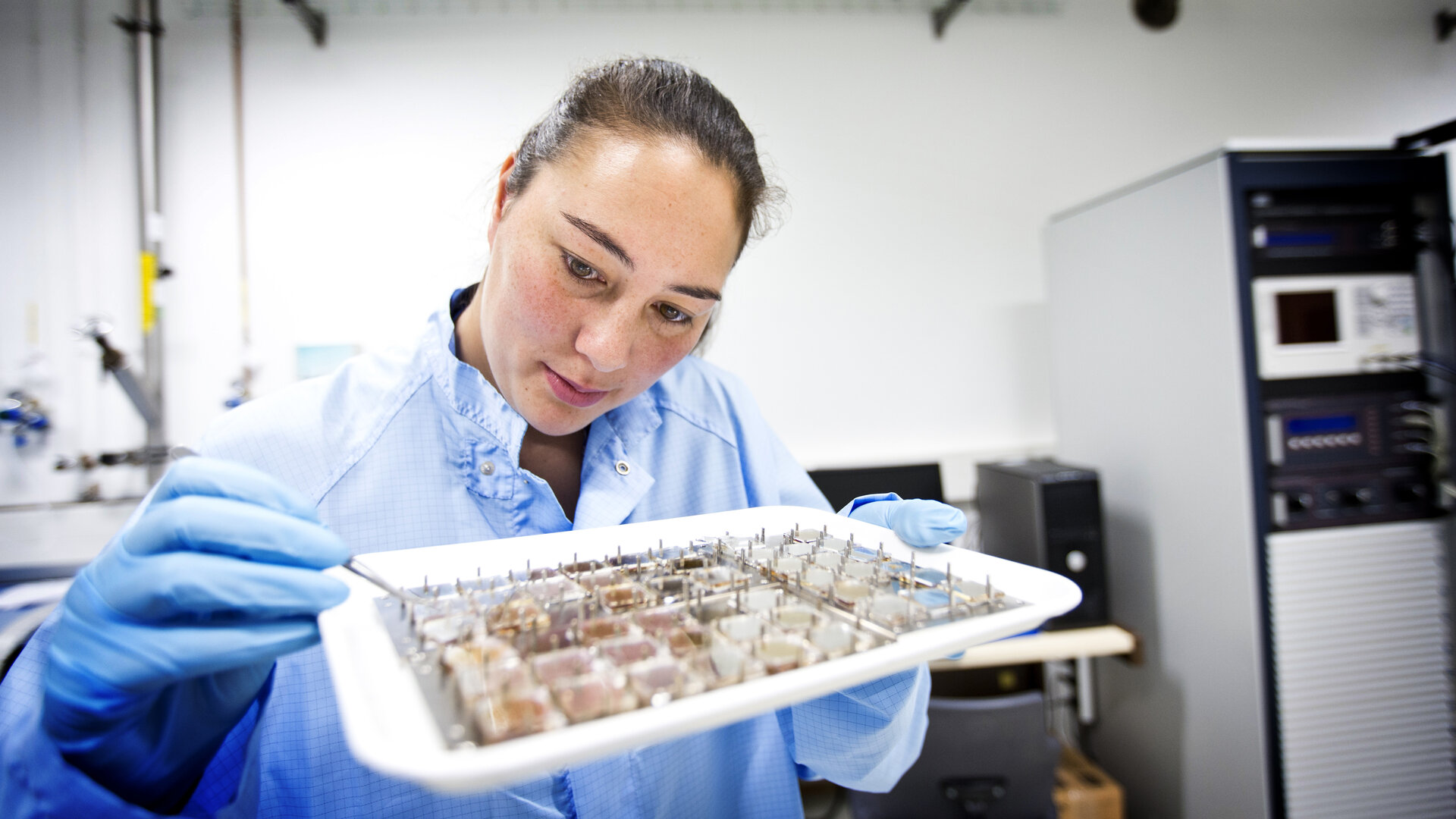
    ESA engineer Mei Mei Stienstra holds a tray of glass samples that have been exposed to simulated space conditions for more than a year. The test campaign assessed a new type of European-made adhesive to keep protective cover glass stuck in place on solar cells.

    The testing – taking place at the Materials and Electrical Components Laboratories in ESA’s technical centre ESTEC, based in Noordwijk, the Netherlands – involved long-duration space simulations lasting for upwards of 10 000 hours to guarantee the reliable operation of solar cells.

    Solar power is the lifeblood of satellites, but the solar cells relied on to produce it need protection from the harsh space environment.

    To minimise the harmful effects of unfiltered sunlight and charged particles, all solar cells are covered by cover glass, typically just 0.1 mm thick. If a bare cell was exposed to the space environment it would degrade as much within a few days as a protected cell does in 15 years.

    But the adhesive keeping cover glass and solar cell together must in turn perform well. For this testing, samples of the adhesive have been sandwiched between two layers of glass, which radiation penetrates through during the long-running simulation.

    Any darkening observed is a measure of degradation which equals a loss of light transmission, resulting in turn in a reduced power output.

    Testing for making

    ESA's Materials and Components Laboratories performs tests concerning a question of central importance to the European space industry: what are the best materials and techniques with which to manufacture spacecraft?

    Made up of around 15 separate experimental facilities overall, the Laboratories perform their space-focused testing and analysis applying an unrivalled combination of expert knowledge and specialised equipment.
    Rate this

    Views

    Share

    • Currently 4.5 out of 5 Stars.
    • 1
    • 2
    • 3
    • 4
    • 5
    Rating: 4.6/5 (25 votes cast)

    Thank you for rating!

    You have already rated this page, you can only rate it once!

    Your rating has been changed, thanks for rating!

    2172
    Tweet

    Related articles

    Lothar Gerlach examines solar cells

    How satellites live off sunlight27 May 2009

    Lothar Gerlach examines solar cells

    How satellites live off sunlight27 May 2009 Solar cells have become almost as crucial an enabling technology for space as rockets themselves. The vast majority of satellites rely on solar power, for an obvious reason: space may be empty of just about everything else, but it has an endless abund...

    Hubble Space Telescope  in orbit

    How Hubble got its wings13 December 2010

    Hubble Space Telescope  in orbit

    How Hubble got its wings13 December 2010 More than any other space mission, the Hubble Space Telescope changed the way people see the Universe. Now, after two decades of remarkable imagery, the Hubble IMAX movie has turned a high-resolution camera onto the orbital observatory itself, sharing...

    Hot stuff: the making of BepiColombo01 June 2011

    Hot stuff: the making of BepiColombo01 June 2011 For BepiColombo, ESA has had to extend the limits of existing design standards and develop altogether new design concepts as well. How to begin building a spacecraft that needs to endure sunlight 10 times more intense than in Earth orbit, with surface...

      • Materials and Electrical Components Laboratories

    Connect with us

    • RSS
    • Youtube
    • Twitter
    • Flickr
    • G+
    • Facebook
    • Livestream
    • Subscribe
    • App Store
    • LATEST ARTICLES
    • · ESA astronaut Timothy Peake set fo…
    • · Space drives e-mobility
    • · Proba-V opens its eyes
    • · First new Galileo satellite arrive…
    • · Next destination: space
    • FAQ

    • Jobs at ESA

    • Site Map

    • Contacts

    • Terms and conditions