• → European Space Agency

      • Space for Europe
      • Space News
      • Space in Images
      • Space in Videos
    • About Us

      • Welcome to ESA
      • DG's News and Views
      • For Member State Delegations
      • Business with ESA
      • ESA Exhibitions
      • ESA Publications
      • Careers at ESA
    • Our Activities

      • Space News
      • Observing the Earth
      • Human Spaceflight
      • Launchers
      • Navigation
      • Space Science
      • Space Engineering
      • Operations
      • Technology
      • Telecommunications & Integrated Applications
    • For Public

    • For Media

    • For Educators

    • For Kids

    • ESA

    • Space Engineering

    • What we do
    • Directorate of Technical and Quality Management (TEC)
    • Electrical
    • Electrical engineering
    • Control Systems
    • Data Systems
    • Radio Frequency Payload Systems
    • Electromagnetics and Space Environment
    • Power and Energy Conversion
    • Mechanical
    • Mechanical engineering
    • Thermal Control
    • Structures and Mechanisms
    • Mechatronics and Optics, incl. robotics and life support
    • Propulsion and Aerothermodynamics
    • Systems
    • Systems and software engineering
    • Software Systems
    • Systems Engineering, incl. cost engineering
    • Technology programmes
    • Product Assurance
    • Product Assurance
    • Flight Safety
    • Dependability
    • Quality Management and Assurance
    • Materials and Processes
    • Electronic Components
    • Software Product Assurance
    • Standards
    • Requirements and standards
    • European Cooperation for Space Standardization (ECSS)
    • European Space Components Coordination (ESCC)
    • Services
    • ESA calendar of events
    • Subscribe

    ESA > Our Activities > Space Engineering

    Student experiments offered spin on ESA's Large Diameter Centrifuge

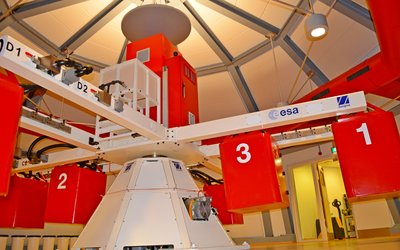
    The Large Diameter Centrifuge at ESA-ESTEC
    The LDC at ESTEC
    5 September 2011

    ESA is offering European students a rare opportunity to conduct hypergravity experiments, with a call for proposals for the third ‘Spin Your Thesis!’ campaign, which will take place in 2012.

    The Spin Your Thesis! programme enables university students to carry out experiments in hypergravity, using the Large Diameter Centrifuge based at the Agency's ESTEC technical centre in Noordwijk, the Netherlands.

    The centrifuge subjects samples to accelerations of 1–20 times Earth’s gravity. Each of the four arms can support two gondolas, with a maximum payload of 80 kg per gondola. In practice, six gondolas are available, plus one in the centre for control experiments.

    The centrifuge is flexible in terms of experiment scenarios, duration and possible equipment. It supports experiments that can last for anything up from one minute to six months.


    The Bubcoa team

    Spin Your Thesis! calls for each team of students to design a scientific or technology experiment that requires hypergravity for a few hours or days, as part of their syllabus.

    Teams from ESA Member States and Cooperating States are encouraged to register on the ESA Education Office's project portal and upload their proposals by 12 December 2011.

    A review board will select up to four teams to develop and perform their experiment during the third ESA Spin Your Thesis! campaign, to be held in ESTEC during September-October 2012. This campaign will last two weeks, with up to two teams using the centrifuge equipment each week.

    During the Spin Your Thesis! project, the teams will be supported by ESA's Education Office, hypergravity experts from ESA and members of the European Low Gravity Research Association (ELGRA). ESA will offer financial support to cover part of the cost of the experiments, travel and accommodation.

    Background

    The ETH Space Biology team

    The first Spin Your Thesis! campaign took place in June and September 2010 and was a great success, with four student teams conducting hypergravity experiments related, amongst others, to the biological processes that affect living cells, and asteroid impacts.

    As a direct result of their research during Spin Your Thesis! 2010, the ETH Space Biology team, comprising three students from the Swiss Federal Institute of Technology in Zurich, the University of Konstanz and the University of Zurich, recently published a paper in the journal ‘Lab on a Chip’.

    The second Spin Your Thesis! campaign is on-going. The four teams are investigating bubble processes in conditions of high gravity, how hypergravity stresses plants, the behaviour of a liquid droplet on a flat solid surface in hypergravity, and the effects of hypergravity on growing cells. Two teams will be conducting their experiment in ESTEC from 19 to 23 of September 2011

    Details about eligibility and how to apply for Spin Your Thesis! 2012 are available on the Spin Your Thesis! pages of the ESA Education portal.

    If you require further information about the 2012 campaign, contact the Spin Your Thesis! team: spinyourthesis @ esa.int

    Rate this

    Views

    Share

    • Currently 0 out of 5 Stars.
    • 1
    • 2
    • 3
    • 4
    • 5
    Rating: 0/5 (0 votes cast)

    Thank you for rating!

    You have already rated this page, you can only rate it once!

    Your rating has been changed, thanks for rating!

    13
    facebook
    twitter
    reddit
    google plus
    digg
    tumbler
    digg
    blogger
    myspace
    • More information
    • Spin Your Thesis!
    • Hypergravity & the LDC
    • Research opportunities
    • 2012 experiments
    • 2011 experiments
    • 2010 experiments
      • How to apply
        • Eligibility criteria
          • List of documents
          • 2013 schedule
          • Related news
          • 2013 call opens
          • 2012 selection
          • 2011 selection
          • 2010 campaign - part 2
          • 2010 campaign - part 1
          • 2010 selection
          • Related Links
          • Life and Physical Sciences and Life Support Laboratory
          • ELGRA
          • Register for ESA Education projects

    Connect with us

    • RSS
    • Youtube
    • Twitter
    • Flickr
    • Google Buzz
    • Subscribe
    • App Store
    • LATEST ARTICLES
    • · CryoSat hits land
    • · Ariane 5 completes seven launches …
    • · Measuring skull pressure without t…
    • · Malargüe station inauguration
    • · The solar wind is swirly
    • FAQ

    • Jobs at ESA

    • Site Map

    • Contacts

    • Terms and conditions