• → European Space Agency

      • Space for Europe
      • Space News
      • Space in Images
      • Space in Videos
    • About Us

      • Welcome to ESA
      • DG's News and Views
      • For Member State Delegations
      • Business with ESA
      • ESA Exhibitions
      • ESA Publications
      • Careers at ESA
    • Our Activities

      • Space News
      • Observing the Earth
      • Human Spaceflight
      • Launchers
      • Navigation
      • Space Science
      • Space Engineering
      • Operations
      • Technology
      • Telecommunications & Integrated Applications
    • For Public

    • For Media

      • Media
      • ESA TV
      • Videos for professionals
      • Photos
    • For Educators

    • For Kids

    • ESA

    • ESA Science

    • Cassini-Huygens

    • Unique insights into a ringed world

      • Striking sights of a ringed world...
      • Solving the puzzles of Saturn and Titan
    • About Cassini-Huygens

      • Cassini-Huygens mission facts
      • The mission
      • Cassini spacecraft
      • Cassini instruments
      • Huygens spacecraft
      • Huygens instruments
      • The launcher
    • About Saturn

      • Facts about Saturn
      • Saturn's rings
      • Saturn's moons
      • Saturn's atmosphere
      • Saturn's magnetosphere
    • About Titan

      • Facts about Titan
      • Titan's atmosphere
      • Titan's surface
      • Life on Titan?
    • Meet the team

      • International collaboration
      • Huygens Mission Team
      • Cassini Project Team
      • ASI Programme Manager
      • Huygens investigators
      • Cassini orbiter investigators (1)
      • Cassini orbiter investigators (2)
    • Multimedia
    • VideoTalk
    • Cassini-Huygens images
    • Cassini-Huygens videos
    • Titan virtual tour
    • Hygens probe descent - multilingual CD-rom
    • Download wallpapers
    • Download screensavers
    • 3D Flash 'model'
    • SOI animation
    • Waiting for Titan - the human side of Huygens
    • Services
    • Comments

    ESA > Our Activities > Space Science > Cassini-Huygens

    Bright and Dark mountains on Iapetus

    Saturn’s moon Iapetus is the Yin-Yang of the Solar System

    13 September 2007

    Cassini scientists are poring through hundreds of images returned from the 10 September fly-by of Saturn's two-toned moon Iapetus.

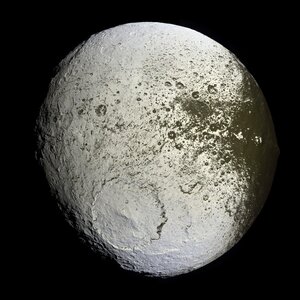
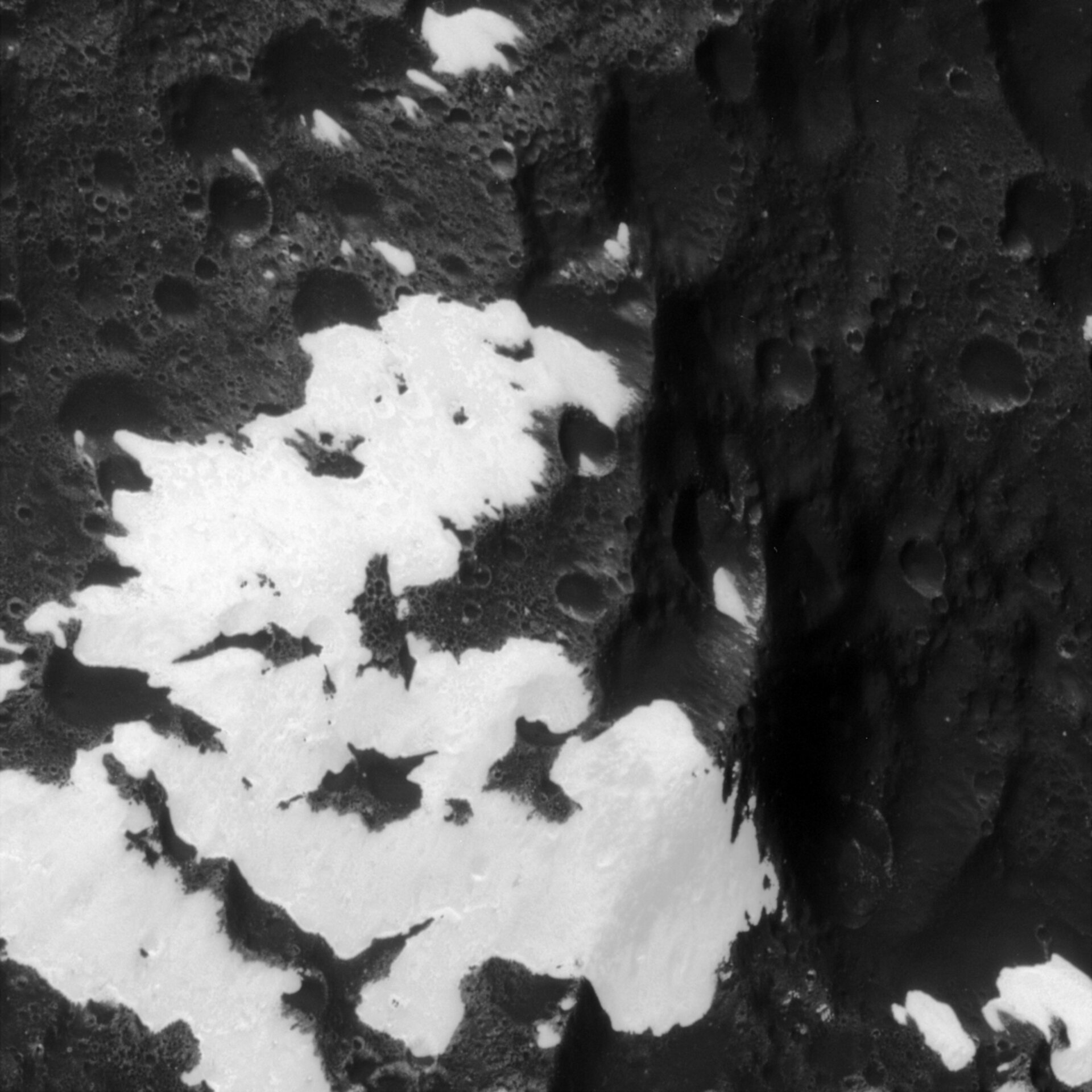
    The pictures show the moon's yin and yang - a white hemisphere resembling snow, and the other as black as tar.

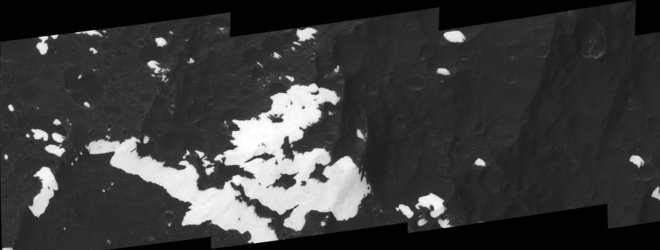
    Images returned late Tuesday and early Wednesday show a surface that is heavily cratered, along with the mountain ridge that runs along the moon's equator. Many of the close-up observations focused on studying the strange 20-km high mountain ridge that gives the moon a walnut-shaped appearance.

    "The images are really stunning," said Tilmann Denk, Cassini imaging scientist at the Free University in Berlin, Germany, who was responsible for the imaging observation planning. "Every new picture contained its own charm. I was most pleased about the images showing huge mountains rising over the horizon. I knew about this scenic viewing opportunity for more than seven years, and now the real images have suddenly materialised."
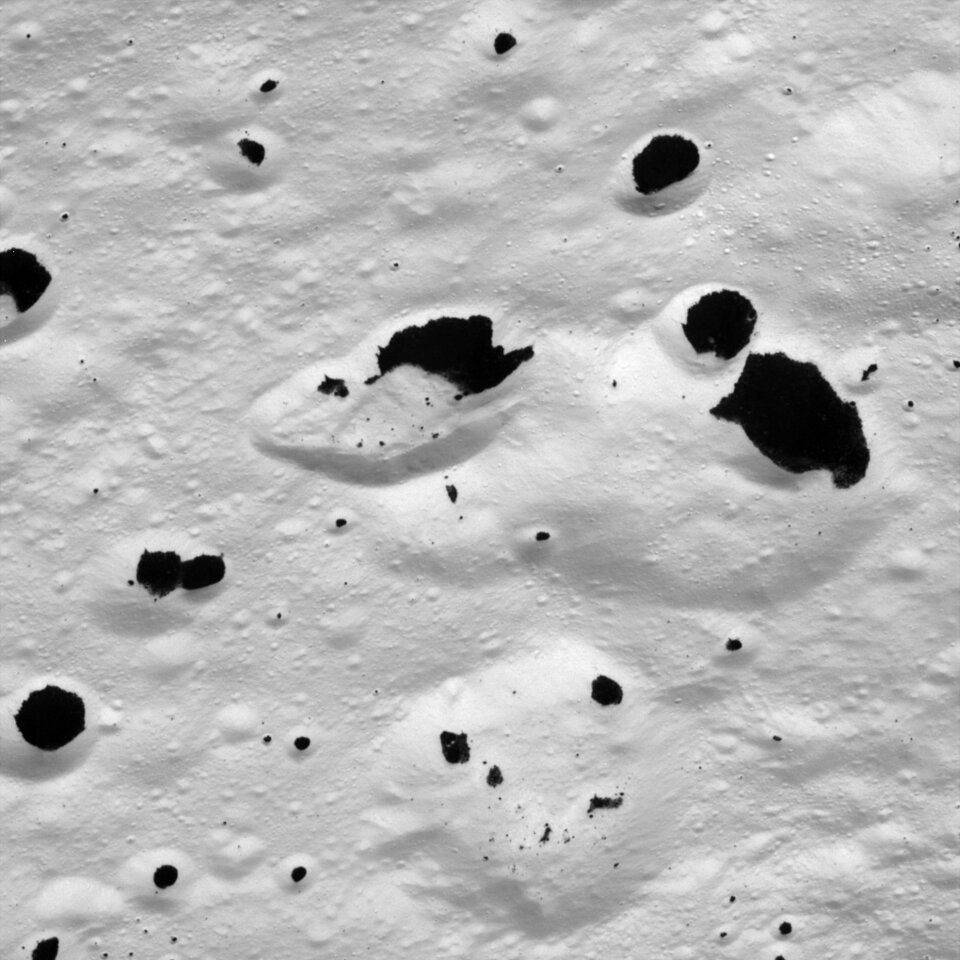
    Frozen wastelands on Iapetus

    This fly-by was nearly 100 times closer to Iapetus than Cassini's 2004 fly-by, bringing the spacecraft to about 1640 km from the surface. The moon's irregular walnut shape, the mountain ridge that lies almost directly on the equator and Iapetus’ brightness contrast are among the key mysteries scientists are trying to solve.

    "There is never a dull moment on this mission," said Bob Mitchell, Cassini programme manager, NASA's Jet Propulsion Laboratory, USA. "We are very excited about the stunning images being returned. There is plenty here to keep many scientists busy for many years."
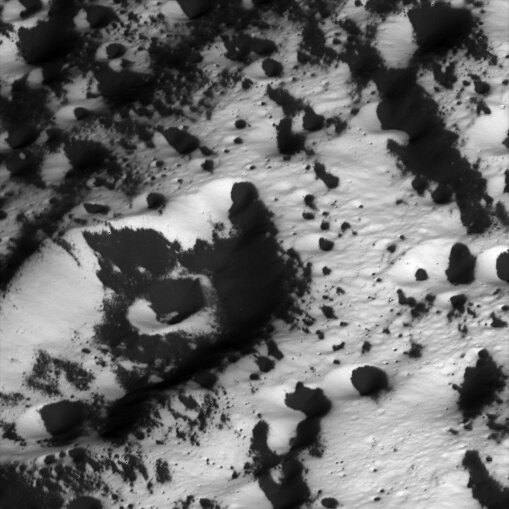

    Iapetus' landscape

    "Our flight over the surface of Iapetus was like a non-stop free fall, down the rabbit hole, directly into Wonderland! Very few places in our solar system are more bizarre than the patchwork of pitch dark and snowy bright we have seen on this moon," said Carolyn Porco, Cassini imaging team leader at the Space Science Institute, USA.

    The return of images and other data was delayed early Tuesday due to a galactic cosmic ray hit which put the spacecraft into the so-called safe mode. This occurred after the spacecraft had placed all of the fly-by data on its data recorders and during the first few minutes after it began sending the data home. The data flow resumed later that day and concluded on Wednesday. The spacecraft is operating normally and its instruments are expected to return to normal operations in a few days.
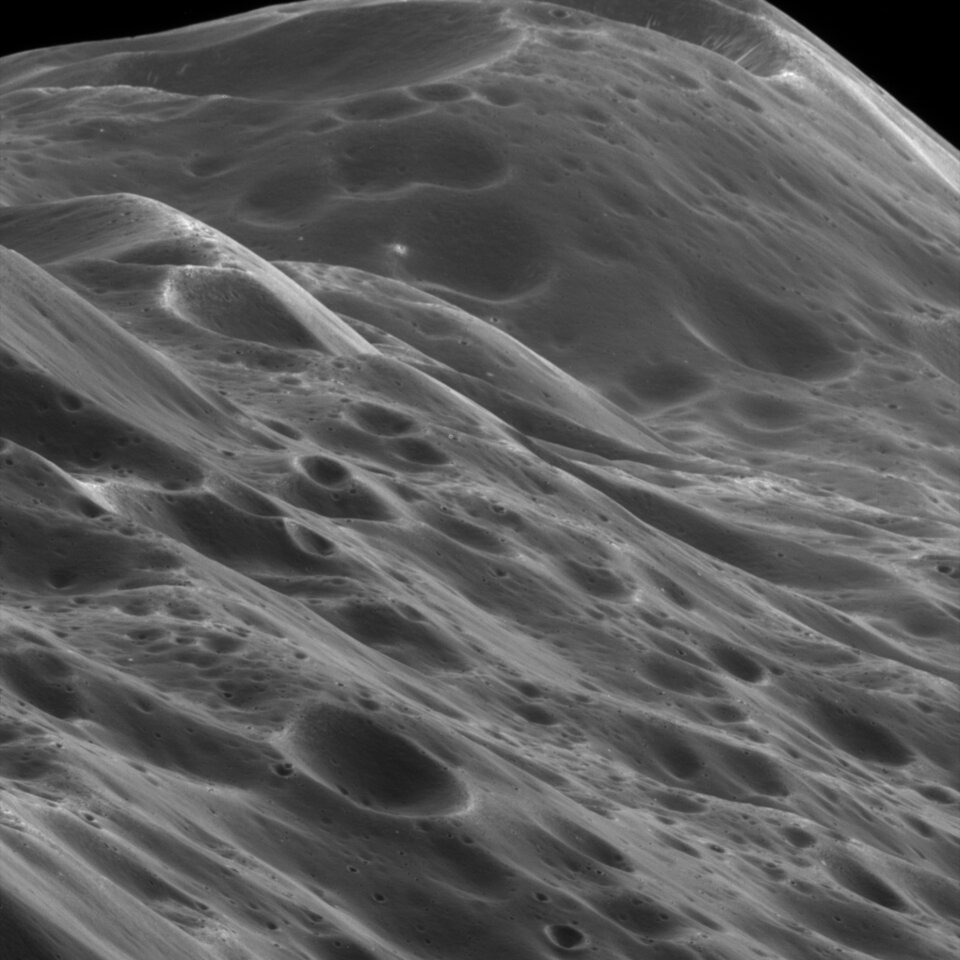
    Mountains on Iapetus

    "Iapetus provides us with a window back in time, to the formation of the planets over four billion years ago. Since then its icy crust has been cold and stiff, preserving this ancient surface for our study," said Torrence Johnson, Cassini imaging team member at JPL.

    Cassini's multiple observations of Iapetus will help to characterise the chemical composition of the surface; look for evidence of a faint atmosphere or erupting gas plumes; and map the night-time temperature of the surface. These and other results will be analysed in the weeks to come.

    Notes for editors:

    The Cassini-Huygens mission is a cooperative project of NASA, ESA and the Italian Space Agency.

    The Jet Propulsion Laboratory (JPL), a division of the California Institute of Technology, manages the Cassini-Huygens mission for NASA's Science Mission Directorate. JPL designed and assembled the Cassini orbiter. ESA developed the Huygens Titan probe, while ASI managed the development of the high-gain antenna and the other instruments of its participation. The imaging team is based at the Space Science Institute, USA.

    For more information:

    Tilmann Denk, Planetary Sciences and Remote Sensing Department, Free University of Berlin
    Email: Tilmann.Denk @ fu-berlin.de

    Jean-Pierre Lebreton, ESA Huygens Project Scientist
    Email: Jean-Pierre.Lebreton @ esa.int
    Rate this

    Views

    Share

    • Currently 5 out of 5 Stars.
    • 1
    • 2
    • 3
    • 4
    • 5
    Rating: 5/5 (1 votes cast)

    Thank you for rating!

    You have already rated this page, you can only rate it once!

    Your rating has been changed, thanks for rating!

    126
    Tweet
    • At Saturn and Titan
    • Related articles
      • Cassini on the trail of a runaway mystery
        • Cassini on the trail of a runaway mystery - more images
          • Saturn’s moon Iapetus is the Yin-Yang of the Solar System
            • Fasten your seat belts, turbulence ahead - lessons from Titan
              • Possible origin of Saturn's mysterious G ring
              • The latest on titan
                • Two more active moons around Saturn
                  • Cassini images bizarre hexagon on Saturn
                    • Enceladus geysers mask the length of Saturn’s day
                      • A hot start might explain geysers on Enceladus
                        • Seas on Titan!
                          • Cassini images mammoth cloud engulfing Titan’s North Pole
                            • The jet stream of Titan
                              • Huygens’s second landing anniversary – the surprises continue
                                • Titan has liquid lakes!
                                  • Tallest mountains ever seen on Titan imaged by Cassini
                                  • In depth
                                  • Cassini-Huygens in-depth
                                  • Related links
                                  • Cassini-Huygens at JPL
                                  • Cassini-Huygens at NASA
                                  • Italian Space Agency (ASI)
                                  • Cassini Imaging Team
                                  • ESA Planetary Science archive (PSA)
                                  • NASA Planetary Data System

    Connect with us

    • RSS
    • Youtube
    • Twitter
    • Flickr
    • G+
    • Facebook
    • Livestream
    • Subscribe
    • App Store
    • LATEST ARTICLES
    • · The fast winds of Venus are gettin…
    • · ExoMars 2016 set to complete const…
    • · Herschel ends operations as orbiti…
    • · Europe’s largest spaceship reache…
    • · ATV ready to nose up to Station
    • FAQ

    • Jobs at ESA

    • Site Map

    • Contacts

    • Terms and conditions