• → European Space Agency

      • Space for Europe
      • Space News
      • Space in Images
      • Space in Videos
    • About Us

      • Welcome to ESA
      • DG's News and Views
      • For Member State Delegations
      • Business with ESA
      • ESA Exhibitions
      • ESA Publications
      • Careers at ESA
    • Our Activities

      • Space News
      • Observing the Earth
      • Human Spaceflight
      • Launchers
      • Navigation
      • Space Science
      • Space Engineering
      • Operations
      • Technology
      • Telecommunications & Integrated Applications
    • For Public

    • For Media

      • Media
      • ESA TV
      • Videos for professionals
      • Photos
    • For Educators

    • For Kids

    • ESA

    • ESA Science

    • Cassini-Huygens

    • Unique insights into a ringed world

      • Striking sights of a ringed world...
      • Solving the puzzles of Saturn and Titan
    • About Cassini-Huygens

      • Cassini-Huygens mission facts
      • The mission
      • Cassini spacecraft
      • Cassini instruments
      • Huygens spacecraft
      • Huygens instruments
      • The launcher
    • About Saturn

      • Facts about Saturn
      • Saturn's rings
      • Saturn's moons
      • Saturn's atmosphere
      • Saturn's magnetosphere
    • About Titan

      • Facts about Titan
      • Titan's atmosphere
      • Titan's surface
      • Life on Titan?
    • Meet the team

      • International collaboration
      • Huygens Mission Team
      • Cassini Project Team
      • ASI Programme Manager
      • Huygens investigators
      • Cassini orbiter investigators (1)
      • Cassini orbiter investigators (2)
    • Multimedia
    • VideoTalk
    • Cassini-Huygens images
    • Cassini-Huygens videos
    • Titan virtual tour
    • Hygens probe descent - multilingual CD-rom
    • Download wallpapers
    • Download screensavers
    • 3D Flash 'model'
    • SOI animation
    • Waiting for Titan - the human side of Huygens
    • Services
    • Comments

    ESA > Our Activities > Space Science > Cassini-Huygens

    Two more active moons around Saturn

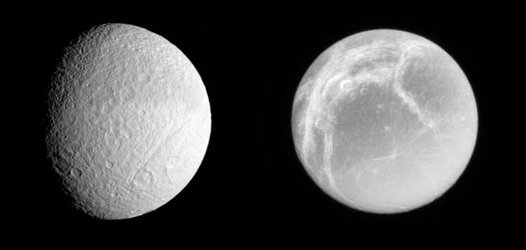
    Tethys and Dione juxtaposed
    13 June 2007

    Saturn’s moons Tethys and Dione are flinging great streams of particles into space, according to data from the NASA/ESA/ASI Cassini mission to Saturn. The discovery suggests the possibility of some sort of geological activity, perhaps even volcanic, on these icy worlds.

    The particles were traced to the two moons because of the dramatic movement of electrically charged gas in the magnetic environs of Saturn. Known as plasma, the gas is composed of negatively charged electrons and positively charged ions, which are atoms with one or more electrons missing. Because they are charged, the electrons and ions can get trapped inside a magnetic field.

    Saturn rotates around itself in just 10 hours and 46 minutes. This sweeps the magnetic field and the trapped plasma through space. Just like a child on a fast-spinning merry-go-round, the trapped gas feels a force trying to throw it outwards, away from the centre of rotation.
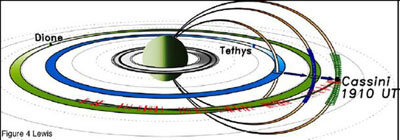
    Sketch of Saturn, Tethys and Dione
    Sketch of Saturn, Tethys and Dione

    Soon after Cassini reached Saturn, in June 2004, it revealed that the planet’s hurried rotation squashes the plasma into a disc and that great fingers of gas are indeed being thrown out into space from the disc’s outer edges. Hotter, more tenuous plasma then rushes in to fill the gaps.

    Now, Jim Burch of the Southwest Research Institute, USA, and colleagues have made a careful study of these events using the Cassini Plasma Spectrometer (CAPS). They have shown that the direction of the ejected electrons points back towards Tethys and Dione. “It establishes Tethys and Dione as important sources of plasma in Saturn’s magnetosphere,” says Burch.

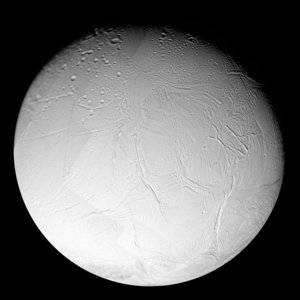
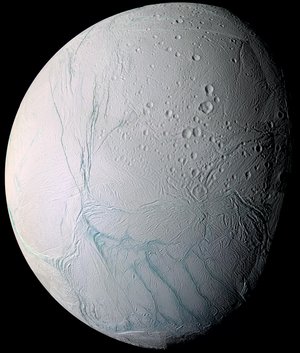
    UUntil this result, among Saturn’s inner moons only Enceladus was known to be an active world, with huge geysers spraying gases hundreds of kilometres above the moon’s surface. “This new result seems to be a strong indication that there is activity on Tethys and Dione as well,” says Andrew Coates from the Mullard Space Science Laboratory, University College London, and a collaborator on this latest work.


    Erupting geysers on Enceladus?

    Activity is a draw for planetary scientists as it means that the planet has yet to reach equilibrium, or is perhaps being supplied with energy. The activity on Enceladus was detected first by Cassini's Dual Technique Magnetometer (MAG). This led the flight team to schedule a particularly close pass of Enceladus, which revealed a wealth of data about Enceladus’ alien geysers – and spectacular pictures, too.

    “The best results arise when we combine a variety of data sets to understand the observations,” says Michele Dougherty, Imperial College, London, and Principal Investigator of MAG.
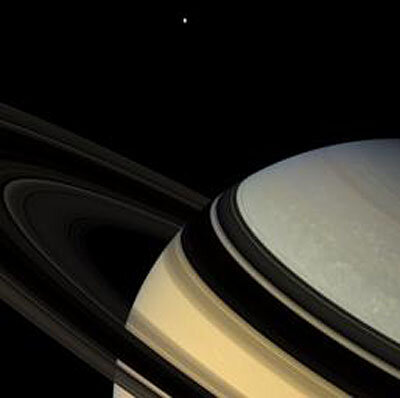
    Saturn and Dione
    Saturn and Dione

    In the case of Dione and Tethys, more fly-bys are scheduled in the future, which will allow the team and the other instruments a close-up look at the moons. Before that happens, the team has to go back and search for further signs of activity in the data already collected during the Tethys and Dione flybys of 2005.

    In addition Burch says that, having detected the electrons, they will now be on the lookout for the ions, so that the composition of the Tethys and Dione plasmas can be determined.

    Notes for editors

    The findings will appear in the 14 June 2007 issue of the scientific journal Nature. The article, ‘Tethys and Dione as sources of outward-flowing plasma in Saturn’s magnetosphere’, is by J. Burch, J. Goldstein, W. Lewis, D. Young, A. Coates, M Dougherty and N. André.

    The Cassini-Huygens mission is a cooperative project of NASA, ESA and the Italian Space Agency (ASI). The CAPS team, consisting of scientists from Europe and the US, is based at the Southwest Research Institute in San Antonio. The MAG team is based at Imperial College in London, and also consists of team members from the United States and several European countries.

    For more information

    Jim Burch, Cassini CAPS Co-Investigator, Southwest Research Inst., Texas, USA
    Email: Jburch @ swri.org

    Andrew J. Coates, Cassini CAPS Co-Investigator, Mullard Space Science Lab, UK
    Email: Ajc @ mssl.ucl.ac.uk

    Michel Dougherty, co-author, Cassini MAG Principal Investigator, Imperial College, Blackett Laboratory, UK
    Email: M.Dougherty @ ic.ac.uk

    Jean-Pierre Lebreton, ESA Huygens Project Scientist
    Email : Jean-Pierre.Lebreton @ esa.int
    Rate this

    Views

    Share

    • Currently 0 out of 5 Stars.
    • 1
    • 2
    • 3
    • 4
    • 5
    Rating: 0/5 (0 votes cast)

    Thank you for rating!

    You have already rated this page, you can only rate it once!

    Your rating has been changed, thanks for rating!

    80
    Tweet
    • At Saturn and Titan
    • More about...
    • More on Cassini-Huygens spacecraft
    • Related articles
      • The latest on Titan
        • Two more active moons around Saturn
          • Cassini images bizarre hexagon on Saturn
            • Enceladus geysers mask the length of Saturn’s day
              • A hot start might explain geysers on Enceladus
                • Seas on Titan!
                  • Cassini images mammoth cloud engulfing Titan’s North Pole
                    • The jet stream of Titan
                      • Huygens’s second landing anniversary – the surprises continue
                        • Titan has liquid lakes!
                          • Tallest mountains ever seen on Titan imaged by Cassini
                            • Vast polar ethane cloud observed on Titan’s north pole
                              • Huygens Scientific Archive data set released
                                • How the world watched Huygens
                                  • Titan's pebbles 'seen' by Huygens radio
                                    • Cassini's radar spots 'Great Lakes' on Titan
                                      • Landing on Titan – the new movies
                                        • Movie of Titan's surface in the infrared
                                        • Related links
                                        • ESA Planetary Science archive (PSA)
                                        • Cassini-Huygens at JPL
                                        • Cassini-Huygens at NASA
                                        • Italian Space Agency (ASI)

    Connect with us

    • RSS
    • Youtube
    • Twitter
    • Flickr
    • G+
    • Facebook
    • Livestream
    • Subscribe
    • App Store
    • LATEST ARTICLES
    • · Earth Explorers take centre stage …
    • · The fast winds of Venus are gettin…
    • · ExoMars 2016 set to complete const…
    • · Herschel ends operations as orbiti…
    • · Europe’s largest spaceship reache…
    • FAQ

    • Jobs at ESA

    • Site Map

    • Contacts

    • Terms and conditions